


Population-specific frequencies for LRRK2 susceptibility variants in the Genetic Epidemiology of Parkinson's Disease (GEO-PD) Consortium
- PMID: 23913756
- PMCID: PMC4108155
- DOI: 10.1002/mds.25600
Population-specific frequencies for LRRK2 susceptibility variants in the Genetic Epidemiology of Parkinson's Disease (GEO-PD) Consortium
Abstract
Background: Variants within the leucine-rich repeat kinase 2 gene are recognized as the most frequent genetic cause of Parkinson's disease. Leucine-rich repeat kinase 2 variation related to disease susceptibility displays many features that reflect the nature of complex, late-onset sporadic disorders like Parkinson's disease.
Methods: The Genetic Epidemiology of Parkinson's Disease Consortium recently performed the largest genetic association study for variants in the leucine-rich repeat kinase 2 gene across 23 different sites in 15 countries.
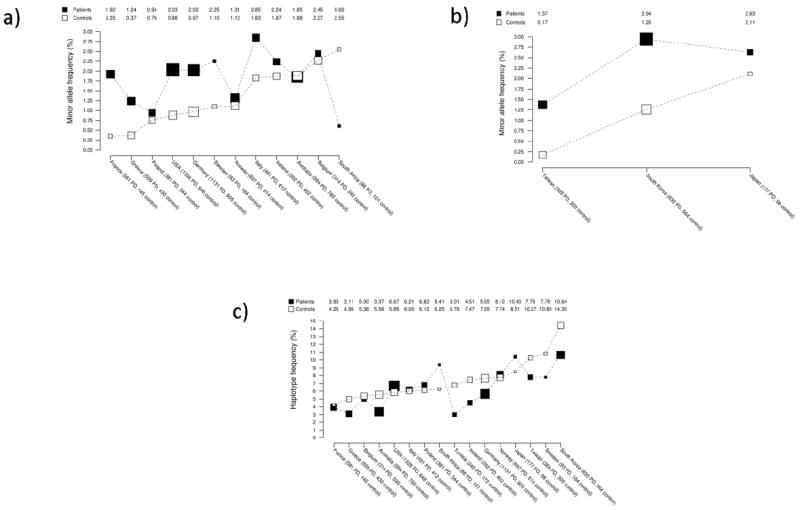
Results: Herein, we detail the allele frequencies for the novel risk factors (p.A419V and p.M1646T) and the protective haplotype (p.N551K-R1398H-K1423K) nominated in the original publication. Simple population allele frequencies not only can provide insight into the clinical relevance of specific variants but also can help genetically define patient groups.
Conclusions: Establishing individual patient-based genomic susceptibility profiles that incorporate both risk factors and protective factors will determine future diagnostic and treatment strategies.
Keywords: LRRK2; Parkinson's disease; association study; genetics.
© 2013 Movement Disorder Society.
Figures
References
-
- Sundal C, Fujioka S, Uitti RJ, Wszolek ZK. Autosomal dominant Parkinson’s disease. Parkinsonism Relat Disord. 2012;18(Suppl 1):S7–10. - PubMed
-
- Tan EK, Peng R, Teo YY, et al. Multiple LRRK2 variants modulate risk of Parkinson disease: a Chinese multicenter study. Hum Mutat. 2010;31(5):561–568. - PubMed
Publication types
MeSH terms
Substances
Grants and funding
LinkOut - more resources
Full Text Sources
Other Literature Sources
Medical
