


Global malaria connectivity through air travel
- PMID: 23914776
- PMCID: PMC3766274
- DOI: 10.1186/1475-2875-12-269
Global malaria connectivity through air travel
Abstract
Background: Air travel has expanded at an unprecedented rate and continues to do so. Its effects have been seen on malaria in rates of imported cases, local outbreaks in non-endemic areas and the global spread of drug resistance. With elimination and global eradication back on the agenda, changing levels and compositions of imported malaria in malaria-free countries, and the threat of artemisinin resistance spreading from Southeast Asia, there is a need to better understand how the modern flow of air passengers connects each Plasmodium falciparum- and Plasmodium vivax-endemic region to the rest of the world.
Methods: Recently constructed global P. falciparum and P.vivax malaria risk maps, along with data on flight schedules and modelled passenger flows across the air network, were combined to describe and quantify global malaria connectivity through air travel. Network analysis approaches were then utilized to describe and quantify the patterns that exist in passenger flows weighted by malaria prevalence. Finally, the connectivity within and to the Southeast Asia region where the threat of imported artemisinin resistance arising is highest, was examined to highlight risk routes for its spread.
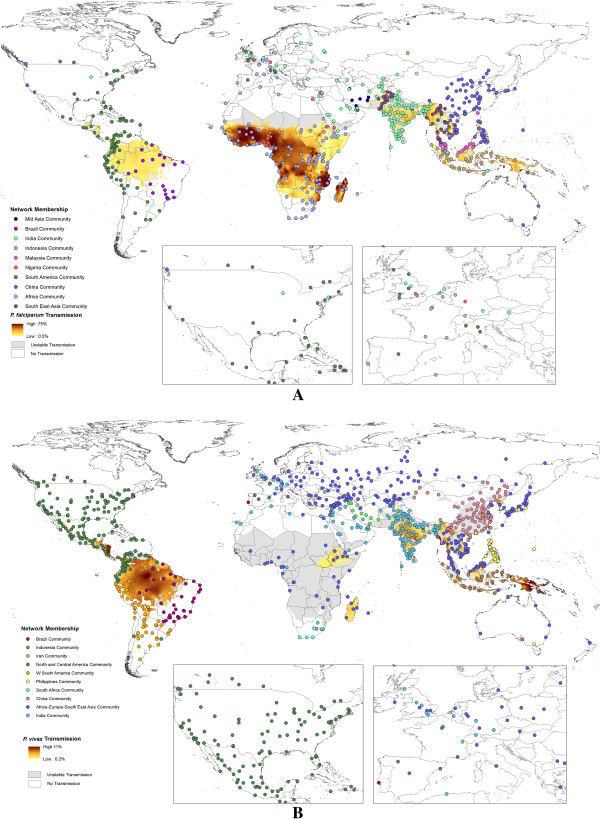
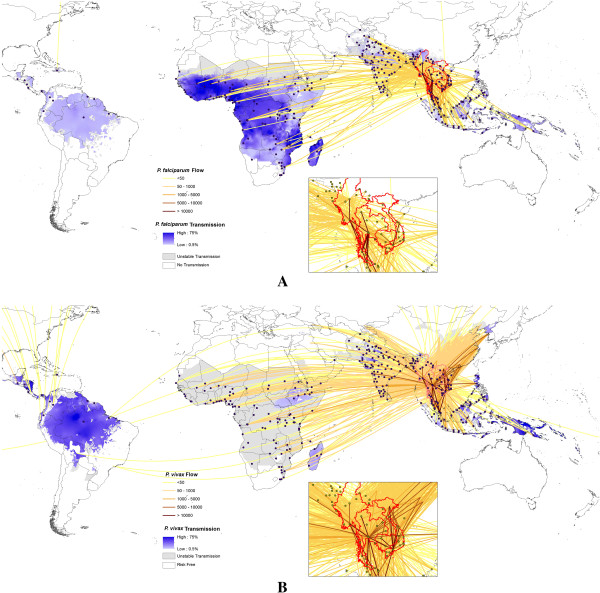
Results: The analyses demonstrate the substantial connectivity that now exists between and from malaria-endemic regions through air travel. While the air network provides connections to previously isolated malarious regions, it is clear that great variations exist, with significant regional communities of airports connected by higher rates of flow standing out. The structures of these communities are often not geographically coherent, with historical, economic and cultural ties evident, and variations between P. falciparum and P. vivax clear. Moreover, results highlight how well connected the malaria-endemic areas of Africa are now to Southeast Asia, illustrating the many possible routes that artemisinin-resistant strains could take.
Discussion: The continuing growth in air travel is playing an important role in the global epidemiology of malaria, with the endemic world becoming increasingly connected to both malaria-free areas and other endemic regions. The research presented here provides an initial effort to quantify and analyse the connectivity that exists across the malaria-endemic world through air travel, and provide a basic assessment of the risks it results in for movement of infections.
Figures
References
-
- IATA Press Release. http://www.iata.org/pressroom/pr/Pages/2012-12-06-01.aspx.
-
- IATA. IATA 2012 Annual Review. Beijing: IATA; 2012.
-
- World Health Organization. The world health report 2007 - A safer future: global public health security in the 21st century. Geneva: WHO Press; 2007.
-
- Khan K, McNabb SJ, Memish ZA, Eckhardt R, Hu W, Kossowsky D, Sears J, Arino J, Johansson A, Barbeschi M, McCloskey B, Henry B, Cetron M, Brownstein JS. Infectious disease surveillance and modelling across geographic frontiers and scientific specialties. Lancet Infect Dis. 2012;12:222–230. doi: 10.1016/S1473-3099(11)70313-9. - DOI - PubMed
Publication types
MeSH terms
Grants and funding
LinkOut - more resources
Full Text Sources
Other Literature Sources
Medical
Molecular Biology Databases
