Side-alternating vibration training for balance and ankle muscle strength in untrained women
- PMID: 23914911
- PMCID: PMC3784360
- DOI: 10.4085/1062-6050-48.4.03
Side-alternating vibration training for balance and ankle muscle strength in untrained women
Abstract
Context: Side-alternating vibration (SAV) may help reduce the risk of falling by improving body balance control. Such training has been promoted as a strength-training intervention because it can increase muscle activation through an augmented excitatory input from the muscle spindles.
Objective: To determine the effect of SAV training on static balance during 3 postural tasks of increasing difficulty and lower limb strength.
Design: Randomized controlled clinical trial.
Setting: Laboratory.
Patients or other participants: A total of 21 healthy women were divided into training (n = 11; age = 43.35 ± 4.12 years, height = 169 ± 6.60 cm, mass = 68.33 ± 11.90 kg) and control (n = 10; age = 42.31 ± 3.73 years, height = 167 ± 4.32 cm, mass = 66.29 ± 10.74 kg) groups.
Intervention(s): The training group completed a 9-week program during which participants performed 3 sessions per week of ten 15-second isometric contractions with a 30-second active rest of 3 exercises (half-squat, wide-stance squat, 1-legged half-squat) on an SAV plate (acceleration = 0.91-16.3g). The control group did not participate in any form of exercise over the 9-week period.
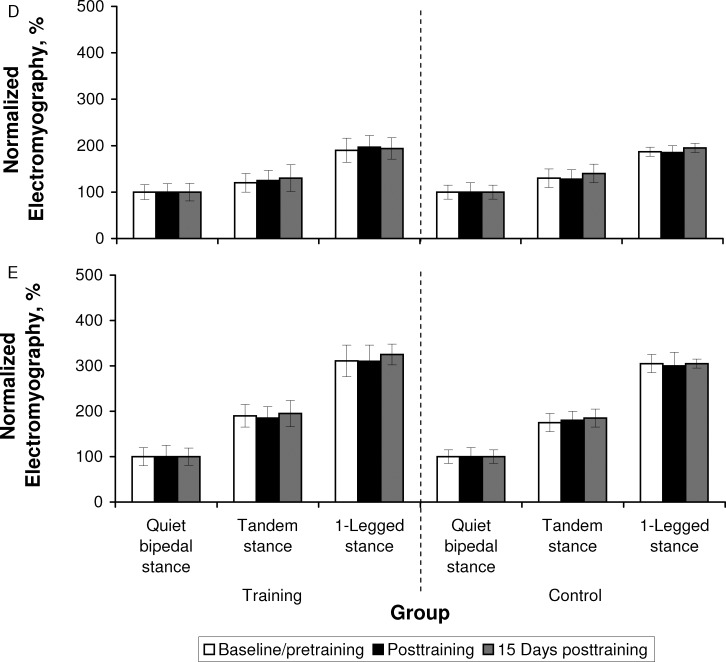
Main outcome measure(s): We evaluated isokinetic and isometric strength of the knee extensors and flexors and ankle plantar flexors, dorsiflexors, and evertors. Static balance was assessed using 3 tasks of increasing difficulty (quiet bipedal stance, tandem stance, 1-legged stance). The electromyographic activity of the vastus lateralis, semitendinosus, medial gastrocnemius, tibialis anterior, and peroneus longus was recorded during postural task performance, baseline and pretraining, immediately posttraining, and 15 days posttraining.
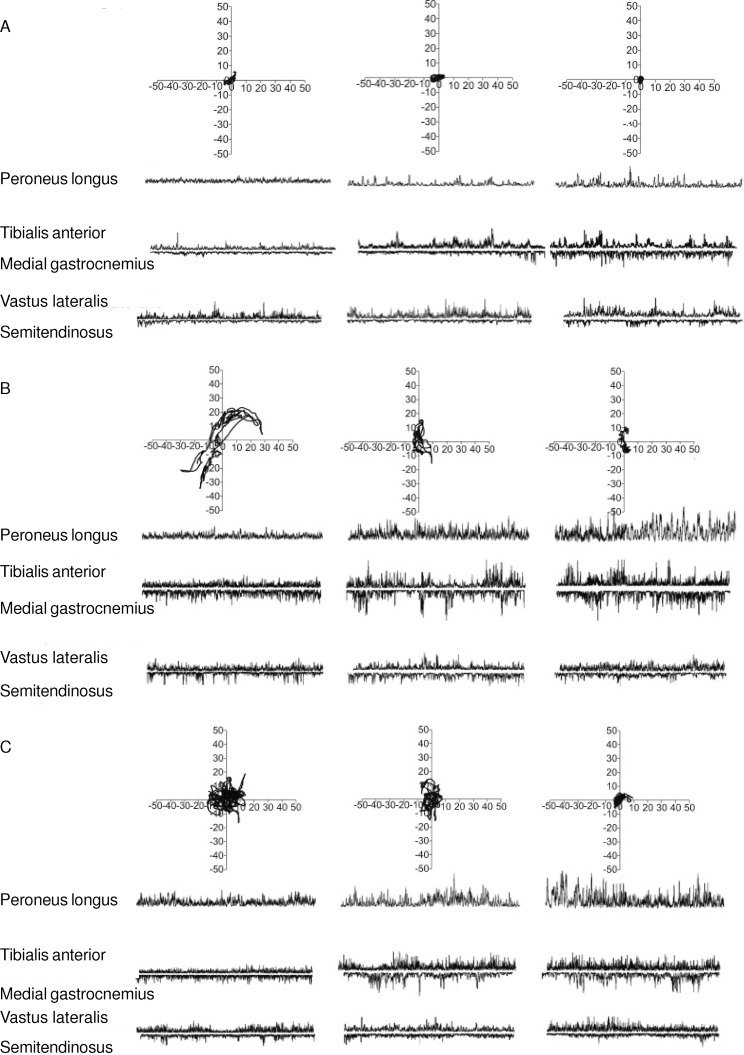
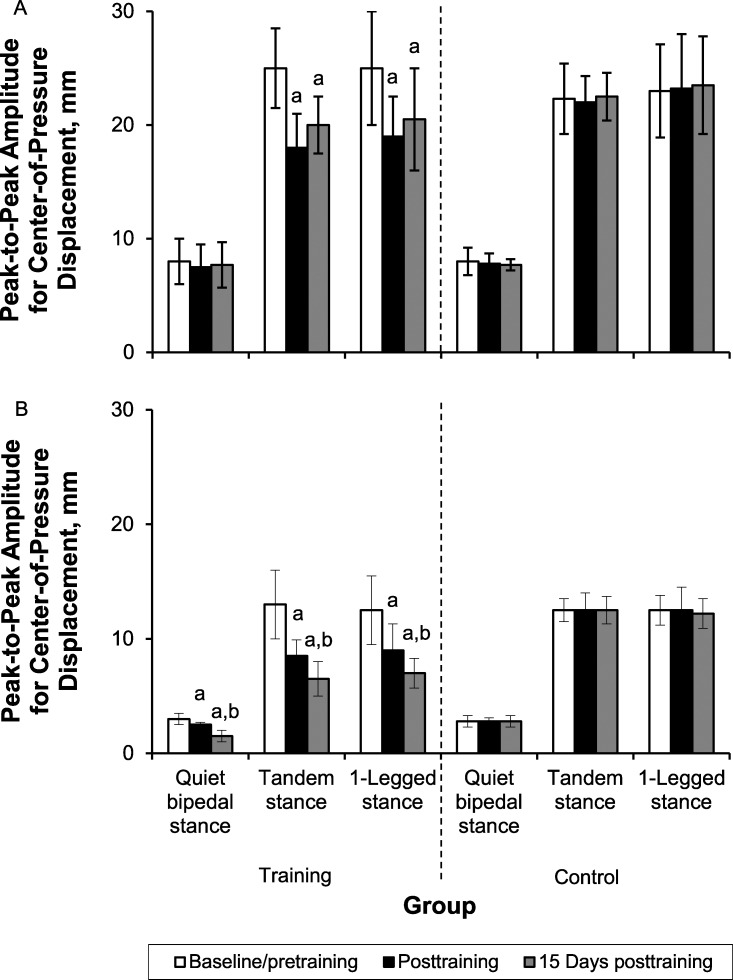
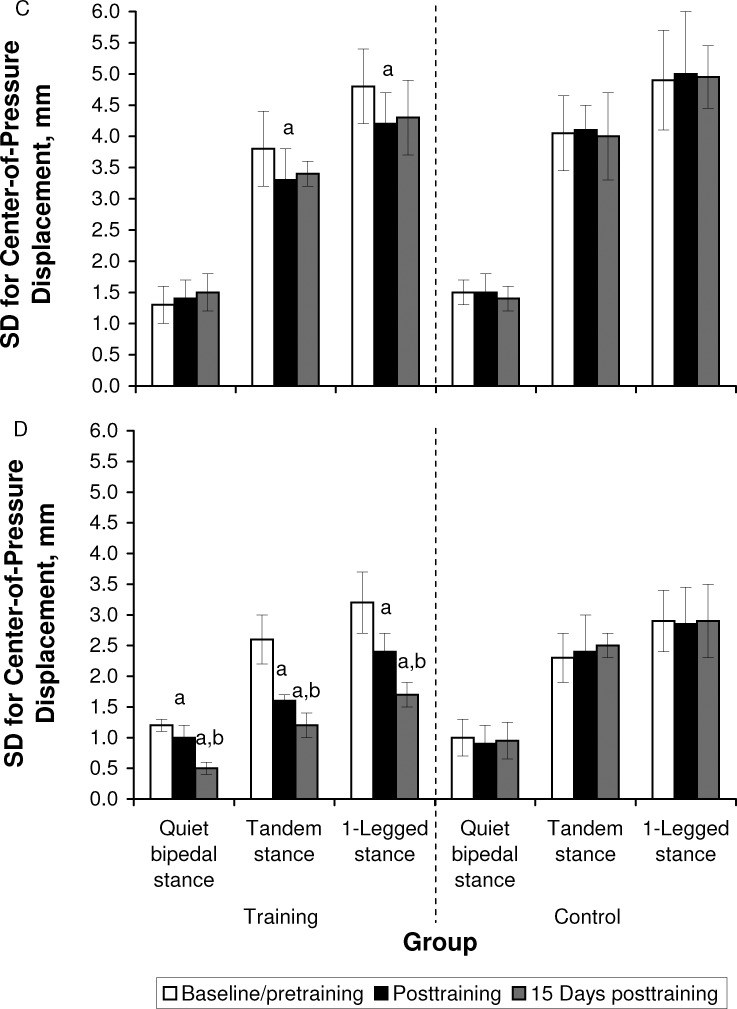
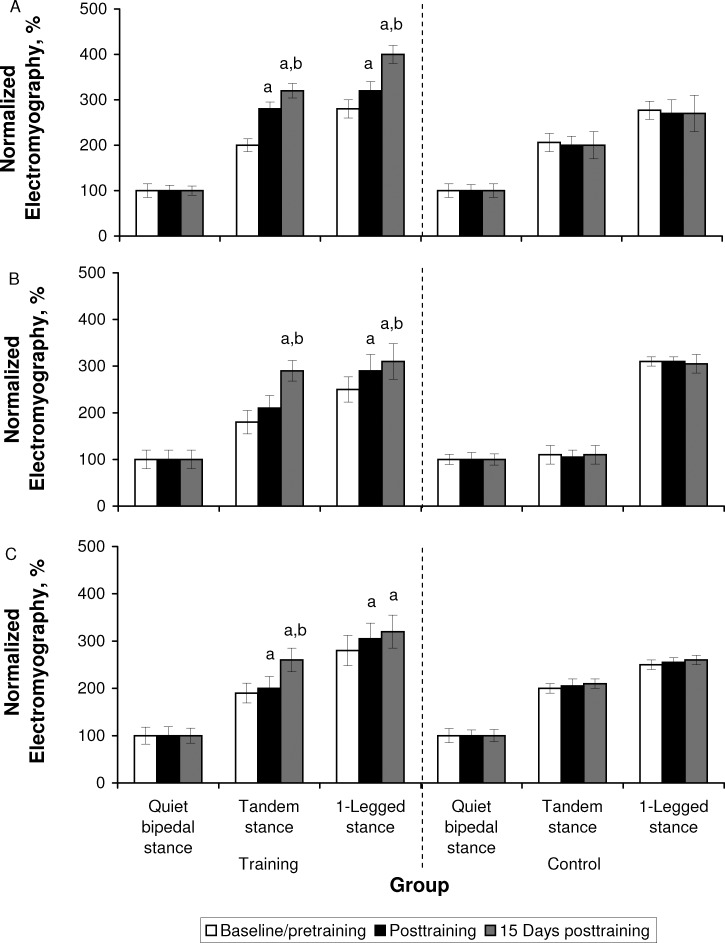
Results: After training in the training group, ankle muscle strength improved (P = .03), whereas knee muscle strength remained unaltered (P = .13). Improved ankle-evertor strength was observed at all angular velocities (P = .001). Postural sway decreased in both directions but was greater in the mediolateral (P < .001) than anteroposterior (P = .02) direction. The electromyographic activity of the peroneus longus increased during the sharpened tandem (P = .001) and 1-legged tasks (P = .007). No changes were seen in the control group for any measures.
Conclusions: The SAV training could enhance ankle muscle strength and reduce postural sway during static balance performance. The reduction in mediolateral sway could be associated with the greater use of ankle evertors due to their strength improvement.
Figures
References
-
- Rittweger J. Vibration as an exercise modality: how it may work, and what its potential might be. Eur J Appl Physiol. 2010;108(5):877–904. - PubMed
-
- Abercromby AFJ, Amonette WE, Layne CS, McFarlin BK, Hinman MR, Paloski WH. Variation in neuromuscular responses during acute whole-body vibration exercise. Med Sci Sports Exerc. 2007;39(9):1642–1650. - PubMed
-
- Cochrane D, Stannard SR, Firth EC, Rittweger J. Acute whole-body vibration elicits post-activation potentiation. Eur J Appl Physiol. 2010;108(2):311–319. - PubMed
-
- Tropp H, Odenrick P. Postural control in single-limb stance. J Orthop Res. 1988;6(6):833–839. - PubMed
-
- Bruyere O, Wuidart MA, Palma E, et al. Controlled whole body vibration to decrease fall risk and improve health-related quality of life of nursing home residents. Arch Phys Med Rehabil. 2005;86(2):303–307. - PubMed
Publication types
MeSH terms
LinkOut - more resources
Full Text Sources
Other Literature Sources