Review
. 2013 Nov;142(4):1211-30.
doi: 10.1037/a0033621. Epub 2013 Aug 5.

The hippocampus, time, and memory across scales

Affiliations
Review

The hippocampus, time, and memory across scales

Marc W Howard et al. J Exp Psychol Gen. 2013 Nov.

Abstract

A wealth of experimental studies with animals have offered insights about how neural networks within the hippocampus support the temporal organization of memories. These studies have revealed the existence of "time cells" that encode moments in time, much as the well-known "place cells" map locations in space. Another line of work inspired by human behavioral studies suggests that episodic memories are mediated by a state of temporal context that changes gradually over long time scales, up to at least a few thousand seconds. In this view, the "mental time travel" hypothesized to support the experience of episodic memory corresponds to a "jump back in time" in which a previous state of temporal context is recovered. We suggest that these 2 sets of findings could be different facets of a representation of temporal history that maintains a record at the last few thousand seconds of experience. The ability to represent long time scales comes at the cost of discarding precise information about when a stimulus was experienced--this uncertainty becomes greater for events further in the past. We review recent computational work that describes a mechanism that could construct such a scale-invariant representation. Taken as a whole, this suggests the hippocampus plays its role in multiple aspects of cognition by representing events embedded in a general spatiotemporal context. The representation of internal time can be useful across nonhippocampal memory systems.


Figures

Figure 1
Figure 1
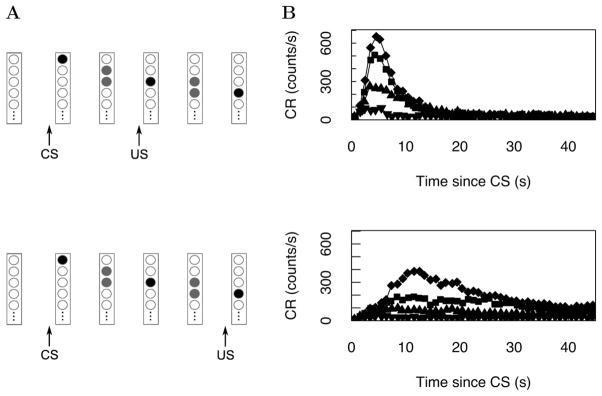
Utility of a distributed timing signal. A: Schematic of a distributed timing signal as a function of time for two conditions in which a conditioned stimulus (CS) precedes an unconditioned stimulus (US) at two different delays. The state of a set of nodes is shown at various times during a trial of a trace conditioning experiment. Shading is meant to represent the activation of each node, with dark shading indicating that the node is more active. Top: Presentation of the CS starts the representation through a series of states in which different nodes are sequentially activated. The US is presented after a particular delay. The activated node can be associated to the node corresponding to an appropriate conditioned response (CR). When the CS is repeated, the CR is not predicted right away but only becomes activated after an appropriate delay. Bottom: When the delay before the US is longer, other nodes are activated. As a consequence, different nodes are conditioned to the CR than when the delay is shorter. B: Experimental data adapted from “Temporal Control of Conditioned Responding in Goldfish,” by M. R. Drew, P. A. Couvillon, B. Zupan, A. Cooke, and P. Balsam, 2005, The Journal of Neuroscience, 31, p. 33. Copyright 2005 by the Society for Neuroscience. A certain time after a light CS is presented a shock US was administered to goldfish. The y axis gives the frequency of a CR during probe trials in which there was no shock. Different lines show responses after different numbers of learning trials (each block had 50 learning trials). The top plot shows performance when the delay was 5 s. The bottom plot shows performance when the delay was 10 s. Note that the time of peak responding varies according to the delay interval, even at early stages of learning.
Figure 2
Figure 2
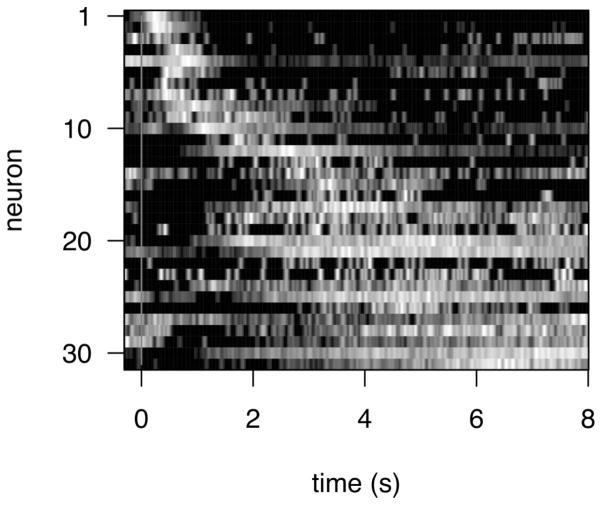
The firing rate of simultaneously recorded cells in dorsal CA1 as a function of time into the delay period of a memory task. Adapted from “Hippocampal ‘Time Cells’ Bridge the Gap in Memory for Discontiguous Events,” by C. J. MacDonald, K. Q. Lepage, U. T. Eden, and H. Eichenbaum, 2011, Neuron, 71, p. 739. Copyright 2011 by Cell Press. Each row is the temporal profile of one cell averaged across trials; the cells have been ordered according to the time at which their firing peaks. CA = cornus ammoni.
Figure 3
Figure 3
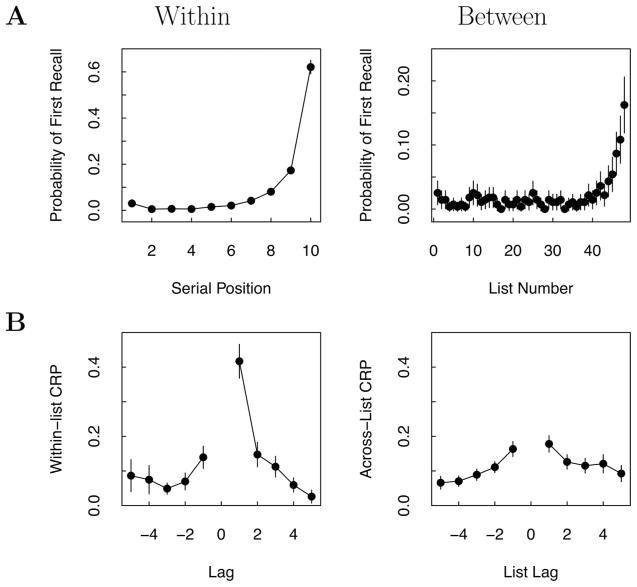
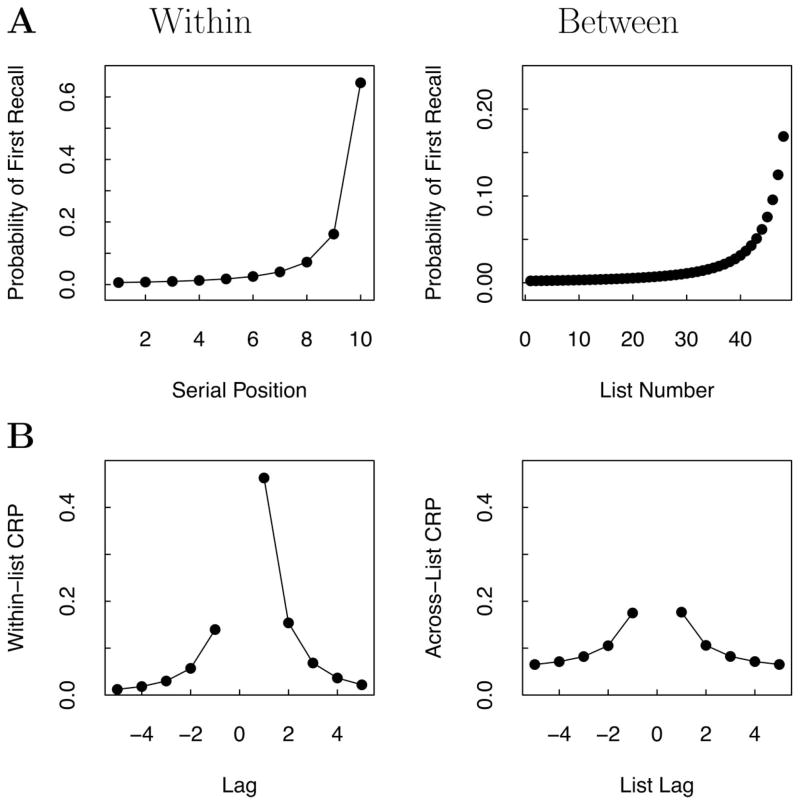
Recency and contiguity effects across time scales in final free recall. A: The recency effect within-and across-lists. Adapted from “The Persistence of Memory: Contiguity Effects Across Several Minutes,” by M. W. Howard, T. E. Youker, and V. Venkatadass, 2008, Psychonomic Bulletin & Review, 15, p. 60. Copyright 2008 by Springer. In Howard et al. (2008), subjects performed immediate free recall on 48 lists of 10 words. At the end of the session, they were asked to recall all of the words in the entire experiment in the order they came to mind. The within-list curve gives the probability that the first word recalled during immediate recall of a particular list came from each serial position. There is a strong tendency recall words from the end of the list. The across-list curve gives the probability of first recall from the final free recall session as a function of list. Here there is again a recency effect favoring the recall of words from the last several lists. B: Contiguity effect within and across lists. Adapted from “Exploring the Retrieval Dynamics of Delayed and Final Free Recall: Further Evidence for Temporal-Contextual Search,” by N. Unsworth, 2008, Journal of Memory and Language, 59, p. 230. Copyright 2006 by Elsevier. Subjects studied 10 lists of 10 words each (Unsworth, 2008). Lists were initially tested with delayed recall. During the final free recall session, subjects recalled many words from many lists. The within-list effect gives the probability of a final free recall transition between words from the same list as a function of the difference in serial position within that list. Given that a pair of successive recalls came from different lists, the across-list effect gives an estimate of the relative probability of making a transition from one list to another as a function of the distance in lists between those two words. CRP = conditional response probability.
Figure 4
Figure 4
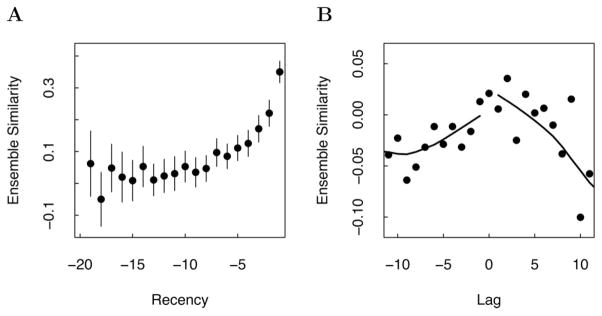
Neural recency and contiguity effects. Adapted from “A Neural Signature of Mental Time Travel in the Human MTL,” by M. W. Howard, I. V. Viskontas, K. H. Shankar, and I. Fried, 2012, Hippocampus, 22, p. 1839. Copyright 2012 by Wiley. Multiple neurons were recorded from human medial temporal lobe during performance of a continuous recognition task. A: The population vector during presentation of each stimulus was compared to the population vector during presentation of previous stimuli and aggregated as a function of recency between the two stimulus presentations. The ensemble state changed gradually over at least a few dozen seconds. B: When an item was repeated, that state was compared to the neighbors of the original presentation, subtracting out the contribution due to recency. The results suggest a jump back in time caused by repetition of the stimulus.
Figure 5
Figure 5
Schematics illustrating a computational hypothesis for a scale-invariant representation of temporal history. A: The cells in an intermediate representation t are driven by an input f describing the presence or absence of a particular stimulus at that moment. Adapted from “A Scale-Invariant Representation of Time,” by K. H. Shankar and M. W. Howard, 2012, Neural Computation, 24, p. 145. Copyright 2012 by MIT Press. At each moment, only the current value of f is available. Each cell in t(s) has a different value of s that controls the rate at which that cell responds to an input. A reconstruction of temporal history T is constructed at each moment from t. Each cell in T is aligned with a paired cell in t(s). Each cell in T receives inputs from several cells in t adjacent to its paired cell. B: Adapted from “A Scale-Invariant Representation of Time,” by K. H. Shankar and M. W. Howard, 2012, Neural Computation, 24, p. 143. Copyright 2012 by MIT Press. Top: The stimulus function f providing input to a set of cells is nonzero for two periods of time. Middle: Cells in the intermediate representation respond immediately to nonzero f like charging capacitors and then decay exponentially after the stimulus is removed. Different cells in the intermediate representation respond at different rates but starting at the same time. Bottom: Cells in the reconstruction T do not respond to the stimulus immediately, but after some characteristic delay. Different cells respond at different delays and with different temporal spreads. C: This plot shows a snapshot of the activation across nodes at one point in time after two presentations of the stimulus. Each presentation contributes to the representation. The representation of history is imperfect, with accuracy that decreases for events further in the past. Adapted from A Quantitative Model of Time in Episodic Memory, by M. W. Howard, K. H. Shankar, W. Aue, and A. H. Criss, 2013, manuscript submitted for publication.
Figure 6
Figure 6
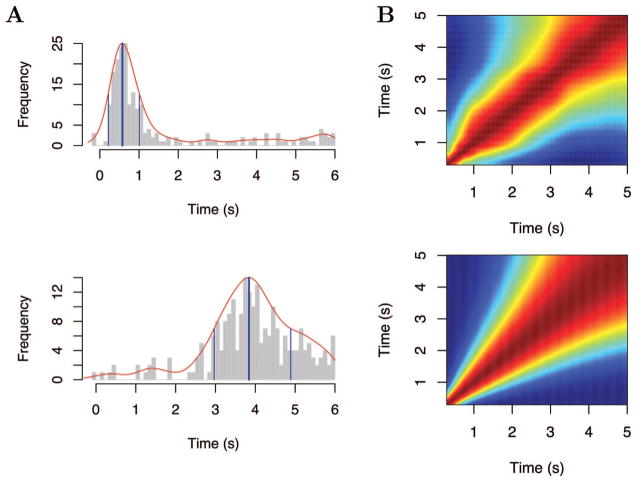
Time cells show decreasing accuracy for times further in the past. From A Unified Mathematical Framework for Coding Time, Space, and Sequences in the Medial Temporal Lobe by M. W Howard, C. J. MacDonald, K. H. Shanker, Q. Du, M. E. Hasselmo, and H. Eichenbaum, 2013, p. 10. Copyright 2013 by M. W Howard, C. J. MacDonald, K. H. Shanker, Q. Du, M. E. Hasselmo, and H. Eichenbaum. A: The firing of two representative time cells as a function of time. In each plot, the total number of spikes fired in each bin is shown as a function of time synchronized to the onset of the delay period. The smooth red line gives an estimate of the density of spikes as function of time. The thick vertical blue line gives the estimate of the cell’s mode; the two thin vertical blue lines give the estimate of the half-height region. The spread is statistically reliable across cells, as is the asymmetry in the shape of the time field. Compare to Figure 5B. B: Ensemble similarity during the delay period. The color scale gives the ensemble similarity (cosine of the angle between the vectors) of the smoothed population vectors across sessions for each pair of times during the delay. Top: Empirical data. Bottom: Ensemble similarity of T at different times.
Figure 7
Figure 7
Recency and contiguity effects across scales using a scale-invariant representation of temporal history. Panels correspond to Figure 3. A: The recency effect was generated with a simple associative model between the current state of history and the list stimuli. The probability of choosing a stimulus to be recalled was generated using a power law softmax rule. From A Quantitative Model of Time in Episodic Memory, by M. W. Howard, K. H. Shankar, W. Aue, and A. H. Criss, 2013, p. 40. Copyright 2013 by M. W. Howard, K. H. Shankar, W. Aue, and A. H. Criss. B: The contiguity effect was generated by assuming that a recalled item causes partial recovery of the state of temporal history that obtained when it was studied. This recovered state overlapped with the state of history when nearby items were encoded, resulting in a contiguity effect. Because the representation of temporal history is scale-invariant, the model can simultaneously account for contiguity effects both within and between lists. See Howard et al. (2013) for details. From A Quantitative Model of Time in Episodic Memory, by M. W. Howard, K. H. Shankar, W. Aue, and A. H. Criss, 2013, p. 42. Copyright 2013 by M. W. Howard, K. H. Shankar, W. Aue, and A. H. Criss. CRP = conditional response probability.

References

    1. Adler A, Finkes I, Katabi S, Prut Y, Bergman H. Encoding by synchronization in the primate striatum. The Journal of Neuroscience. 2013;33:4854–4866. doi: 10.1523/JNEUROSCI.4791-12.2013. - DOI - PMC - PubMed
    1. Adler A, Katabi S, Finkes I, Israel Z, Prut Y, Bergman H. Temporal convergence of dynamic cell assemblies in the striato-pallidal network. Journal of Neuroscience. 2012;32:2473–2484. doi: 10.1523/JNEUROSCI.4830-11.2012. - DOI - PMC - PubMed
    1. Agster KL, Fortin NJ, Eichenbaum H. The hippocampus and disambiguation of overlapping sequences. The Journal of Neuroscience. 2002;22:5760–5768. - PMC - PubMed
    1. Ainge JA, van der Meer MAA, Langston RF, Wood ER. Exploring the role of context-dependent hippocampal activity in spatial alternation behavior. Hippocampus. 2007;17:988–1002. doi: 10.1002/hipo.20301. - DOI - PubMed
    1. Anderson J, Schooler L. Reflections of the environment in memory. Psychological Science. 1991;2:396–408. doi: 10.1111/j.1467-9280.1991.tb00174.x. - DOI

Publication types