


Overexpression of CARM1 in breast cancer is correlated with poorly characterized clinicopathologic parameters and molecular subtypes
- PMID: 23915145
- PMCID: PMC3766166
- DOI: 10.1186/1746-1596-8-129
Overexpression of CARM1 in breast cancer is correlated with poorly characterized clinicopathologic parameters and molecular subtypes
Abstract
Background: Coactivator-associated arginine methyltransferase 1 (CARM1) belongs to the protein arginine methyltransferase family. CARM1 has been reported to be associated with high grade tumors in breast cancer. It still remains unknown the expression pattern of CARM1 in breast cancer and its relationships with clinicopathological characteristics and molecular subtypes.
Methods: Two hundred forty-seven invasive breast cancer cases were collected and prepared for tissue array. There were thirty-seven tumors with benign glandular epithelium adjacent to the tumors among these cases. Molecular subtype and CARM1 expression were investigated using immunohistochemistry.
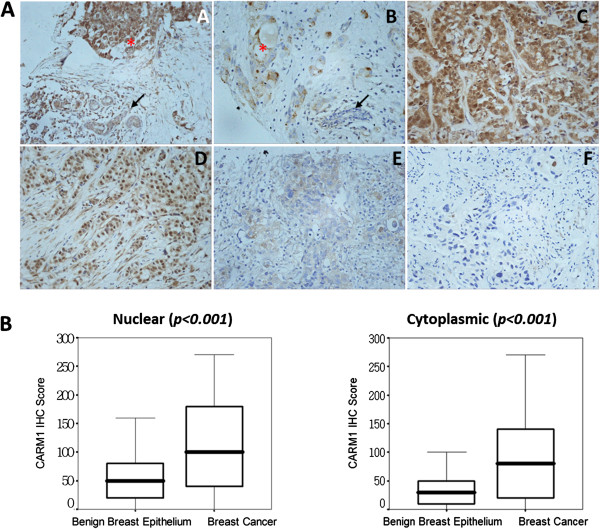
Results: Cell staining was observed in the cytoplasm and/or nucleus. Staining for CARM1 was significantly stronger in adenocarcinoma compared with adjacent benign epithelium. There is a significant correlation between CARM1 overexpression with young age, high grade, estrogen receptor (ER) and progesterone receptor (PR) negative, increased p53 expression, and high Ki-67 index. Our study demonstrated CARM1 overexpression was associated with an increase in the protein expression of HER2. Furthermore, our data indicated CARM1-overexpression rate were remarkably higher in HER2 subtype (69.6%), luminal B subtype (59.6%) and TN subtype (57.1%) compared with luminal A subtype (41.3%).
Conclusions: CARM1 expression was increased in invasive breast cancer. CARM1 overexpression was associated with poorly characterized clinicopathologic parameters and HER2 overexpression. There were significant differences between different molecular subtypes in their relationship to CARM1 overexpression. Our results support the value of using CARM1 in prognostic stratification of breast cancer patients and its potential therapeutic implications in targeting treatment.
Virtual slides: The virtual slide(s) for this article can be found here: http://www.diagnosticpathology.diagnomx.eu/vs/4116338491022965.
Figures
References
-
- Wolff AC, Hammond ME, Schwartz JN, Hagerty KL, Allred DC, Cote RJ, Dowsett M, Fitzgibbons PL, Hanna WM, Langer A, McShane LM, Paik S, Pegram MD, Perez EA, Press MF, Rhodes A, Sturgeon C, Taube SE, Tubbs R, Vance GH, van de Vijver M, Wheeler TM, Hayes DF. American society of clinical oncology/college of American pathologists guideline recommendations for human epidermal growth factor receptor 2 testing in breast cancer. J Clin Oncol. 2007;25:118–145. - PubMed
-
- Baselga J, Swain SM. Novel anticancer targets: revisiting ERBB2 and discovering ERBB3. Nat Rev Cancer. 2009;9:463–475. - PubMed
Publication types
MeSH terms
Substances
LinkOut - more resources
Full Text Sources
Other Literature Sources
Medical
Research Materials
Miscellaneous
