


Patient and primary care provider experience using a family health history collection, risk stratification, and clinical decision support tool: a type 2 hybrid controlled implementation-effectiveness trial
- PMID: 23915256
- PMCID: PMC3765729
- DOI: 10.1186/1471-2296-14-111
Patient and primary care provider experience using a family health history collection, risk stratification, and clinical decision support tool: a type 2 hybrid controlled implementation-effectiveness trial
Abstract
Background: Family health history (FHH) is the single strongest predictor of disease risk and yet is significantly underutilized in primary care. We developed a patient facing FHH collection tool, MeTree, that uses risk stratification to generate clinical decision support for breast cancer, colorectal cancer, ovarian cancer, hereditary cancer syndromes, and thrombosis. Here we present data on the experience of patients and providers after integration of MeTree into 2 primary care practices.
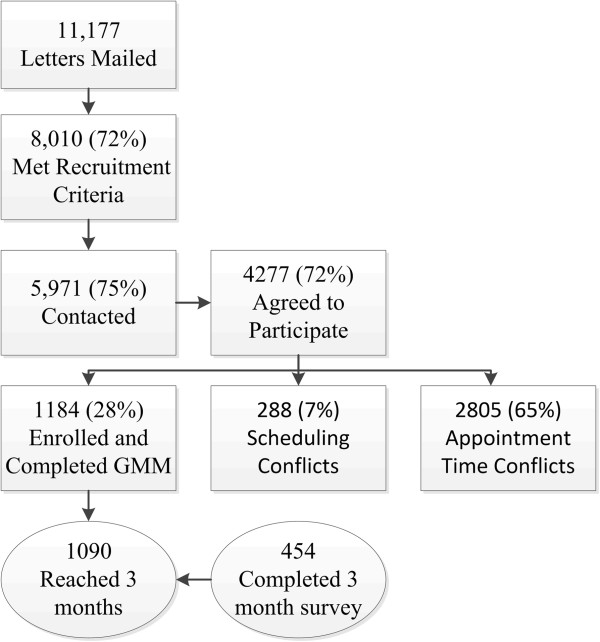
Methods: This was a Type 2 hybrid controlled implementation-effectiveness study in 3 community-based primary care clinics in Greensboro, NC. All non-adopted adult English speaking patients with upcoming routine appointments were invited. Patients were recruited from December 2009 to the present and followed for one year. Ease of integration of MeTree into clinical practice at the two intervention clinics was evaluated through patient surveys after their appointment and at 3 months post-visit, and physician surveys 3 months after tool integration.
Results: Total enrollment =1,184. Average time to complete MeTree = 27 minutes. Patients found MeTree: easy to use (93%), easy to understand (97%), useful (98%), raised awareness of disease risk (85%), and changed how they think about their health (86%). Of the 26% (N = 311) asking for assistance to complete the tool, age (65 sd 9.4 vs. 57 sd 11.8, p-value < 0.00) and large pedigree size (24.4 sd 9.81 vs. 22.2 sd 8.30, p-value < 0.00) were the only significant factors; 77% of those requiring assistance were over the age of 60. Providers (N = 14) found MeTree: improved their practice (86%), improved their understanding of FHH (64%), made practice easier (79%), and worthy of recommending to their peers (93%).
Conclusions: Our study shows that MeTree has broad acceptance and support from both patients and providers and can be implemented without disruption to workflow.
Figures
References
-
- DeGowin EL, DeGowin RL. Bedside diagnostic examination. 2d. New York: Macmillan; 1969.
-
- Greenland P, Alpert JS, Beller GA, Benjamin EJ, Budoff MJ, Fayad ZA, Foster E, Hlatky MA, Hodgson JM, Kushner FG. et al. ACCF/AHA guideline for assessment of cardiovascular risk in asymptomatic adults: executive summary: a report of the american college of cardiology foundation/American heart association task force on practice guidelines. Circulation. 2010;2010(122):2748–2764. - PubMed
-
- Smith RA, Cokkinides V, Brawley OW. Cancer screening in the united states, 2012: a review of current american cancer society guidelines and current issues in cancer screening. CA Cancer J Clin. 2012;2012(58):161–179. - PubMed
Publication types
MeSH terms
LinkOut - more resources
Full Text Sources
Other Literature Sources
Medical
