


Review
doi: 10.1089/rej.2013.1435.
Recognition and control of the progression of age-related hearing loss
Affiliations
- PMID: 23915327
- PMCID: PMC3869427
- DOI: 10.1089/rej.2013.1435
Item in Clipboard
Review
Recognition and control of the progression of age-related hearing loss
Rejuvenation Res.
2013 Dec.
Abstract
Recent breakthroughs have provided notable insights into both the pathogenesis and therapeutic strategies for age-related hearing loss (ARHL). Simultaneously, these breakthroughs enhance our knowledge about this neurodegenerative disease and raise the question of whether the disorder is preventable or even treatable. Discoveries relating to ARHL have revealed a unique link between ARHL and the underlying pathologies. Therefore, we need to better understand the pathogenesis or the mechanism of ARHL and learn how to take full advantage of various therapeutic strategies to prevent the progression of ARHL.
Figures
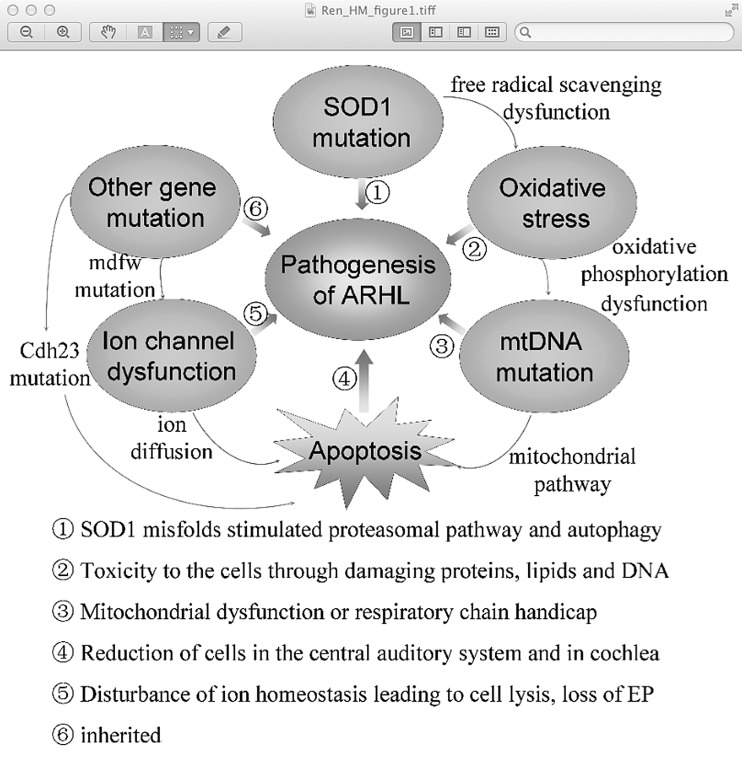
The mechanism of age-related hearing loss (ARHL). The SOD1 mutation, as an initial event accelerating ARHL through stimulating the proteasomal pathway and autophagy, directly leads to free radical scavenging dysfunction, which in turn stimulates mitochondrial (mt) DNA mutation. mtDNA mutations are not only toxic to the auditory cells by damaging proteins, lipids, and DNA in cells but also results in cell apoptosis through the mitochondrial pathway, which untimately leads to ARHL. Other gene mutations such as the Cdh23 mutation may be harmful to the stereociliary tip link and cause hair cell apoptosis from the base to apex, leading to early onset of ARHL. Meanwhile, the mdfw mutation leads to the plasma membrane Ca2+ ATPase2 dysfunction, finally resulting in cell apoptosis and even the appearance of ARHL.
References
-
- Fetoni AR, Picciotti PM, Paludetti G, Troiani D. Pathogenesis of presbycusis in animal models: A review. Exp Gerontol 2011;46:413–425 - PubMed
-
- Huang Q, Tang J. Age-related hearing loss or presbycusis. Eur Arch Otorhinolaryngol 2010; 267:1179–91 - PubMed
-
- Sprinzl G, Riechelmann H. Current trends in treating hearing loss in elderly people: A review of the technology and treatment options—a mini-review. Gerontology 2010;56:351–358 - PubMed
Publication types
MeSH terms
LinkOut - more resources
Full Text Sources
Other Literature Sources
Medical
