


Pesticide exposure and self-reported incident depression among wives in the Agricultural Health Study
- PMID: 23916637
- PMCID: PMC3805780
- DOI: 10.1016/j.envres.2013.06.001
Pesticide exposure and self-reported incident depression among wives in the Agricultural Health Study
Abstract
Background: Depression in women is a public health problem. Studies have reported positive associations between pesticides and depression, but few studies were prospective or presented results for women separately.
Objectives: We evaluated associations between pesticide exposure and incident depression among farmers' wives in the Agricultural Health Study, a prospective cohort study in Iowa and North Carolina.
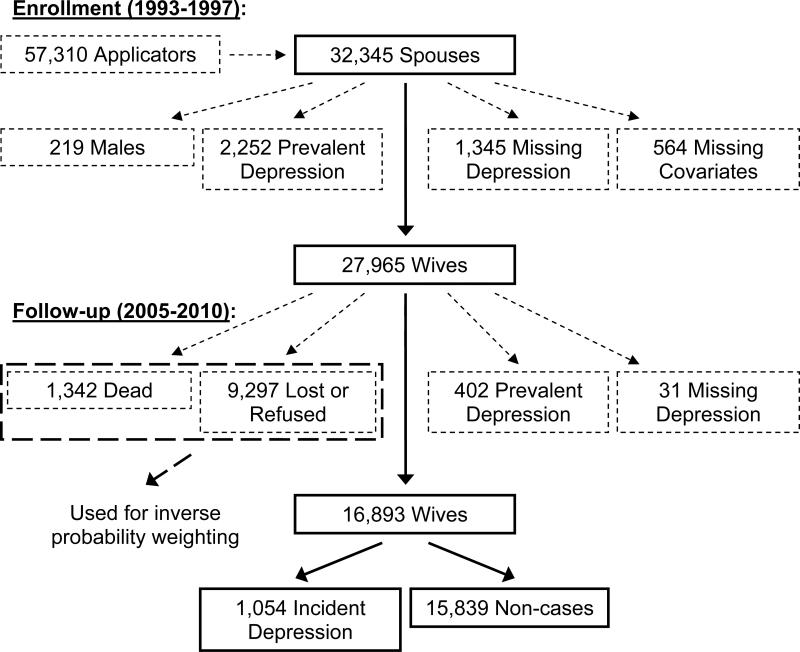
Methods: We used data on 16,893 wives who did not report physician-diagnosed depression at enrollment (1993-1997) and who completed a follow-up telephone interview (2005-2010). Among these wives, 1054 reported physician diagnoses of depression at follow-up. We collected information on potential confounders and on ever use of any pesticide, 11 functional and chemical classes of pesticides, and 50 specific pesticides by wives and their husbands via self-administered questionnaires at enrollment. We used inverse probability weighting to adjust for potential confounders and to account for possible selection bias induced by the death or loss of 10,639 wives during follow-up. We used log-binomial regression models to estimate risk ratios and 95% confidence intervals.
Results: After weighting for age at enrollment, state of residence, education level, diabetes diagnosis, and drop out, wives' incident depression was positively associated with diagnosed pesticide poisoning, but was not associated with ever using any pesticide. Use of individual pesticides or functional or chemical classes of pesticides was generally not associated with wives' depression. Among wives who never used pesticides, husbands' ever use of individual pesticides or functional or chemical classes of pesticides was generally not associated with wives' incident depression.
Conclusions: Our study adds further evidence that high level pesticide exposure, such as pesticide poisoning, is associated with increased risk of depression and sets a lower bound on the level of exposure related to depression, thereby providing reassurance that the moderate levels of pesticide exposure experienced by farmers' wives likely do not increase risk.
Keywords: (2,4,5-trichlorophenoxy)acetic acid; (RS)2-(2,4,5-trichlorophenoxy)propanonic acid; 1,1,1-trichloro-2,2-bis(4-chlorophenyl)ethane; 2,4,5-T; 2,4,5-TP; 2,4-D; 2-(2,4-dichlorophenoxy)acetic acid; CI; Confidence interval; DDT; Depression; EPTC; Female; IQR; Incidence; Interquartile range; NIEHS; National Institute of Environmental Health Sciences; Pesticides; RR; Risk ratio; S-ethyl dipropyl(thiocarbamate); Spouses.
Published by Elsevier Inc.
Figures
References
-
- Abdel-Rahman A, Dechkovskaia AM, Goldstein LB, Bullman SH, Khan W, El-Masry EM, Abou-Donia MB. Neurological deficits induced by malathion, DEET, and permethrin, alone or in combination in adult rats. J. Toxicol. Environ. Health A. 2004;67:331–356. - PubMed
-
- Agricultural Health Study [December 18, 2012];Full Text of Questionnaires. 2012 Available at: < http://aghealth.nci.nih.gov/questionnaires.html>.
-
- Allison PD. Survival Analysis Using SAS: A Practical Guide. 2nd ed. SAS Institute Inc.; Cary, NC: 2010.
-
- Bazylewicz-Walczak B, Majczakowa W, Szymczak M. Behavioral effects of occupational exposure to organophosphorous pesticides in female greenhouse planting workers. Neurotoxicology. 1999;20:819–826. - PubMed
Publication types
MeSH terms
Substances
Grants and funding
LinkOut - more resources
Full Text Sources
Other Literature Sources
Medical
Miscellaneous
