Review
. 2013 Sep;14(9):609-17.
doi: 10.1038/nrg3543. Epub 2013 Aug 6.

Genomic imprinting and parent-of-origin effects on complex traits

Affiliations
Review

Genomic imprinting and parent-of-origin effects on complex traits

Heather A Lawson et al. Nat Rev Genet. 2013 Sep.

Abstract

Parent-of-origin effects occur when the phenotypic effect of an allele depends on whether it is inherited from the mother or the father. Several phenomena can cause parent-of-origin effects, but the best characterized is parent-of-origin-dependent gene expression associated with genomic imprinting. The development of new mapping approaches applied to the growing abundance of genomic data has demonstrated that imprinted genes can be important contributors to complex trait variation. Therefore, to understand the genetic architecture and evolution of complex traits, including complex diseases and traits of agricultural importance, it is crucial to account for these parent-of-origin effects. Here, we discuss patterns of phenotypic variation associated with imprinting, evidence supporting its role in complex trait variation and approaches for identifying its molecular signatures.


Figures
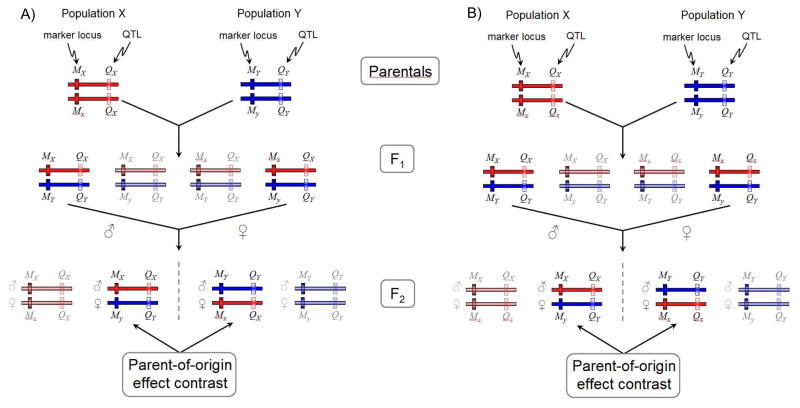
Figure 1
Figure 1
The line cross-design and the appearance of pseudo-imprinted loci. Genetically variable individuals from two parental populations, X and Y, are intercrossed to produce an F2 population. Haplotypes are composed of a marker locus (M) and a linked QTL (Q). Haplotypes originating from population X appear in red and from population Y in blue. The marker locus has two alleles in each population, with markers M1 and M2 from population X and M3 and M4 from population Y. The F1 intercross contains four possible unordered genotypes. The F2 population resulting from a random intercross of these F1 genotypes would produce 16 possible ordered genotypes, but for simplicity only the cross between the M1M3 and M2M4 F1 genotypes are illustrated. This cross produces four ordered F2 genotypes, with the paternally inherited allele appearing above the maternally inherited allele. The two genotypes that contain a marker allele from the X and Y parental populations (M1M4and M3M2) contribute to the parent-of-origin effect contrast. A) In the first scenario the parental populations are fixed for alternative QTL alleles (Q1 and Q3). The parent-of-origin effect contrast therefore represents a comparison between the phenotypes of the Q1Q3 and Q3Q1 genotypes that are genetically equivalent at the QTL but differ in the parent-of-origin of alleles. B) In the second scenario population X has segregating variation at the QTL locus, with alleles Q1and Q2, which are linked to markers M1 and M2 respectively. As a result, the parent-of-origin effect contrast represents a comparison between the phenotypes of the Q1Q3 and Q3Q2 genotypes that are not genetically equivalent and hence the contrast confounds parent-of-origin of alleles and allelic differences at the QTL locus.
Figure 2
Figure 2
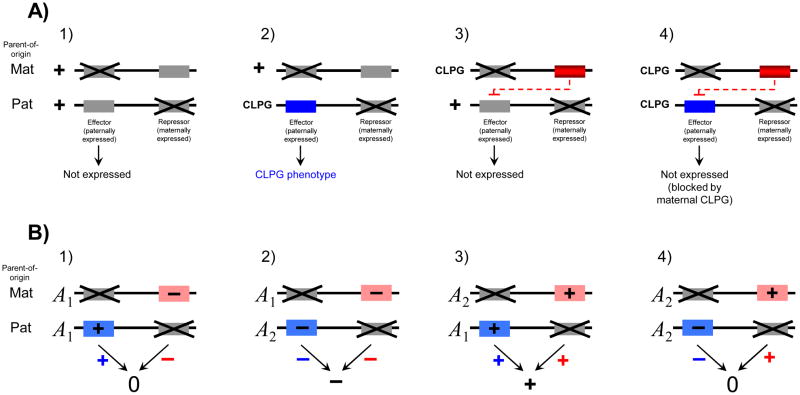
Molecular mechanisms that generate complex phenotypic patterns associated with genomic imprinting. In each figure the locus is composed of two imprinted genes, one showing maternal expression and the other paternal expression. The imprinted copies appear with a cross through them. Genes in grey are not expressed, either because they are imprinted or because they are inactive. Genes in blue are paternally expressed while those in red are maternally expressed. A) A working model for polar overdominance following Georges et al. (for simplicity the long range control element is not included). A.1) Individuals homozygous for the wild-type allele (W) do not express the effector or repressor and show the wild-type phenotype, A.2) Heterozygotes that inherit the active effector (CLPG allele) from their fathers and the inactive (wild-type) repressor from their mothers manifest the callipyge phenotype, A.3) Heterozygotes that inherit the active repressor (CLPG allele) from their mothers but the inactive effector from their fathers have a wild-type phenotype (the repressor is expressed but has no effect if there is no effector to block in trans). A.4) The CLPG homozygote expresses the effector from the paternally inherited copy and the repressor from the maternally inherited copy. The repressor blocks the effector in trans and results in a wild-type phenotype. B) Hypothetical model for the origin of bipolar dominance imprinting. The A1 allele has a positive effect on the phenotype when paternally inherited (because of a paternally expressed gene) but a negative effect when maternally inherited (because of a maternally expressed gene) while the A2 allele has the opposite pattern of effect. The effect of the two genes are summed together to determine the influence of the A locus on the phenotype. B.1) In the A1A1 homozygote the paternally inherited positive effect cancels out the maternally inherited negative effect to result in a net effect of zero B.2) in the A2A1 heterozygote both the paternally inherited (A2) and maternally inherited (A1) alleles have a negative effect, resulting in a net negative phenotypic effect, B.3) In the A1A2 heterozygotes both the paternally inherited (A1) and maternally inherited (A2) alleles have a positive effect, resulting in a net positive phenotypic effect, B.4) In the A2A2 homozygote the paternally inherited negative effect cancels out the maternally inherited positive effect to result in a net effect of zero
None

References

    1. Reik W, Walter J. Genomic imprinting: parental influence on the genome. Nature Reviews Genetics. 2001;2:21–32. - PubMed
    1. Ferguson-Smith A. Genomic imprinting: the emergence of an epigenetic paradigm. Nature Reviews Genetics. 2011;12:565–575. - PubMed
    1. Tycko B, Morison IM. Physiological functions of imprinted genes. Journal of Cellular Physiology. 2002;192:245–258. - PubMed
    1. Swaney WT, Curley JP, Champagne FA, Keverne EB. The paternally expressed gene Peg3 regulates sexual experience-dependent preferences for estrous odors. Behavioral Neuroscience. 2008;122:963–973. - PubMed
    1. Curley JP. Is there a genomically imprinted social brain? BioEssays. 2011;33:662–668. - PubMed

Publication types

LinkOut - more resources