


Sexual violence and mental health symptoms among National Guard and Reserve soldiers
- PMID: 23918158
- PMCID: PMC3889956
- DOI: 10.1007/s11606-013-2555-5
Sexual violence and mental health symptoms among National Guard and Reserve soldiers
Abstract
Background: Reserve and National Guard (NG) soldiers report disproportionate mental health problems relative to active duty military upon returning from the Iraq and Afghanistan conflicts. However, few studies have examined whether exposure to particular types of traumatic events (e.g., lifetime sexual violence) is associated with this increased burden of psychopathology.
Objective: The current study examined the prevalence of lifetime sexual violence exposure as well as the adjusted odds and population attributable fraction of psychopathology associated with sexual violence in a large sample of male and female Reserve and NG soldiers.
Design: Baseline structured telephone interviews were conducted in 2009.
Participants: 1,030 Reserve (23 % female) and 973 NG (15 % female) soldiers.
Main measures: Four items assessed lifetime and deployment-related sexual violence. Probable lifetime and past-year posttraumatic stress disorder (PTSD) and depression were assessed with the PTSD Checklist and the Patient Health Questionnaire, respectively.
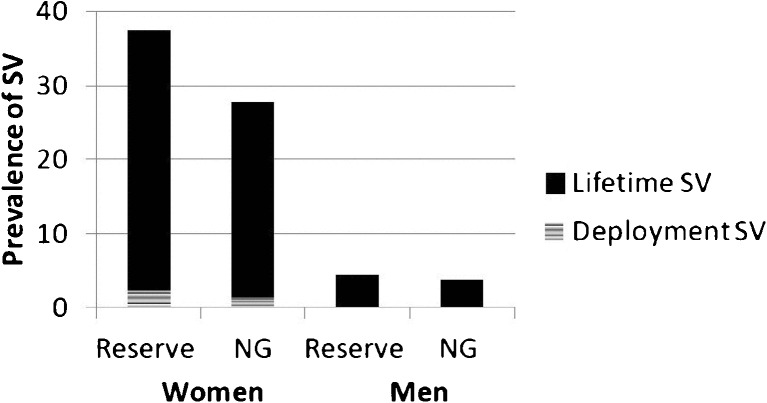
Key results: Lifetime sexual violence prevalence was 37.4 % and 27.6 % among Reserve and NG women, and 4.3 % and 3.7 % among Reserve and NG men, respectively. Recent deployment-related sexual violence ranged from 1.4 to 2.6 % for women and 0 % for men. Regression analyses indicated that the adjusted odds of probable past-year and lifetime PTSD and depression were 1.2 to 3.5 times greater among those reporting sexual violence relative to non-victims. The proportion of probable lifetime PTSD and depression attributable to sexual violence was 45.2 % and 16.6 %, respectively, in the Reserves, and 10.3 % and 6.2 %, respectively, in the NG.
Conclusions: Lifetime sexual violence prevalence was high among female soldiers, with approximately one-third of Reserve and National Guard women reporting a history. The majority of sexual violence was not related to the most recent deployment; however, sexual violence contributed to a high burden of psychopathology. Findings emphasize a need to screen for lifetime sexual violence and associated mental disorders in military samples.
Figures
Comment in
-
Capsule commentary on Walsh et al. Sexual violence and mental health symptoms among National Guard and Reserve soldiers.J Gen Intern Med. 2014 Jan;29(1):179. doi: 10.1007/s11606-013-2575-1. J Gen Intern Med. 2014. PMID: 24002619 Free PMC article. No abstract available.
References
-
- Black MC, Basile KC, Breiding MJ, et al. The National Intimate Partner and Sexual Violence Survey (NISVIS): 2010 Summary Report. Atlanta, GA: National Center for Injury Prevention and Control, Centers for Disease Control and Prevention.
-
- Dolan P, Loomes G, Peasgood T, Tsuchiya A. Estimating the intangible victim costs of violent crime. Br J Criminol. 2005;45:958–976. doi: 10.1093/bjc/azi029. - DOI
-
- Post LA, Mezey NJ, Maxwell C, Wibert WN. The rape tax: tangible and intangible costs of sexual violence. J Interpers Violence. 2002;17:773–782. doi: 10.1177/0886260502017007005. - DOI
Publication types
MeSH terms
Grants and funding
LinkOut - more resources
Full Text Sources
Other Literature Sources
Medical
Miscellaneous
