Cross-sectional study to assess risk factors for leishmaniasis in an endemic region in Sri Lanka
- PMID: 23918217
- PMCID: PMC3795106
- DOI: 10.4269/ajtmh.12-0640
Cross-sectional study to assess risk factors for leishmaniasis in an endemic region in Sri Lanka
Abstract
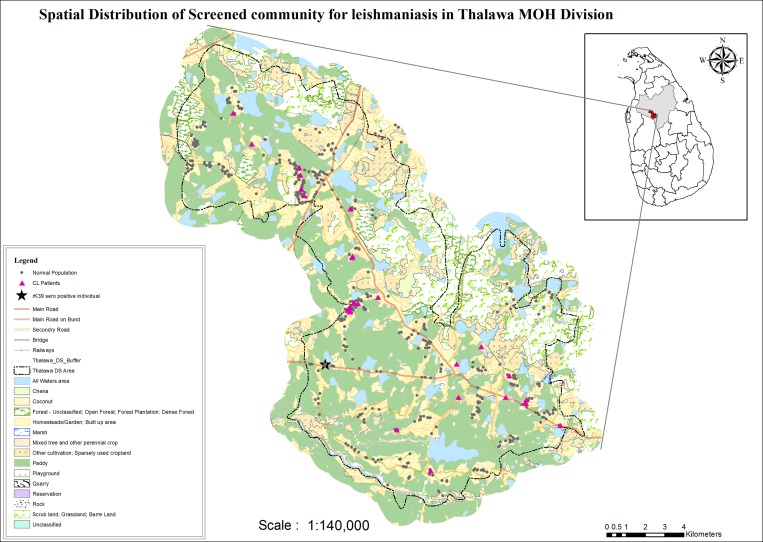
Sri Lanka reports significantly more cutaneous leishmaniasis (CL) cases than visceral leishmaniasis (VL) cases, both of which are caused by Leishmania donovani MON-37. A cross-sectional study conducted in an area with a high prevalence of CL prevalent included 954 participants of an estimated population of 61,674 to estimate the number of CL cases, ascertain whether there is a pool of asymptomatic VL cases, and identify risk factors for transmission. A total of 31 cases of CL were identified, of whom 21 were previously diagnosed and 10 were new cases. Using rK39 rapid diagnostic test to detect antibodies against Leishmania spp., we found that only one person was seropositive but did not have clinical symptoms of CL or VL, which indicated low transmission of VL in this area. χ(2) test, independent sample t-test, and multivariate analysis of sociodemographic and spatial distribution of environmental risk factors showed that living near paddy fields is associated with increased risk for transmission of CL (P ≤ 0.01).
Figures
References
-
- World Health Organization Control of the leishmaniases. World Health Organ Tech Rep Ser. 2010;949:1–186. - PubMed
-
- Dedet JP, Pratlong F. Leishmaniasis. In: Cook G, Zumla A, editors. Manson's Tropical Diseases. Twenty-first edition. London: Saunders Elsevier Sciences; 2003. pp. 1297–1302.
-
- Johnson RN, Ngumbi PM, Gachihi GS, Mwanyumba JP, Mbugua J, Mosonik N, Were JB, Roberts CR. A new focus of kala-azar due to Leishmania donovani sensu lato in Kenya. Trans R Soc Trop Med Hyg. 1993;87:142–144. - PubMed
-
- Marlet MV, Wuillaume F, Jacquet D, Quispe KW, Dujardin JC, Boelaert M. A neglected disease of humans: a new focus of visceral leishmaniasis in Bakool, Somalia. Trans R Soc Trop Med Hyg. 2003;97:667–671. - PubMed
Publication types
MeSH terms
LinkOut - more resources
Full Text Sources
Other Literature Sources
Medical
Miscellaneous