. 2013 Aug 20;110(34):13950-5.
doi: 10.1073/pnas.1312793110. Epub 2013 Aug 5.

An allele of the crm gene blocks cyanobacterial circadian rhythms

Affiliations

An allele of the crm gene blocks cyanobacterial circadian rhythms

Joseph S Boyd et al. Proc Natl Acad Sci U S A. .

Abstract

The SasA-RpaA two-component system constitutes a key output pathway of the cyanobacterial Kai circadian oscillator. To date, rhythm of phycobilisome associated (rpaA) is the only gene other than kaiA, kaiB, and kaiC, which encode the oscillator itself, whose mutation causes completely arrhythmic gene expression. Here we report a unique transposon insertion allele in a small ORF located immediately upstream of rpaA in Synechococcus elongatus PCC 7942 termed crm (for circadian rhythmicity modulator), which results in arrhythmic promoter activity but does not affect steady-state levels of RpaA. The crm ORF complements the defect when expressed in trans, but only if it can be translated, suggesting that crm encodes a small protein. The crm1 insertion allele phenotypes are distinct from those of an rpaA null; crm1 mutants are able to grow in a light:dark cycle and have no detectable oscillations of KaiC phosphorylation, whereas low-amplitude KaiC phosphorylation rhythms persist in the absence of RpaA. Levels of phosphorylated RpaA in vivo measured over time are significantly altered compared with WT in the crm1 mutant as well as in the absence of KaiC. Taken together, these results are consistent with the hypothesis that the Crm polypeptide modulates a circadian-specific activity of RpaA.

Keywords: chronobiology; transcription regulation.


Conflict of interest statement

The authors declare no conflict of interest.

Figures
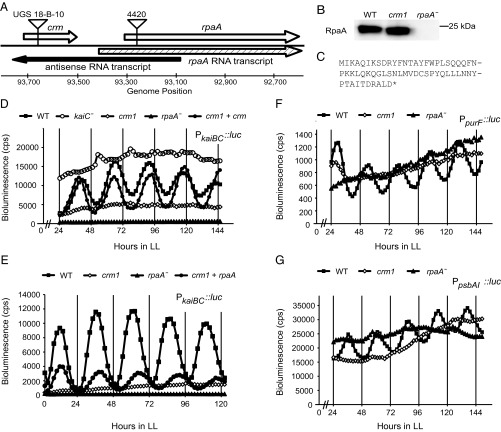
Fig. 1.
Fig. 1.
Transposon insertion in the crm gene affects circadian rhythmicity, but not rpaA expression. (A) Diagram of genomic region containing crm and rpaA genes. Arrows indicate direction of transcription. Positions of insertions are noted. (B) Immunoblots of whole-cell extracts of WT, crm1, and rpaA null (4420 insertion) strains (10 μg total protein/lane) probed with RpaA antiserum. The crm1 mutation did not alter levels of the RpaA protein. (C) Amino acid sequence of crm ORF. (D–G) Bioluminescence rhythms. After entrainment to a 12:12 LD cycle, bioluminescence traces were captured over 6 d under LL. crm1 causes arrhythmic expression from the kaiBC::luc reporter. rpaA strains are arrhythmic and demonstrate only a barely detectable level of kaiBC reporter expression, whereas kaiC strains display high-baseline arrhythmic expression. The crm1 mutant transformed with the crm coding sequence in neutral site I complements arrhythmic expression from kaiBC::luc in trans. Representative traces are shown. cps, counts per second. (E) Ectopic expression of an extra copy of rpaA in a crm1 background partially restores rhythmicity, displaying a low-amplitude, long-period rhythm compared with WT. Average bioluminescence levels of each strain are shown. (F and G) The crm1 allele abolishes rhythmic expression from the purF (F) and psbAI (G) promoters. Bioluminescence in crm1 strains is consistently near WT peak level as measured from the class II purF promoter, in contrast to WT trough level as measured from the class I promoters kaiBC and psbAI. Representative traces are shown.
Fig. 2.
Fig. 2.
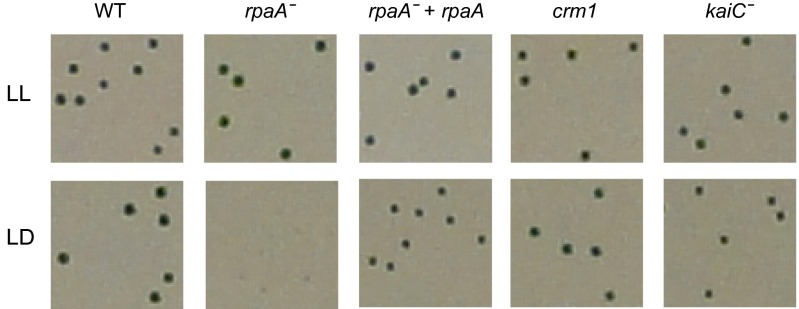
Phenotypes of crm1 mutants differ from those of an rpaA mutant. Growth of crm1 strain is not impaired in an LD cycle. WT, crm1, kaiC, rpaA, and rpaA-complemented strains were plated for single colonies and maintained in either 100 μmol m-2s-1 LL (Upper) or a 12:12 LD cycle (Lower) over 4 d. The crm1 mutant does not exhibit the growth impairment of an rpaA strain under the LD regimen.
Fig. 3.
Fig. 3.
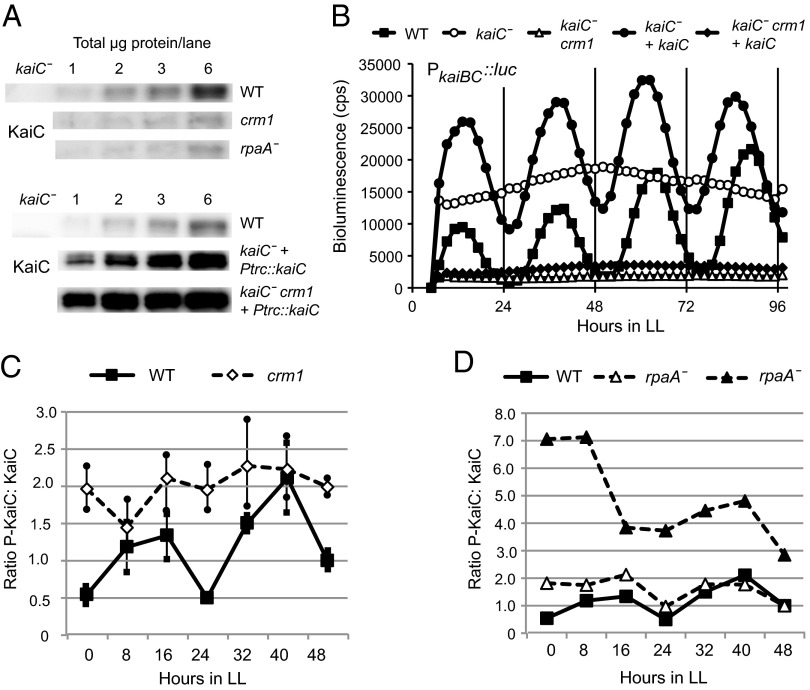
Quantitation of in vivo KaiC levels and phosphorylation rhythm in crm1 and rpaA deletion mutants. (A) (Upper) Immunoblots of whole-cell extracts of WT, crm1, kaiC, and rpaA strains (1, 2, 3, and 6 μg total protein/lane) sampled at 9 h after onset of light and probed with KaiC antiserum. Steady-state levels of KaiC were reduced by approximately two-thirds in both crm1 and rpaA mutants. (Lower) Immunoblots of whole-cell extracts of WT and strains expressing KaiC from uninduced trc promoter in kaiC and kaiC crm1 backgrounds. (B) Arrhythmic gene reporter expression in crm1 background is not due to low KaiC levels. Shown are representative bioluminescence traces of strains with KaiC expressed ectopically from a neutral site. Expression from kaiBC::luc reporter in a kaiC crm1 background remains low and arrhythmic with ectopically expressed KaiC, whereas ectopic KaiC expression restores rhythms in a kaiC deletion background. (C and D) Densitometric analysis of immunoblots of whole-cell extracts from strains entrained to a 12:12 LD regime and sampled every 8 h in LL for 48 h. (C) Densitometric analysis showing average ± SD values of two blots of crm1 and two WT samples. The crm1 strain is characterized by constitutively elevated KaiC phosphorylation and no discernible overall rhythm over 48 h. (D) KaiC phosphorylation is elevated in rpaA cells, but the rhythm of phosphorylation remains detectable. Quantitation of two separate blots of rpaA samples is shown compared with the WT trace shown in C.
Fig. 4.
Fig. 4.
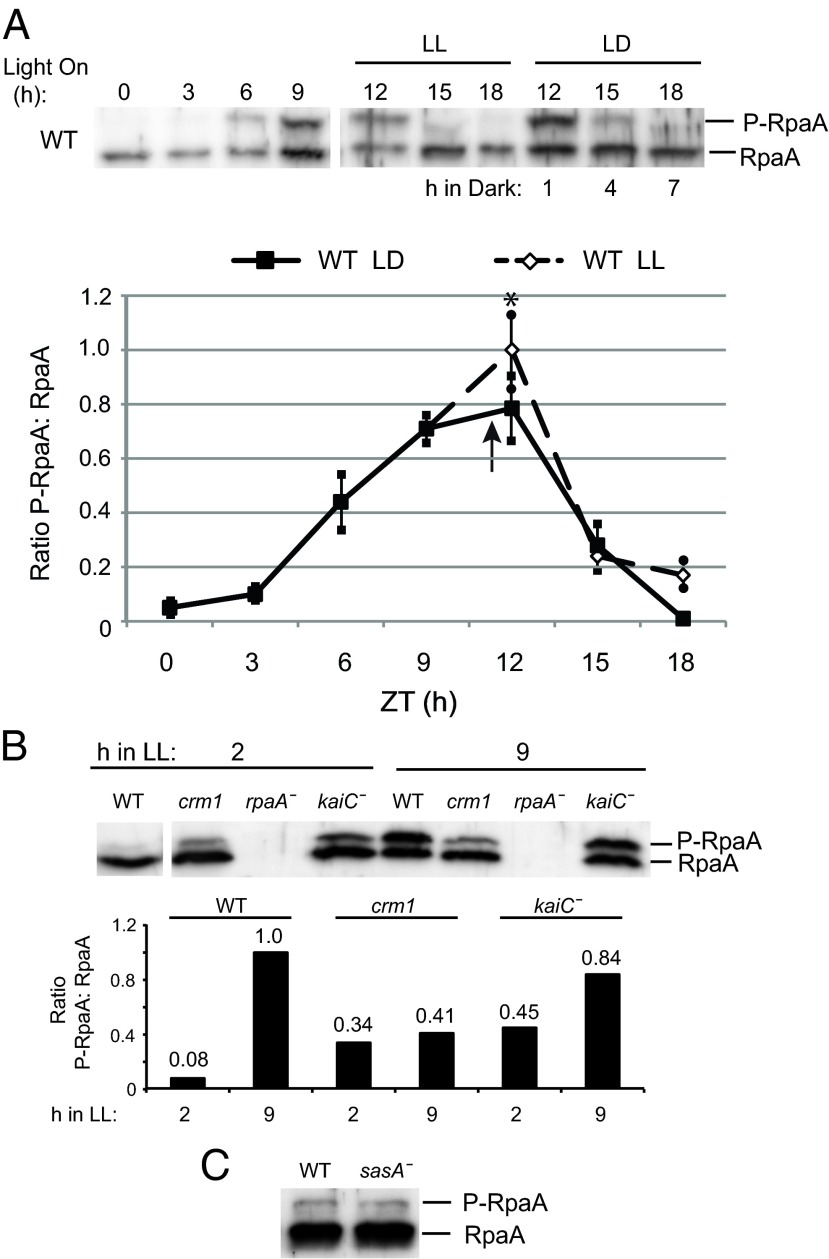
The in vivo RpaA phosphorylation cycle is minimally sensitive to a dark cue and is perturbed in arrhythmic strains. (A) Time points from representative immunoblots (Upper) and densitometric analysis showing average ± SD values from multiple immunoblots (Lower) demonstrating overall levels of RpaA phosphorylation in WT cells entrained to a 12:12 LD cycle and sampled every 3 h over 18 h. Samples were either maintained in LL or collected after entering dark at 11 h after onset of light. The overall RpaA phosphorylation level in LD is significantly lower after 1 h in dark compared with the 12-h LL sample, but the overall phosphorylation cycle remains substantially the same under both LL and LD conditions. The arrow indicates onset of darkness (at ZT = 11 h) for LD samples. (B) Representative immunoblot (Upper) and quantification (Lower) of the P-RpaA:RpaA ratio of whole-cell extracts (10 μg total protein/lane) sampled at 2 h and 9 h after onset of light after entrainment to a 12:12 LD cycle and probed with RpaA antiserum. A high proportion of RpaA is phosphorylated in the WT strain at 9 h after entering light, whereas the majority of RpaA appears nonphosphorylated at 2 h. The P-RpaA:RpaA ratio does not change substantially in crm1 cells sampled at 2 h compared with 9 h. In a kaiC deletion strain, P-RpaA:RpaA remains at intermediate levels compared with WT at both time points. (C) Immunoblot of nonentrained WT and sasA deletion strain probed with RpaA antiserum. P-RpaA is detectable in the absence of SasA in vivo.

References

    1. Mackey SR, Golden SS, Ditty JL. The itty-bitty time machine: Genetics of the cyanobacterial circadian clock. Adv Genet. 2011;74:13–53. - PMC - PubMed
    1. Ishiura M, et al. Expression of a gene cluster kaiABC as a circadian feedback process in cyanobacteria. Science. 1998;281(5382):1519–1523. - PubMed
    1. Nishiwaki T, et al. Role of KaiC phosphorylation in the circadian clock system of Synechococcus elongatus PCC 7942. Proc Natl Acad Sci USA. 2004;101(38):13927–13932. - PMC - PubMed
    1. Terauchi K, et al. ATPase activity of KaiC determines the basic timing for circadian clock of cyanobacteria. Proc Natl Acad Sci USA. 2007;104(41):16377–16381. - PMC - PubMed
    1. Liu Y, Golden SS, Kondo T, Ishiura M, Johnson CH. Bacterial luciferase as a reporter of circadian gene expression in cyanobacteria. J Bacteriol. 1995;177(8):2080–2086. - PMC - PubMed

Publication types

MeSH terms

LinkOut - more resources