. 2013 Aug 20;110(34):E3179-88.
doi: 10.1073/pnas.1217812110. Epub 2013 Aug 5.

Conditionals by inversion provide a universal method for the generation of conditional alleles

Affiliations

Conditionals by inversion provide a universal method for the generation of conditional alleles

Aris N Economides et al. Proc Natl Acad Sci U S A. .

Abstract

Conditional mutagenesis is becoming a method of choice for studying gene function, but constructing conditional alleles is often laborious, limited by target gene structure, and at times, prone to incomplete conditional ablation. To address these issues, we developed a technology termed conditionals by inversion (COIN). Before activation, COINs contain an inverted module (COIN module) that lies inertly within the antisense strand of a resident gene. When inverted into the sense strand by a site-specific recombinase, the COIN module causes termination of the target gene's transcription and simultaneously provides a reporter for tracking this event. COIN modules can be inserted into natural introns (intronic COINs) or directly into coding exons as part of an artificial intron (exonic COINs), greatly simplifying allele design and increasing flexibility over previous conditional KO approaches. Detailed analysis of over 20 COIN alleles establishes the reliability of the method and its broad applicability to any gene, regardless of exon-intron structure. Our extensive testing provides rules that help ensure success of this approach and also explains why other currently available conditional approaches often fail to function optimally. Finally, the ability to split exons using the COIN's artificial intron opens up engineering modalities for the generation of multifunctional alleles.

Keywords: conditional-null; genome engineering.


Conflict of interest statement

All authors of this manuscript are employed by Regeneron Pharmaceuticals, Inc., and some of the authors own a substantial amount of Regeneron stock.

Figures
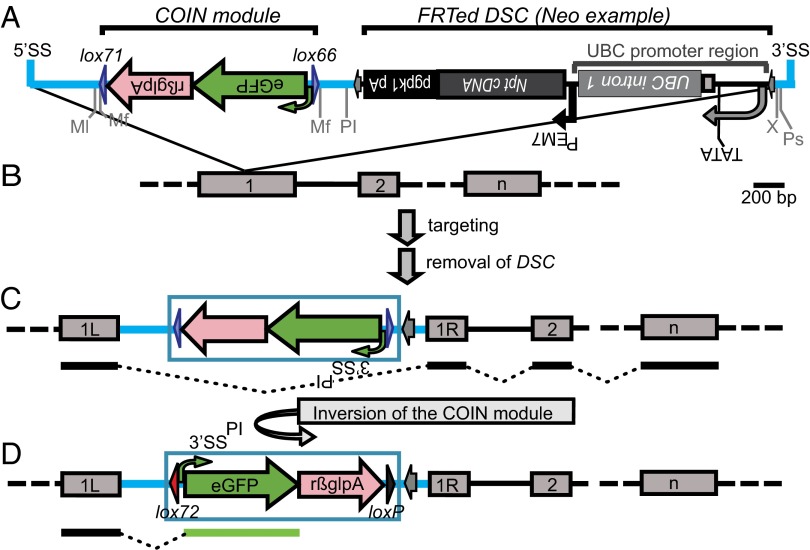
Fig. 1.
Fig. 1.
Design of COIN alleles. (A) Detailed schematic of the COIN intron (version eGFP, phase 0; neo). The COIN module was inserted into the MfeI site (Mf) of HBB2 intron 2, and it is comprised of a 3′SSPI-eGFP-rßglpA flanked by lox71 and lox66 in a mirror image configuration to enable inversion of 3′SSPI-eGFP-rßglpA; 3′SSPI is the 3′ splice region of HBB2 intron 2 (SI Appendix, Fig. S14). Postinversion (PI) indicates that this 3′SS participates in trapping the message of the COIN allele after inversion of the COIN module. rßglpA is mainly the 3′UTR region of HBB2 (SI Appendix, Fig. S15). FRTed DSC is an FRT-flanked drug selection minigene [e.g., PUBC-driven neomycin phosphotransferase (Npt)] (SI Appendix, Fig. S16); FTR sites are indicated as gray arrows. The 5′ splice site (5′SS) and 3′ splice site (3′SS) of rßgl i2 mark the boundaries of the COIN intron (blue line). Restriction sites are shown below the sequence line. Ml, MluI; Ps, PspOMI; X, XmaI. All elements are drawn to scale. (Scale bar: 200 bp.) (B) A hypothetical gene comprised of n number of exons is rendered conditional-null by insertion of the COIN intron (elements not drawn to scale) into exon 1, (C) splitting exon 1 into a left exon (1L) and a right exon (1R). After BHR, targeting, and removal of the DSC, the resulting exCOIN allele encodes a WT transcript, because the COIN module is in the antisense strand and therefore, stealth to transcription. (D) Inversion of the COIN module results in a null allele encoding for a transcript that incorporates exon 1L and eGFP. In addition, Cre-mediated inversion of the COIN module through lox71 and lox66 gives rise to a double mutant lox site, lox72 (red arrowhead), and loxP (black arrowhead). The COIN module is framed by a blue box in C and D to facilitate visualization of the region being inverted.
Fig. 2.
Fig. 2.
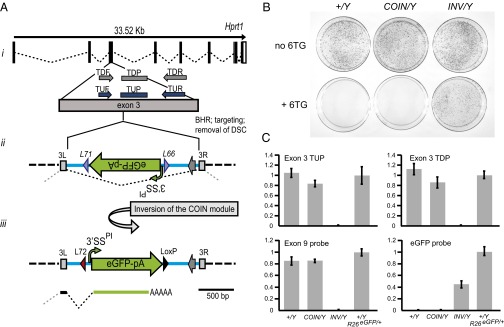
Hprt1ex3COIN validates COIN approach in ES cells. (A) Engineering of Hprt1ex3COIN. (i) Schematic of Hprt1ex3COIN allele. The exon–intron region of Hprt1 adapted from Ensembl.org. Exon 3 (ENSMUSE00000491684) is highlighted together with the loss-of-allele (LOA) probes (TUP, TDP) and primers (TUF, TUR; TDF, TDR). The same probes and primers are used for RT-PCR to quantitate Hprt1 mRNA levels. (ii) The COIN intron was placed after the 85th nucleotide of exon 3 (SI Appendix, Fig. S2), splitting exon 3 into exons 3L and 3R. (iii) Before inversion, the Hprt1ex3COIN allele generates a normal message as the COIN intron is spliced out. (iv) After inversion, the COIN module becomes the terminal exon of the modified gene (Hprt1ex3COIN-INV), abrogating transcription of the downstream exons and resulting in a functional null allele. Exons 3L and 3R of Hprt1ex3COIN allele are shown as light gray boxes. Blue line denotes the COIN intron sequence. L66, lox66; L71, lox71; L72, lox72. lox and FRT sites are not drawn to scale. (Scale bar: iiiv, 500 bp.) (B) Hprt1ex3COIN-INV/Y cells are Hprt1-null. ES cells were cultured in either the absence (Upper) or presence (Lower) of 10 µM 6-TG for 10 d, and then, they were fixed and stained with Giemsa. Hprt1+/Y and Hprt1ex3COIN/Y cells die on treatment with 6-TG, whereas Hprt1ex3COIN-INV/Y cells survive. (C) Insertion of the COIN element does not alter the expression level of Hprt1 before inversion but ablates it after inversion. Quantitative RT-PCR analysis of Hprt1 and eGFP-encoding mRNA from Hprt1+/Y (+/Y), Hprt1ex3COIN/Y (COIN/Y), Hprt1ex3COIN-INV/Y (INV/Y), and Hprt1+/Y; Gt(ROSA)26SoreGFP/+ (+/Y; R26eGFP/+) ES cells. (Upper Left) Level of Hprt1 mRNA relative to Hprt1+/Y; Gt(ROSA)26SoreGFP/+ detected using probe TUP. (Upper Right) Level of Hprt1 mRNA relative to Hprt1+/Y; Gt(ROSA)26SoreGFP/+ detected using probe TDP. (Lower Left) Level of Hprt1 mRNA relative to Hprt1+/Y; Gt(ROSA)26SoreGFP/+ detected using a probe that detects exon 9 of Hprt1. (Lower Right) Level of eGFP-encoding mRNAs relative to Hprt1+/Y; Gt(ROSA)26SoreGFP/+ detected using a probe for eGFP.
Fig. 3.
Fig. 3.
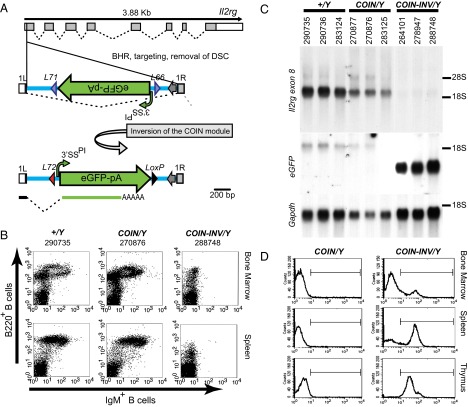
Il2rgex1COIN-INV provides in vivo validation of COIN and shows the functionality of the reporter. (A) Schematic of Il2rgex1COIN allele. The exon–intron region of Il2rg (isoform Il2rg-001, CCDS30312) is shown as adapted from Ensembl.org. The COIN intron was placed after the 90th nucleotide of exon 1 (SI Appendix, Fig. S3), splitting exon 1 into exons 1L and 1R. Before inversion, the Il2rgex1COIN allele generates a normal message as the COIN intron is spliced out. After inversion, the COIN module becomes the terminal exon of the modified gene, abrogating expression of the downstream exons and resulting in a functional null allele incorporating eGFP. Naming conventions, abbreviations, and markings are as noted in Fig. 2. (Scale bar: 200 bp.) (B) IgM+, B220+ B-cell population is largely absent in bone marrow and spleen cells of Il2rgex1COIN-INV/Y (288748) but unaffected in Il2rgex1COIN/Y (270876) compared with Il2rg+/Y (290735) mice. Numbers denote mouse identity. (C) Insertion of the COIN element does not alter the expression level of Il2rg before inversion but ablates it after inversion. Northern analysis of RNA isolated from spleens of Il2rg+/Y (290736, 290735, and 283124), Il2rgex1COIN/Y (270877, 270876, and 283125), and Il2rgex1COIN-INV/Y (278947, 288748, and 283126) mice. Probes are (Top) Il2rg, (Middle) eGFP, and (Bottom) Gapdh. The positions of 18S and 28S rRNAs are marked. Numbers denote the identification of each mouse belonging to each genotypic class; the same mice were analyzed phenotypically (B) (SI Appendix, Fig. S4). (D) Bone Marrow, thymic, and splenic lymphocyte populations from Il2rgex1COIN-INV/Y mice express eGFP. eGFP expression is absent from Il2rgex1COIN/Y lymphocyte populations.
Fig. 4.
Fig. 4.
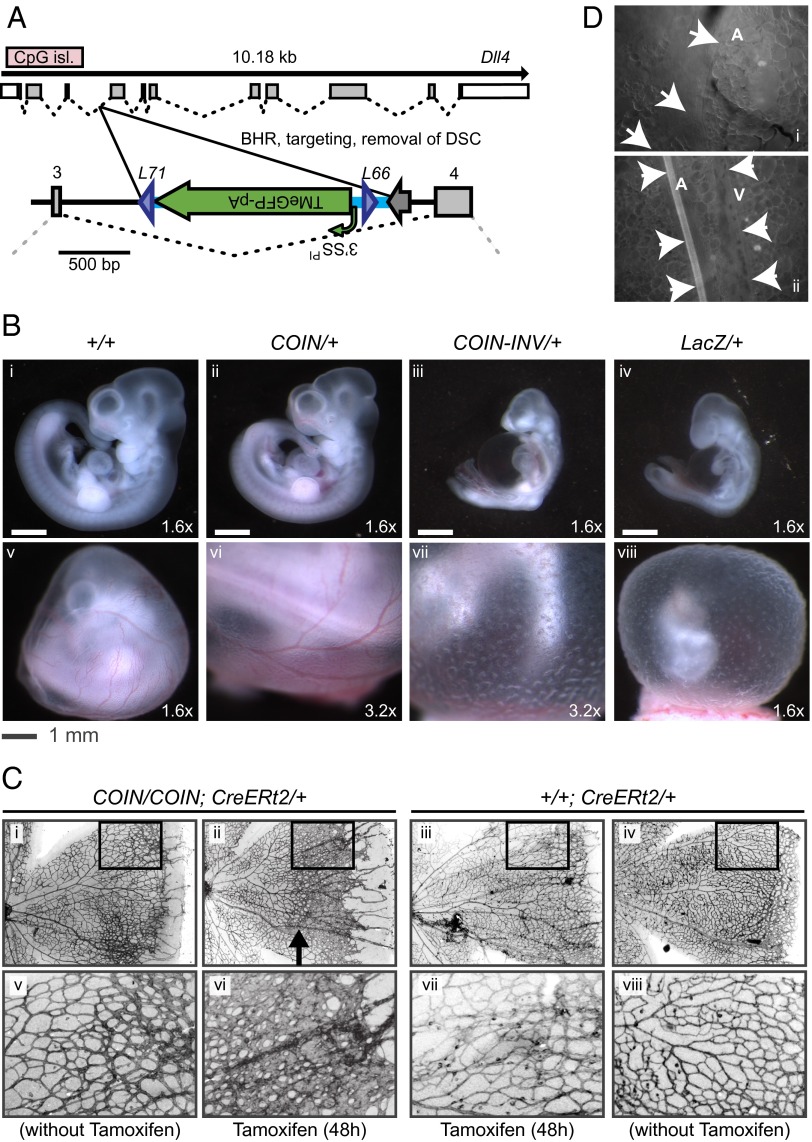
Dll4i3COIN provides a stringent test for engineering COIN alleles that are WT before inversion. (A) Schematic of Dll4i3COIN allele. The exon–intron region of Dll4 was adapted from Ensembl.org. The COIN module was inserted into intron 3. Before inversion, the Dll4i3COIN allele generates a normal message as the COIN intron is spliced out. For brevity, the Dll4i3COIN-INV allele is not depicted schematically; however, as depicted in Fig. 1, after inversion, the COIN module becomes the terminal exon of the modified gene, abrogating expression of the downstream exons and resulting in a functional null allele incorporating TMeGFP. The Dll4i3T2ACOIN allele is identical to the Dll4i3COIN allele, except for the incorporation of a T2A peptide leading into the marker (TMT2AeGFP). Naming conventions, abbreviations, and markings for different elements are as noted in Fig. 2. (Scale bar: 500 bp.) (B) The Dll4i3COIN-INV allele corresponds to a null allele. Embryos from a Dll4i3COIN × Nanog-Cre cross were collected at E10.5, visualized by light microscopy, genotyped, and compared with Dll4LacZ/+ E10.5 embryos. Embryos and yolk sacs with genotypes (i and v) Dll4+/+; LocXNanog-Cre/+ (+/+); (ii and vi) Dll4i3COIN/+ (COIN/+); (iii and vii) Dll4i3COIN-INV/+LocXNanog-Cre/+ (COIN-INV/+); and (iv and vii) Dll4LacZ/+ (LacZ/+) are shown. Dll4i3COIN-INV/+ embryos phenocopy Dll4LacZ/+ embryos. (C) Inversion of the COIN module in Dll4i3COIN mice at postnatal day 5 (P5) results in abrogated maturation of the retinal vasculature. P5 mice were treated with tamoxifen to activate CreERt2 or vehicle; 48 h later, retinas were collected, and their vasculatures were visualized. Neither (i and v) the COIN allele in homozygosis [Dll4i3COIN/i3COIN; Gt(ROSA)26SOR+/+, denoted as COIN/COIN; CreERt2/+] nor (iii and vii) the activation of CreERt2 by tamoxifen (+/+; CreERt2/+) has any impact on retinal angiogenesis and (iv and viii) phenocopy of DII4+/+; Gt(ROSA)26SORCreERt2/+. (ii and vi) Activation of CreERt2 in Dll4i3COIN/i3COIN; Gt(ROSA)26SORCreERt2/+ results in abrogated maturation of the retinal vasculature. Treatment with tamoxifen is indicated. (D) Inclusion of T2A in Dll4i3T2ACOIN restores function of the reporter (TMT2AeGFP). Fluorescence photomicrographs of skin from Dll4i3T2ACOIN/+; Gt(ROSA)26SORCreERt2/+ mice (i) before and (ii) after treatment with tamoxifen. Note the expression of eGFP in the arteries (A) but not veins (V) only in ii.
Fig. 5.
Fig. 5.
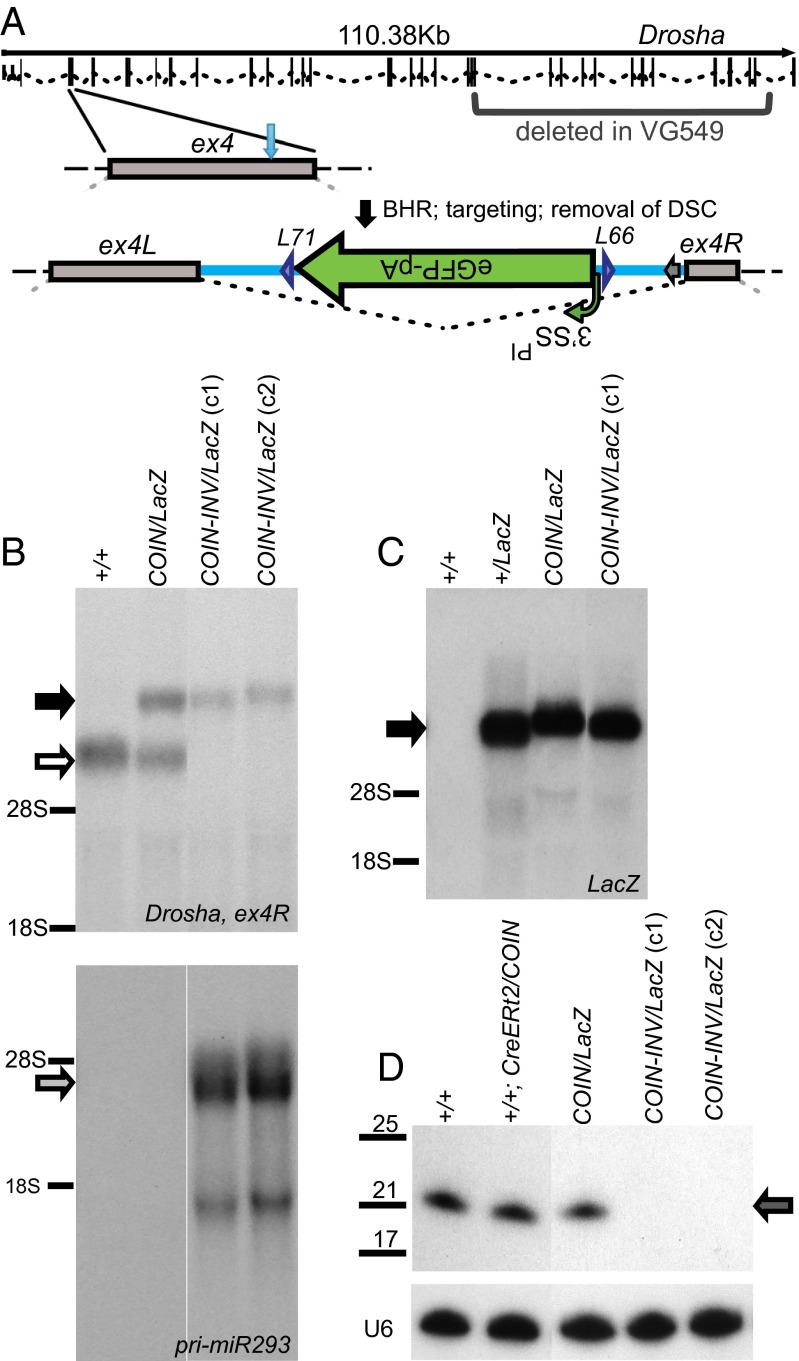
The exonic COIN of Drosha is a postinversion functional null. (A) Schematic of Droshaex4COIN allele. The exon–intron region of Drosha (splice variant 001, transcript ID ENSMUST00000090292) was adapted from Ensembl.org. Light blue vertical arrow indicates the point of insertion of the COIN intron within exon 4 (SI Appendix, Fig. S5). Before inversion, Droshaex4COIN generates a normal message as the COIN intron is spliced out. For brevity, Droshaex4COIN-INV is not depicted schematically; however, as shown in Fig. 1, after inversion, the COIN module becomes the terminal exon of the modified gene, abrogating expression of the downstream exons and resulting in a functional null allele incorporating eGFP. The region replaced in the DroshaLacZ allele VG549 is marked by brackets. Naming conventions, abbreviations, and markings for different elements are as noted in Fig. 2. (Scale bar: 100 bp.) (BD) Inversion of the COIN module results in abrogation of expression of Drosha and microRNA maturation and concomitant accumulation of pri-miRs. Northern analysis of Drosha using exon 4 (ENSMUSE00000563117) as a probe reveals lack of Drosha mRNA (B, Upper, white arrow) in Droshaex4COIN-INV/LacZ ES cells and the presence of a hybrid/fusion message encoding exons 1–21 of Drosha plus LacZ (B, Upper, black arrow), which is also detected with a LacZ probe (C, black arrow). Loss of Drosha expression results in accumulation of pri-miR293 (B, Lower, gray arrow) and loss of the mature miR-293 (D, Upper, gray arrow) in Droshaex4COIN-INV/LacZ ES cells. Maturation of the miR is not affected by induction of Cre activity or expression of eGFP (D, lane 2). The positions of 18S and 28S rRNAs (B and C) as well as the positions of U6, miR-293, and a small RNA ladder (D) are marked. Genotype key: +/+, Drosha+/+; +/LacZ, Drosha+/LacZ; CreERt2/COIN-INV, Drosha+/+; Gt(ROSA)26SorCreERt2/COIN-INV; COIN-INV/LacZ, Droshaex4COIN-INV/LacZ; Gt(ROSA)26SorCreERt2/+, +/+; COIN/LacZ, Droshaex4COIN/LacZ. c1 and c2 denote clones 1 and 2 of Droshaex4COIN-INV/LacZ; Gt(ROSA)26SorCreERt2/+ derived from treatment with tamoxifen.
Fig. 6.
Fig. 6.
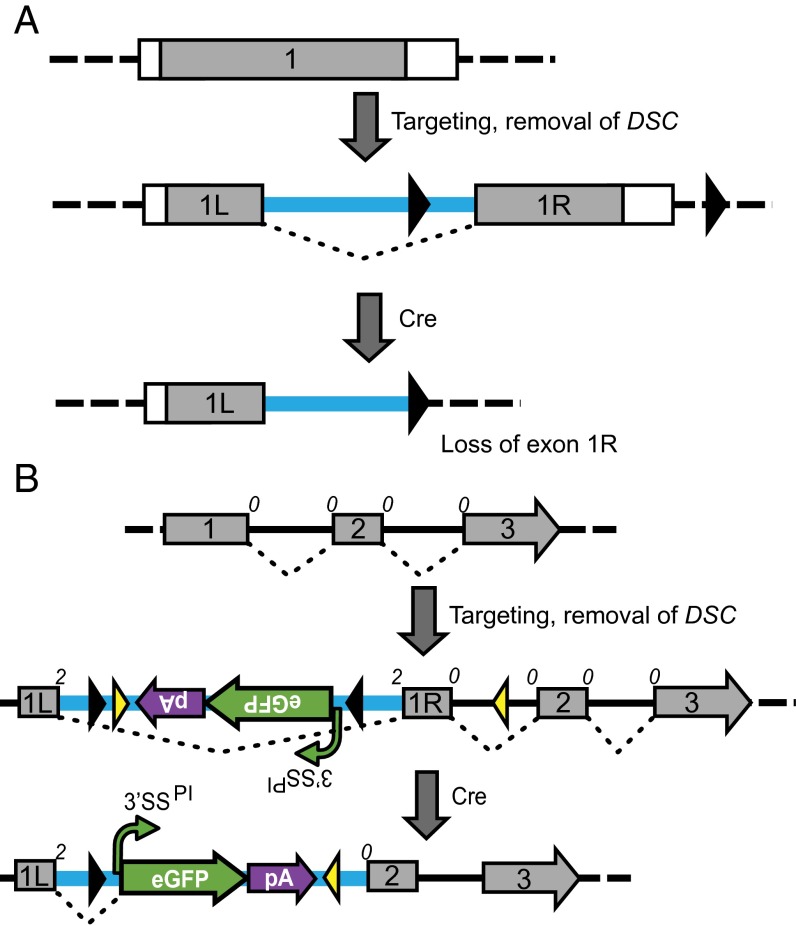
COIN methodology enables unique engineering modalities. (A) Exon splitting enables floxing of single exon genes as well as genes lacking critical exons. A hypothetical protein-coding gene comprised of a single exon (1) is depicted. This exon is split into exons 1L and 1R using an intron that contains an loxP site. Another loxP site is placed downstream of exon 1R in a parallel configuration, rendering exon 1R amenable to deletion by Cre. Black triangles denote loxP sites, protein-coding sequence is denoted by gray color, and splicing is denoted by dotted black lines. All other elements are as described in Fig. 1. (B) Converting a noncritical exon to critical using a FlEx–COIN hybrid design. A hypothetical protein-coding gene comprised of three exons is depicted, where the exons are in the same phase (phase 0). Exons are shown as gray boxes, splicing is denoted by dotted black lines, the starting and end phases of each exon are denoted by numbers above the corresponding spot on each exon, and black and yellow triangles denote loxP and lox2372 sites, respectively. Exon 1 is rendered critical (3) by splitting it using the COIN intron in a manner such that exon 1L ends in phase 2. Recombination by Cre results in inversion of the COIN module and simultaneous deletion of exon 1R. (A version where exon 1R is preserved is shown in SI Appendix, Fig. S18.) Consequently, exons 1L and 2 are out of phase; thus, even if the COIN module is spliced out, the resulting mRNA will encode for a truncated, nonfunctional protein.

References

    1. Branda CS, Dymecki SM. Talking about a revolution: The impact of site-specific recombinases on genetic analyses in mice. Dev Cell. 2004;6(1):7–28. - PubMed
    1. Voehringer D, Wu D, Liang HE, Locksley RM. Efficient generation of long-distance conditional alleles using recombineering and a dual selection strategy in replicate plates. BMC Biotechnol. 2009;9:69. - PMC - PubMed
    1. Testa G, et al. A reliable lacZ expression reporter cassette for multipurpose, knockout-first alleles. Genesis. 2004;38(3):151–158. - PubMed
    1. Schnütgen F, et al. Genomewide production of multipurpose alleles for the functional analysis of the mouse genome. Proc Natl Acad Sci USA. 2005;102(20):7221–7226. - PMC - PubMed
    1. Schnütgen F, et al. A directional strategy for monitoring Cre-mediated recombination at the cellular level in the mouse. Nat Biotechnol. 2003;21(5):562–565. - PubMed

MeSH terms

Substances