. 2013 Aug 20;110(34):13904-9.
doi: 10.1073/pnas.1308335110. Epub 2013 Aug 5.

Efficient multiplex biallelic zebrafish genome editing using a CRISPR nuclease system

Affiliations

Efficient multiplex biallelic zebrafish genome editing using a CRISPR nuclease system

Li-En Jao et al. Proc Natl Acad Sci U S A. .

Abstract

A simple and robust method for targeted mutagenesis in zebrafish has long been sought. Previous methods generate monoallelic mutations in the germ line of F0 animals, usually delaying homozygosity for the mutation to the F2 generation. Generation of robust biallelic mutations in the F0 would allow for phenotypic analysis directly in injected animals. Recently the type II prokaryotic clustered regularly interspaced short palindromic repeats (CRISPR)/CRISPR-associated proteins (Cas) system has been adapted to serve as a targeted genome mutagenesis tool. Here we report an improved CRISPR/Cas system in zebrafish with custom guide RNAs and a zebrafish codon-optimized Cas9 protein that efficiently targeted a reporter transgene Tg(-5.1mnx1:egfp) and four endogenous loci (tyr, golden, mitfa, and ddx19). Mutagenesis rates reached 75-99%, indicating that most cells contained biallelic mutations. Recessive null-like phenotypes were observed in four of the five targeting cases, supporting high rates of biallelic gene disruption. We also observed efficient germ-line transmission of the Cas9-induced mutations. Finally, five genomic loci can be targeted simultaneously, resulting in multiple loss-of-function phenotypes in the same injected fish. This CRISPR/Cas9 system represents a highly effective and scalable gene knockout method in zebrafish and has the potential for applications in other model organisms.

Keywords: RNA-guided mutagenesis; genome engineering; pigmentation.


Conflict of interest statement

The authors declare no conflict of interest.

Figures
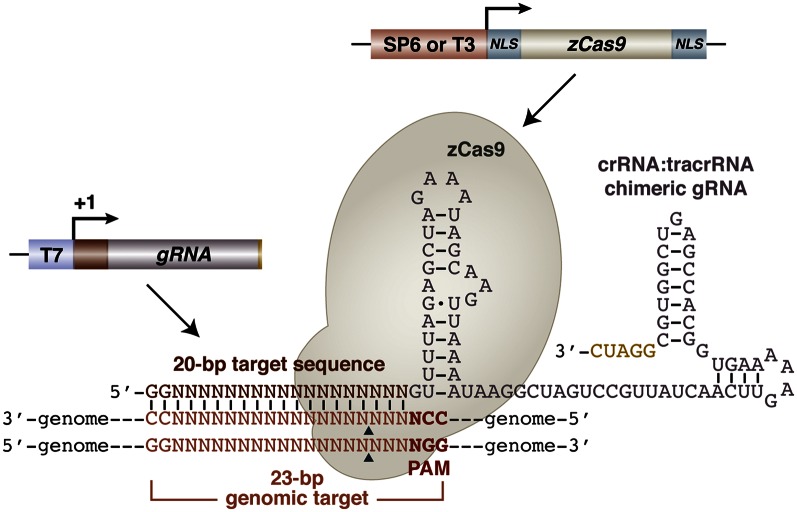
Fig. 1.
Fig. 1.
Genome editing in zebrafish using a CRISPR/Cas9 system. The system consists of two components, a dual NLS-tagged zebrafish codon-optimized Cas9 protein and a single crRNA:tracrRNA chimeric gRNA, comprising a 20-bp target sequence (dark red) complementary to the genomic target adjacent to a PAM site of NGG. Both components are first generated as RNAs by in vitro transcription from the SP6 or T3 (for Cas9) or T7 (for gRNA) promoter. The mix of gRNA and Cas9 RNA was then injected into one-cell–stage embryos to induce RNA-guided targeted DNA double-stranded breaks mediated by the Cas9 enzyme. Arrowheads denote putative cleavage sites.
Fig. 2.
Fig. 2.
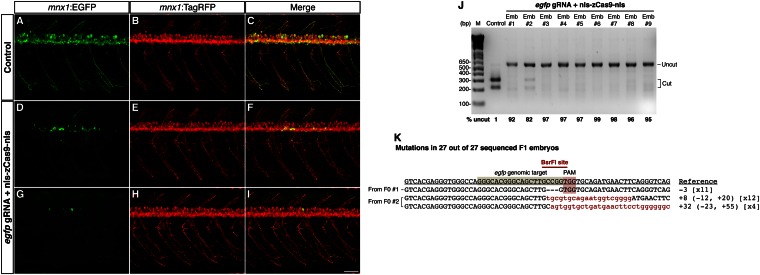
Efficient disruption of the Tg(-5.1mnx1:EGFP) transgene by Cas9 results in mosaic EGFP expression in the motoneurons. egfp gRNA (6 or 30 pg) and nls-zCas9-nls RNA (150 pg) were injected into Tg(-5.1mnx1:EGFP)/Tg(-5.1mnx1:TagRFP) double transgenic embryos. The control embryos were injected with nls-zCas9-nls RNA and a gRNA lacking the egfp target sequence. (AI) Confocal images of spinal motoneurons of live zebrafish embryos at 3 dpf. In contrast to the uniform motoneuron EGFP expression pattern in the control (A), egfp-targeted embryos showed mosaic EGFP expression in the motoneurons (D and G). However, the motoneurons of the egfp-targeted embryos developed normally as indicated by the uniform TagRFP labeling (E and H). (J) BsrFI digestion showed high mutagenesis rates at the egfp target site (82–99%) in nine randomly selected egfp-targeted embryos. (K) Sequences of egfp mutations in 27 F1 embryos from two egfp-targeted Tg(-5.1mnx1:EGFP)-positive founders. The wild-type reference sequence is underlined with the target site and PAM highlighted in gray and red, respectively. Note that all 27 F1 siblings had egfp mutations with the BsrFI site (marked by a red line) disrupted. Deletions and insertions are indicated by dashes and lowercase red letters, respectively. The net change of each indel mutation is noted at the Right of each sequence (+, insertion; –, deletion). The number of times a mutant allele was identified is indicated in brackets. (Scale bar: 50 µm.)
Fig. 3.
Fig. 3.
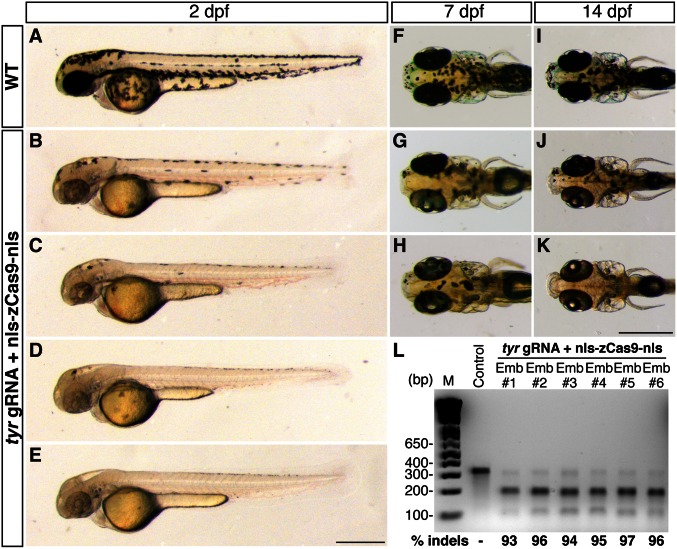
Biallelic disruption of tyrosinase (tyr) by Cas9 generates mosaic pigmentation phenotypes. tyr gRNA (30 pg) and nls-zCas9-nls RNA (150 pg) were injected into wild-type embryos. (AE) Lateral views of wild-type (A) and tyr-targeted embryos (BE) at 2 dpf. tyr-targeted embryos showed different degrees of hypopigmentation, some of them were almost unpigmented (e.g., E). (FK) Dorsal view of the wild-type (F and I) and tyr-targeted larvae (G, H, J, and K) at 7 dpf (FH) and 14 dpf (IK). Mosaic pigmentation defects in tyr-targeted larvae persisted to later stages. (L) T7EI assays showed high mutagenesis rates at the tyr target (93–97%) in six randomly selected tyr-targeted embryos. (Scale bars: 500 µm.)
Fig. 4.
Fig. 4.
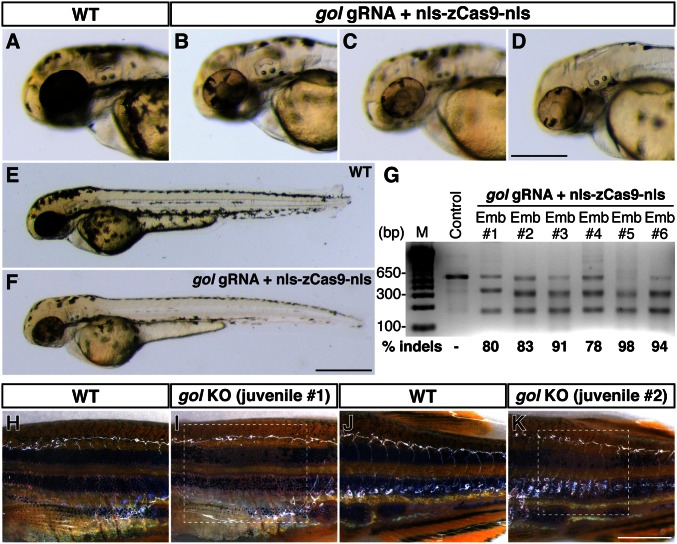
Biallelic disruption of golden (gol) by Cas9 generates mosaic pigmentation phenotypes. gol gRNA (50 pg) and nls-zCas9-nls RNA (150 pg) were injected into wild-type embryos. (AF) Lateral views of wild-type (A and E) and gol-targeted embryos (BD and F) at 2 dpf. Whereas the wild-type embryo showed darkly pigmented retinal pigment epithelium (RPE), gol-targeted embryos had patches of unpigmented cells in RPE (BD). The skin melanophores in gol-targeted embryos were also hypopigmented (F). (G) T7EI assays showed high mutagenesis rates at the gol target (80–98%) in six randomly selected gol-targeted embryos. (HK) Lateral views of wild-type (H and J) and gol-targeted (I and K) juvenile fish at 54 dpf. gol-targeted fish had patches of pale melanophores (dashed boxes) among the dark skin stripes. (Scale bars: in D, 300 µm; in F, 500 µm; in K, 2 mm.)
Fig. 5.
Fig. 5.
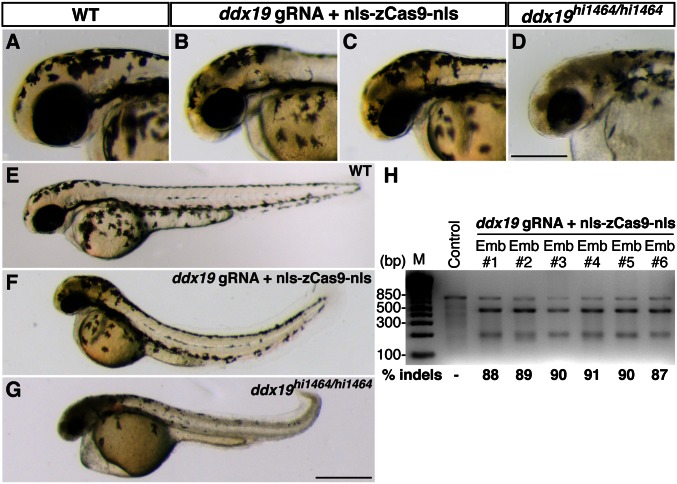
Biallelic disruption of ddx19 by Cas9 generates null-like phenotypes. ddx19 gRNA (150 pg) and nls-zCas9-nls RNA (150 pg) were injected into wild-type embryos. (AG) Lateral views of the wild-type (A and E), ddx19-targeted (B, C, and F), and homozygous ddx19 mutants (ddx19hi1464/hi1464 ) (D and G) embryos. ddx19-targeted embryos recapitulated several ddx19 null phenotypes (e.g., brain necrosis, small eyes, and curved body axis), albeit to a lesser extent. (H) T7EI assays showed high mutagenesis rates at the ddx19 target (87–91%) in six randomly selected ddx19-targeted embryos. (Scale bars: in D, 300 µm; in G, 500 µm.)
Fig. 6.
Fig. 6.
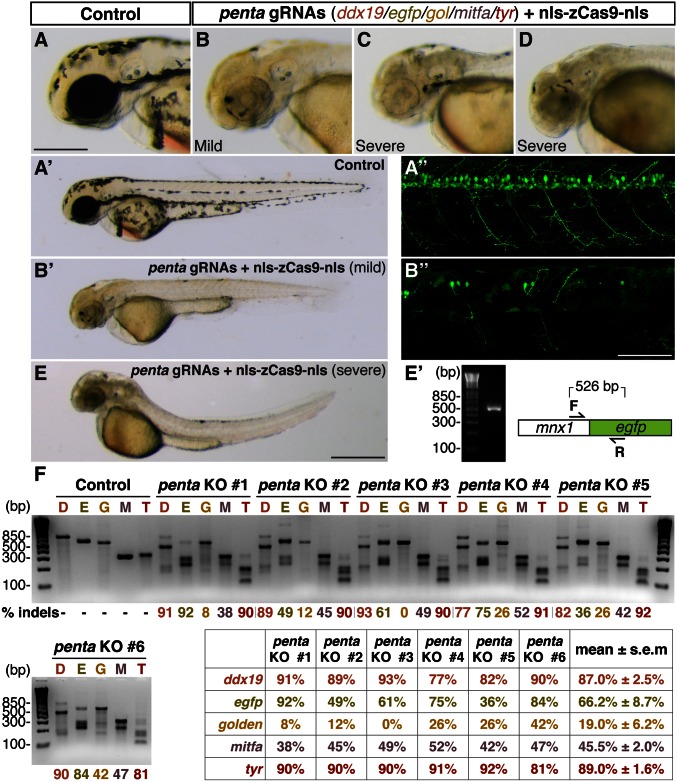
Multiplex genome editing in zebrafish by Cas9. A mix of five gRNAs (penta gRNAs: ddx19 gRNA, 55 pg; egfp gRNA, 15 pg; gol gRNA, 25 pg; mitfa gRNA, 60 pg; and tyr gRNA, 25 pg) were coinjected with nls-zCas9-nls RNA (150 pg) into Tg(-5.1mnx1:egfp) transgenic embryos. (AE) Lateral views of the wild-type (AA′′) and the penta gRNAs/nls-zCas9-nls RNA-injected (BB′′ and CE) embryos. The combination of three distinct phenotypes—brain necrosis/small eyes/curved body axis, hypopigmentation, and loss of EGFP expression in the motoneurons—caused by biallelic inactivations of multiple target genes simultaneously were observed in the same embryos (BB′′ and E and E′). Some quintuple knockout embryos showed no EGFP-positive motoneurons due to the almost nonmosaic disruption of the Tg(-5.1mnx1:egfp) transgene, whose presence was confirmed by PCR (E′). (F) T7EI assays showed high mutagenesis rates at five genomic targets in six randomly selected quintuple knockout embryos (penta KO 1–6: D, ddx19; E, egfp; G, gol; M, mitfa; T, tyr). (Scale bars: in A, 300 µm; in B′′, 50 µm; in E, 500 µm.)

References

    1. Joung JK, Sander JD. TALENs: A widely applicable technology for targeted genome editing. Nat Rev Mol Cell Biol. 2013;14(1):49–55. - PMC - PubMed
    1. Urnov FD, et al. Highly efficient endogenous human gene correction using designed zinc-finger nucleases. Nature. 2005;435(7042):646–651. - PubMed
    1. Jinek M, et al. A programmable dual-RNA-guided DNA endonuclease in adaptive bacterial immunity. Science. 2012;337(6096):816–821. - PMC - PubMed
    1. Bhaya D, Davison M, Barrangou R. CRISPR-Cas systems in bacteria and archaea: Versatile small RNAs for adaptive defense and regulation. Annu Rev Genet. 2011;45:273–297. - PubMed
    1. Terns MP, Terns RM. CRISPR-based adaptive immune systems. Curr Opin Microbiol. 2011;14(3):321–327. - PMC - PubMed

Publication types

Substances