Risk assessment of postoperative nausea and vomiting in the intravenous patient-controlled analgesia environment: predictive values of the Apfel's simplified risk score for identification of high-risk patients
- PMID: 23918581
- PMCID: PMC3743191
- DOI: 10.3349/ymj.2013.54.5.1273
Risk assessment of postoperative nausea and vomiting in the intravenous patient-controlled analgesia environment: predictive values of the Apfel's simplified risk score for identification of high-risk patients
Abstract
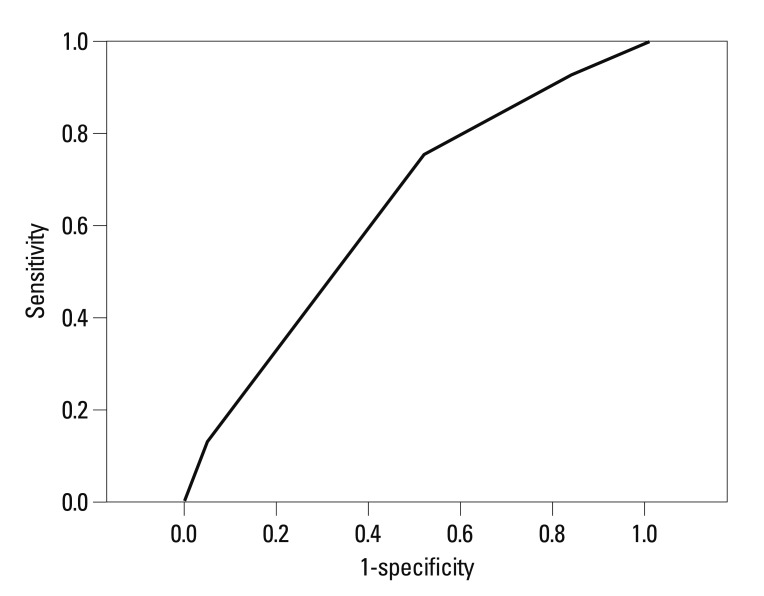
Purpose: Opioid-based intravenous patient-controlled analgesia (IV PCA) is popular method of postoperative pain control, but many patients suffer from IV PCA-related postoperative nausea and vomiting (PONV). In this retrospective observational study, we have determined independent predictors of IV PCA-related PONV and predictive values of the Apfel's simplified risk score in pursuance of identifying high-risk patients.
Materials and methods: We analyzed 7000 patients who received IV PCA with background infusion after elective surgery. Patients who maintained IV PCA for a postoperative period of 48 hr (completion group, n=6128) were compared with those who have discontinued IV PCA within 48 hr of surgery due to intractable PONV (cessation group, n=872). Patients, anesthetics, and surgical factors known for predicting PONV were evaluated by logistic regression analysis to identify independent predictors of IV PCA related intractable PONV.
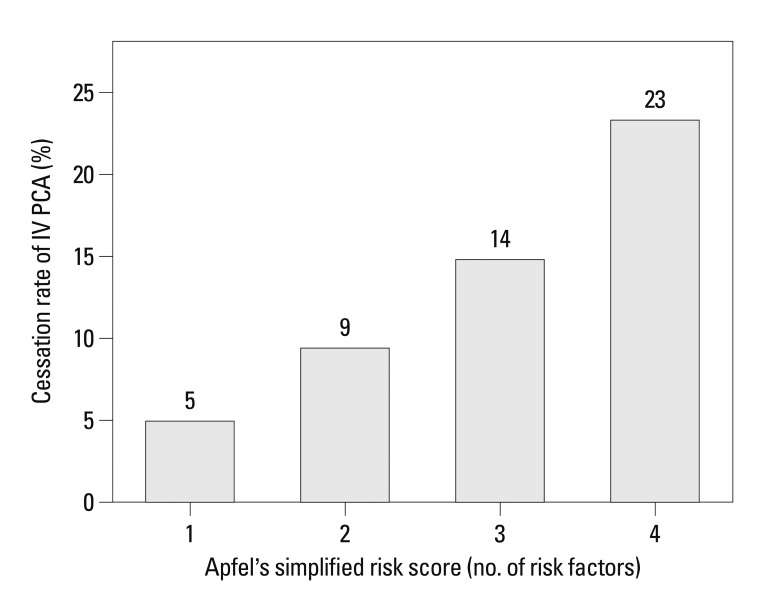
Results: In a stepwise multivariate analysis, weight, background infusion dose of fentanyl, addition of ketolorac to PCA, duration of anesthesia, general anesthesia, head and neck surgery, and Apfel's simplified risk score were revealed as independent risk factors for intractable PONV followed by the cessation of IV PCA. In addition, Apfel's simplified risk score, which demonstrated the highest odds ratio among the predictors, was strongly correlated with the cessation rate of IV PCA.
Conclusion: Multimodal prophylactic antiemetic strategies and dose reduction of opioids may be considered as strategies for the prevention of PONV with the use of IV PCA, especially in patients with high Apfel's simplified risk scores.
Keywords: Apfel’s simplified risk score; patient-controlled analgesia; postoperative nausea and vomiting.
Conflict of interest statement
The authors have no financial conflicts of interest.
Figures


References
-
- Macintyre PE. Safety and efficacy of patient-controlled analgesia. Br J Anaesth. 2001;87:36–46. - PubMed
-
- Ballantyne JC, Carr DB, Chalmers TC, Dear KB, Angelillo IF, Mosteller F. Postoperative patient-controlled analgesia: meta-analyses of initial randomized control trials. J Clin Anesth. 1993;5:182–193. - PubMed
-
- Yen CR, Tsou MY, Mandell MS, Chan CT, Chan KH, Chen TH, et al. An analysis of patient variables that influence intravenous patient-controlled analgesic use of morphine with quantile regression. Anesthesiology. 2010;112:688–695. - PubMed
-
- Song JW, Park EY, Lee JG, Park YS, Kang BC, Shim YH. The effect of combining dexamethasone with ondansetron for nausea and vomiting associated with fentanyl-based intravenous patient-controlled analgesia. Anaesthesia. 2011;66:263–267. - PubMed
-
- Ishikawa Y, Imashuku Y, Kitagawa H, Kawamoto S, Yuasa M, Nosaka S. [Evaluation of the side effects of intravenous patient controlled analgesia after spine surgery] Masui. 2011;60:920–923. - PubMed
MeSH terms
Substances
LinkOut - more resources
Full Text Sources
Other Literature Sources