. 2013 Dec 20;22(25):5136-45.
doi: 10.1093/hmg/ddt367. Epub 2013 Aug 4.

Non-exomic and synonymous variants in ABCA4 are an important cause of Stargardt disease

Affiliations

Non-exomic and synonymous variants in ABCA4 are an important cause of Stargardt disease

Terry A Braun et al. Hum Mol Genet. .

Abstract

Mutations in ABCA4 cause Stargardt disease and other blinding autosomal recessive retinal disorders. However, sequencing of the complete coding sequence in patients with clinical features of Stargardt disease sometimes fails to detect one or both mutations. For example, among 208 individuals with clear clinical evidence of ABCA4 disease ascertained at a single institution, 28 had only one disease-causing allele identified in the exons and splice junctions of the primary retinal transcript of the gene. Haplotype analysis of these 28 probands revealed 3 haplotypes shared among ten families, suggesting that 18 of the 28 missing alleles were rare enough to be present only once in the cohort. We hypothesized that mutations near rare alternate splice junctions in ABCA4 might cause disease by increasing the probability of mis-splicing at these sites. Next-generation sequencing of RNA extracted from human donor eyes revealed more than a dozen alternate exons that are occasionally incorporated into the ABCA4 transcript in normal human retina. We sequenced the genomic DNA containing 15 of these minor exons in the 28 one-allele subjects and observed five instances of two different variations in the splice signals of exon 36.1 that were not present in normal individuals (P < 10(-6)). Analysis of RNA obtained from the keratinocytes of patients with these mutations revealed the predicted alternate transcript. This study illustrates the utility of RNA sequence analysis of human donor tissue and patient-derived cell lines to identify mutations that would be undetectable by exome sequencing.


Figures
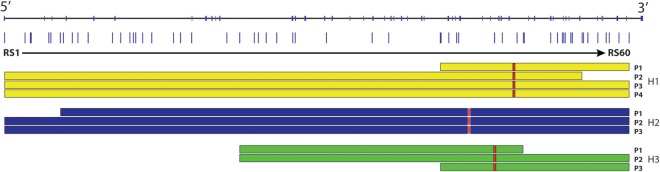
Figure 1.
Figure 1.
ABCA4 haplotype analysis. The positions of the 60-tagged SNPs used for the haplotype analysis are shown as small vertical lines beneath the schematic diagram of the genomic structure of the ABCA4 gene. The SNP numbers correspond to those in Supplementary Material, Table S1. The 5′ end of the gene is to the left. The contiguous SNPs shared by subjects with haplotypes H1, H2 and H3 are shown as horizontal bars.
Figure 2.
Figure 2.
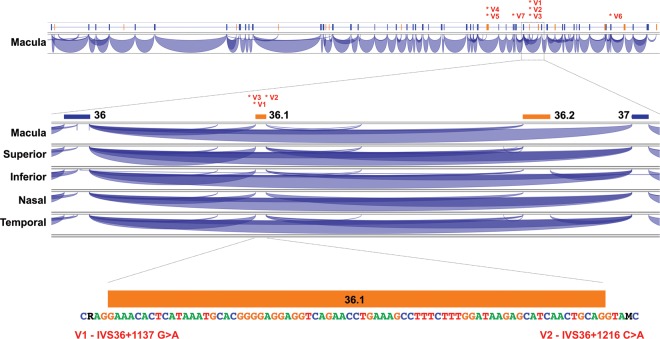
RNA sequence analysis from normal human retina. Top: The genomic organization of ABCA4 is shown schematically with canonical exons in blue and the 15 most abundant alternate exons in pink. The 5′ end of the gene is to the left. RNA sequencing data supporting a specific splice junction is shown as a purple arc linking two exons. For 1 to 50 sequencing reads, the thickness of each arc is proportional to the number of reads supporting the given splice junction. Junctions supported by more than 50 reads are all shown at equal height. The positions of disease-causing variants V1–V7 are indicated with labeled asterisks. Middle: The portion of the splice junction map spanning canonical exons 36 and 37 is shown for samples obtained from five different regions of the retina (macula, superior, inferior, nasal and temporal). Two alternate exons, 36.1 and 36.2, each have sequence support for their splice acceptor and splice donor junctions in at least two of these retinal regions. Bottom: The sequence of alternate exon 36.1 and its flanking nucleotides is shown. Variant V1 (G>A, represented as R in the sequence) is 3 nucleotides upstream of the splice acceptor site, and variant V2 (C>A, represented as M in the sequence) is 4 nucleotides downstream of the splice donor site. Both variants increase the similarity of the splice junction sequence to a canonical splice sequence (Table 2).
Figure 3.
Figure 3.
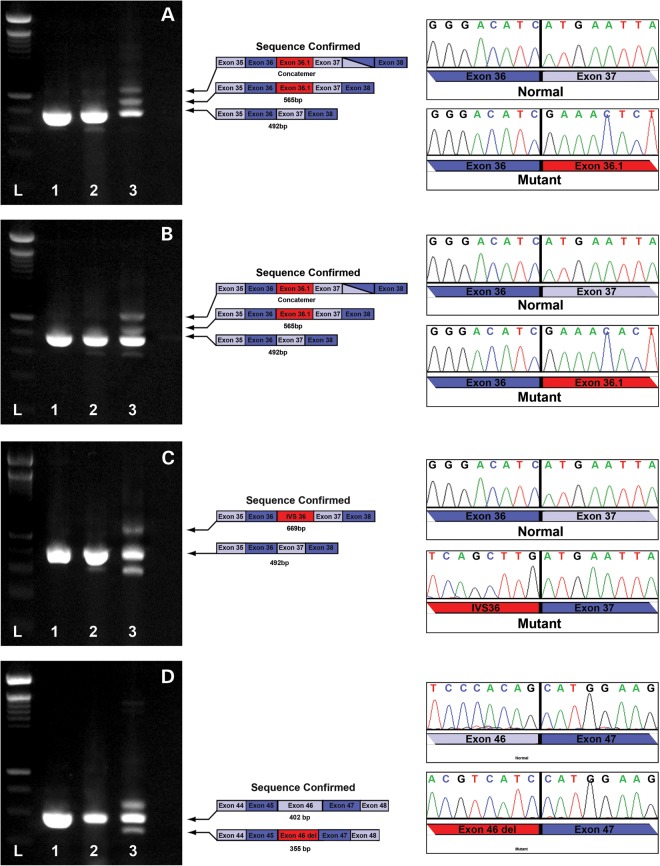
Functional confirmation of ABCA4 variants in patient-derived cell lines. RT-PCR analysis of ABCA4 in RNA extracted from human control retina (lane 1), human keratinocytes isolated from an unaffected individual (lane 2) and human keratinocytes isolated from a patient with ABCA4 associated retinal degeneration (lane 3). Two intronic splice site mutations (V1, A; and V2, B) in IVS 36 of the ABCA4 gene result in the introduction of an alternate exon (36.1, Fig. 2). An intronic splice site mutation within IVS 36 results in the introduction of a 177 bp segment of IVS 36 (V3, C). A synonymous codon change (Val2114Val) in exon 46 creates a premature donor splice site that results in deletion of the last 47 bases of exon 46 from the transcript (V6, D).
Figure 4.
Figure 4.
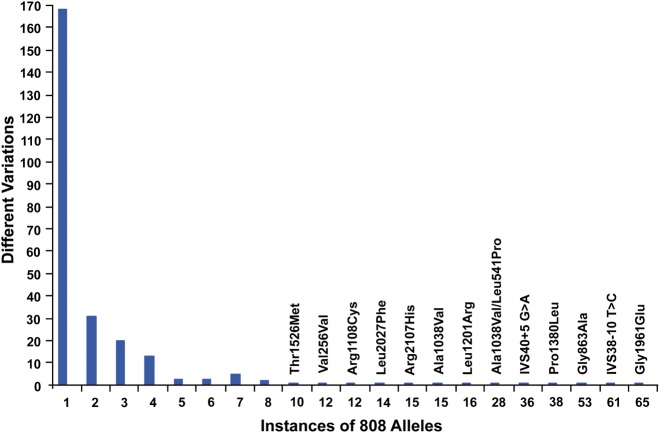
Allelic diversity of ABCA4. This figure shows the number of different disease-causing ABCA4 variants (y-axis) that occur at each frequency (x-axis) in a population of 404 patients with clinical features of ABCA4 disease ascertained by one of the authors. Variants seen eight or more times in the cohort are specifically labeled. Of the 258 different plausible disease-causing variants seen in this cohort, 168 (65%) were observed only once.

References

    1. Schindler E.I., Nylen E.L., Ko A.C., Affatigato L.M., Heggen A.C., Wang K., Sheffield V.C., Stone E.M. Deducing the pathogenic contribution of recessive ABCA4 alleles in an outbred population. Hum. Mol. Genet. 2010;19:3693–3701. - PMC - PubMed
    1. Sheffield V.C., Stone E.M. Genomics and the eye. N. Engl. J. Med. 2011;364:1932–1942. - PubMed
    1. Weng J., Mata N.L., Azarian S.M., Tzekov R.T., Birch D.G., Travis G.H. Insights into the function of Rim protein in photoreceptors and etiology of Stargardt's disease from the phenotype in abcr knockout mice. Cell. 1999;98:13–23. - PubMed
    1. Quazi F., Lenevich S., Molday R.S. ABCA4 Is an N-retinylidene-phosphatidylethanolamine and phosphatidylethanolamine importer. Nat. Commun. 2012;3:925. - PMC - PubMed
    1. Kong J., Kim S.R., Binley K., Pata I., Doi K., Mannik J., Zernant-Rajang J., Kan O., Iqball S., Naylor S., et al. Correction of the disease phenotype in the mouse model of Stargardt disease by lentiviral gene therapy. Gene. Ther. 2008;15:1311–1320. - PMC - PubMed

Publication types

Substances