. 2013 Sep 1;191(5):2446-56.
doi: 10.4049/jimmunol.1300678. Epub 2013 Aug 5.

Divergent immunomodulating effects of probiotics on T cell responses to oral attenuated human rotavirus vaccine and virulent human rotavirus infection in a neonatal gnotobiotic piglet disease model

Affiliations

Divergent immunomodulating effects of probiotics on T cell responses to oral attenuated human rotavirus vaccine and virulent human rotavirus infection in a neonatal gnotobiotic piglet disease model

Kuldeep S Chattha et al. J Immunol. .

Abstract

Rotaviruses (RVs) are a leading cause of childhood diarrhea. Current oral vaccines are not effective in impoverished countries where the vaccine is needed most. Therefore, alternative affordable strategies are urgently needed. Probiotics can alleviate diarrhea in children and enhance specific systemic and mucosal Ab responses, but the T cell responses are undefined. In this study, we elucidated the T cell and cytokine responses to attenuated human RV (AttHRV) and virulent human RV (HRV) in gnotobiotic pigs colonized with probiotics (Lactobacillus rhamnosus strain GG [LGG] and Bifidobacterium lactis Bb12 [Bb12]), mimicking gut commensals in breastfed infants. Neonatal gnotobiotic pigs are the only animal model susceptible to HRV diarrhea. Probiotic colonized and nonvaccinated (Probiotic) pigs had lower diarrhea and reduced virus shedding postchallenge compared with noncolonized and nonvaccinated pigs (Control). Higher protection in the Probiotic group coincided with higher ileal T regulatory cells (Tregs) before and after challenge, and higher serum TGF-β and lower serum and biliary proinflammatory cytokines postchallenge. Probiotic colonization in vaccinated pigs enhanced innate serum IFN-α, splenic and circulatory IFN-γ-producing T cells, and serum Th1 cytokines, but reduced serum Th2 cytokines compared with noncolonized vaccinated pigs (Vac). Thus, LGG+Bb12 induced systemic Th1 immunostimulatory effects on oral AttHRV vaccine that coincided with lower diarrhea severity and reduced virus shedding postchallenge in Vac+Pro compared with Vac pigs. Previously unreported intestinal CD8 Tregs were induced in vaccinated groups postchallenge. Thus, probiotics LGG+Bb12 exert divergent immunomodulating effects, with enhanced Th1 responses to oral AttHRV vaccine, whereas inducing Treg responses to virulent HRV.


Figures
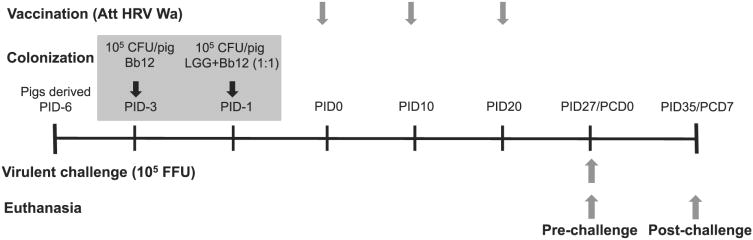
Figure 1
Figure 1
Schematic for experimental design showing time points for probiotic colonization, vaccination (AttHRV Wa), VirHRV Wa challenge, and euthanasia.
Figure 2
Figure 2
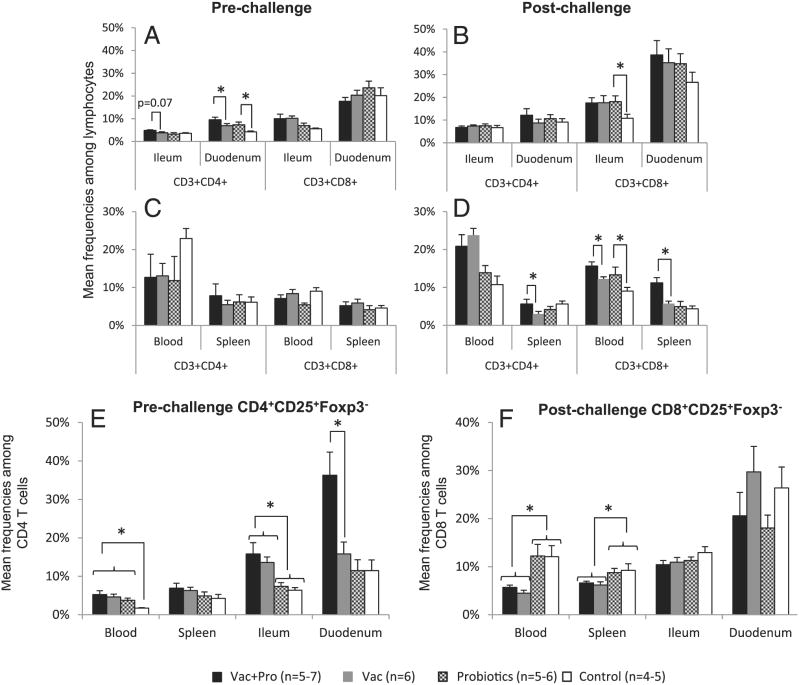
Probiotics colonization enhanced intestinal Th cells and activated CD4 T cells prechallenge and systemic cytotoxic T cells postchallenge in vaccinated pigs. Mean frequencies (n = 4–7/group prechallenge and postchallenge) of CD3+CD4+ and CD3+CD8+ T cells among the lymphocytes (± SEM) in blood, spleen, ileum, and duodenum prechallenge and postchallenge (AD). Mean frequencies of CD4+CD25+Foxp3 (prechallenge) (E) and CD8+ CD25+Foxp3 (postchallenge) (F) T cells among CD4+ and CD8+ T cells subsets (± SEM), respectively. Significant differences between groups are indicated by *p < 0.05, as determined by nonparametric Kruskal–Wallis rank sum test. Control, Nonvaccinated and noncolonized control; Probiotics, probiotic colonized only.
Figure 3
Figure 3
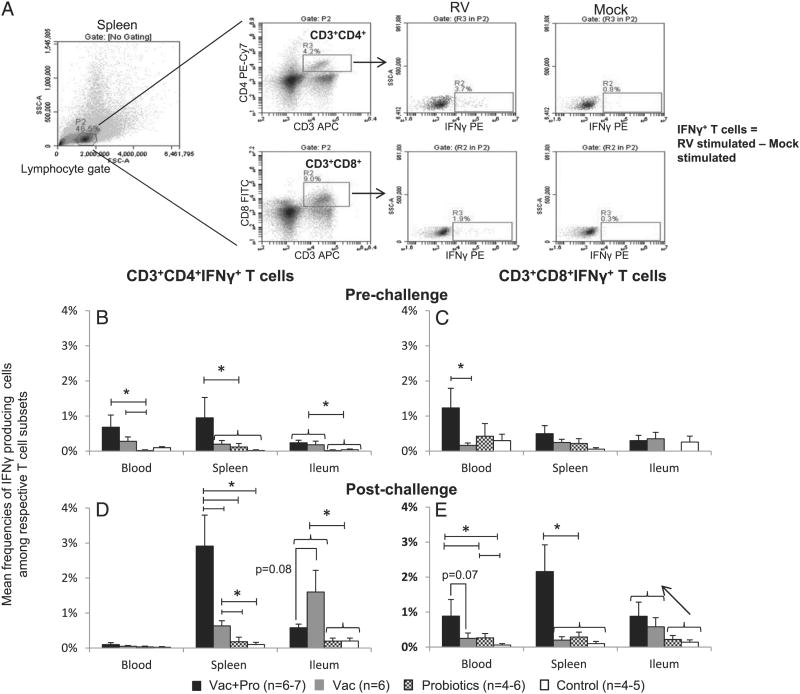
Probiotic colonization enhanced systemic IFN-γ−producing T cells pre- and post-VirHRV challenge in vaccinated pigs. Representative dot plot of frequencies of CD3+CD4+IFN-γ+ and CD3+CD8+IFN-γ+ T cells among respective T cell subsets in RV and mock-stimulated (18 h at 37°C) splenic MNCs from the Vac+Pro group (A). For each cell population and tissue sample, IFN-γ−producing cells from mocks were subtracted from HRV Ag-stimulated samples. Mean frequencies (n = 4–7/group prechallenge and postchallenge) of IFN-γ−producing T cells (± SEM) prechallenge (B, CD3+CD4+ IFN-γ+; C, CD3+CD8+IFN-γ+) and post-VirHRV challenge (D, CD3+CD4+IFN-γ+; E, CD3+CD8+IFN-γ+) in blood, spleen, and ileum. Significant differences between groups are indicated by *p < 0.05, as determined by nonparametric Kruskal–Wallis rank sum test. Arrow indicates numerical increase (not significant) in CD8 IFN-γ−producing T cells in vaccinated groups compared with controls postchallenge. Control, Nonvaccinated and noncolonized control; Probiotics, probiotic colonized only.
Figure 4
Figure 4
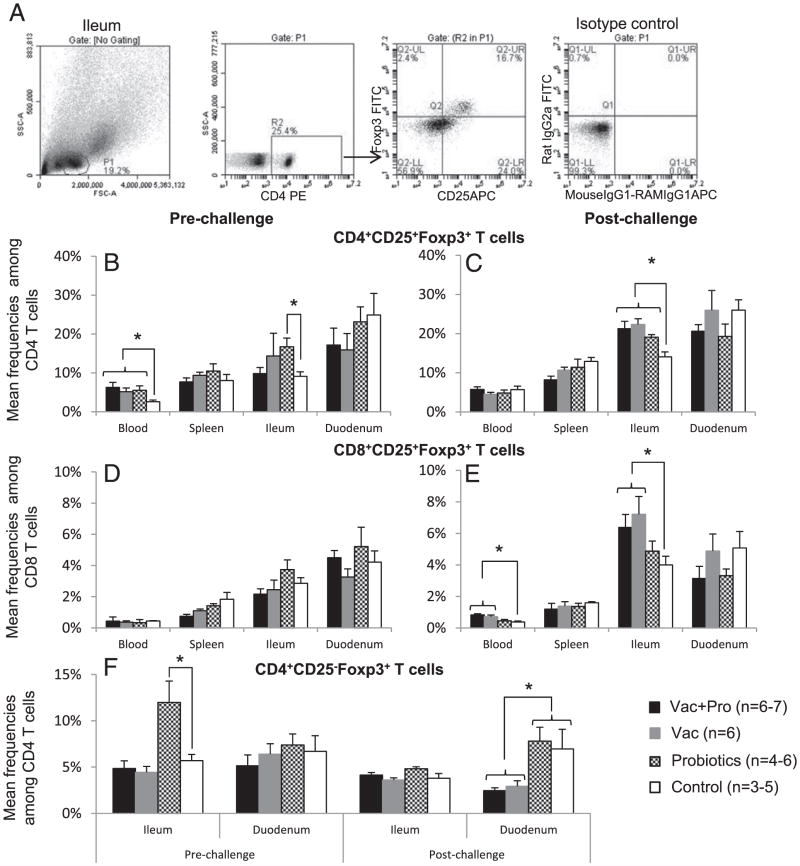
Probiotic colonization and/or vaccination increased ileal CD4+CD25+Foxp3+ Tregs post-VirHRV infection. Representative dot plot of frequencies of ileal CD4+CD25+Foxp3+ T cells among CD4 T cells from the Vac+Pro group (A). Mean frequencies (n = 4-7/group prechallenge and post-challenge) of CD4+CD25+Foxp3+ (B, prechallenge; C, postchallenge), CD8+CD25+Foxp3+ (D, prechallenge; E, postchallenge), and CD4+CD25Foxp3+ T cells (F, prechallenge and postchallenge) ± SEM in blood, spleen, ileum, and duodenum. Significant differences between groups are indicated with *p < 0.05, as determined by nonparametric Kruskal−Wallis rank sum test. Control, Nonvaccinated and noncolonized control; Probiotics, probiotic colonized only.
Figure 5
Figure 5
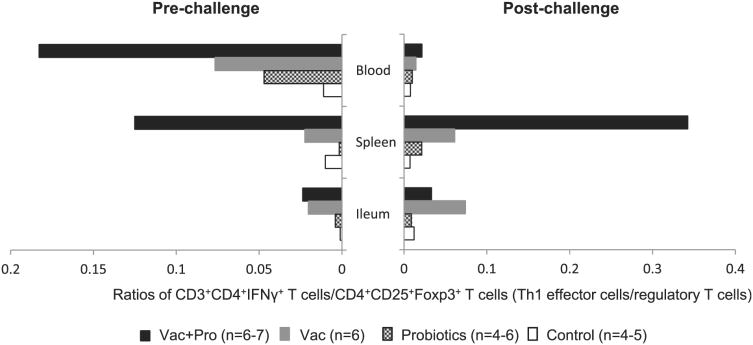
Probiotics colonized and vaccinated (Vac+Pro) pigs had higher ratios of systemic effector/Treg responses compared with vaccinated group (Vac). Mean ratios (n = 4–7/group prechallenge and postchallenge) of CD3+CD4+IFN-γ+ cells as subset of CD4 T cell (effector T cells) and CD4+CD25+Foxp3+ cells (Tregs) among CD4 T cells prechallenge and postchallenge in blood, spleen, and ileum for different treatment groups. Control, Nonvaccinated and noncolonized control; Probiotics, probiotic colonized only.
Figure 6
Figure 6
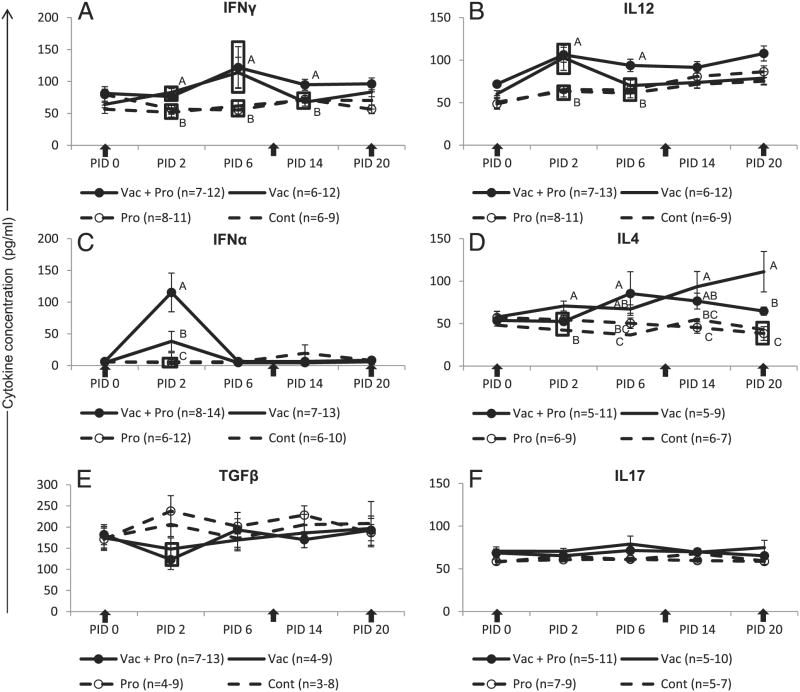
LGG+Bb12 enhanced innate and Th1 cytokines, and reduced Th2 cytokine responses in vaccinated pigs prechallenge. Mean concentrations (± SEM) of IFN-γ and IL-12 (both Th1), IFN-α (innate), IL-4 (Th2), TGF-β (Treg), and IL-17 (Th17) in serum of pigs from different groups (AF). Arrows indicate vaccine time points. Different alphabetical letters indicate significant differences (derived by nonparametric Kruskal–Wallis rank sum test, p < 0.05) at the same time point in cytokine concentrations among treatment groups. Cont, Nonvaccinated and noncolonized control; Pro, probiotic colonized only.
Figure 7
Figure 7
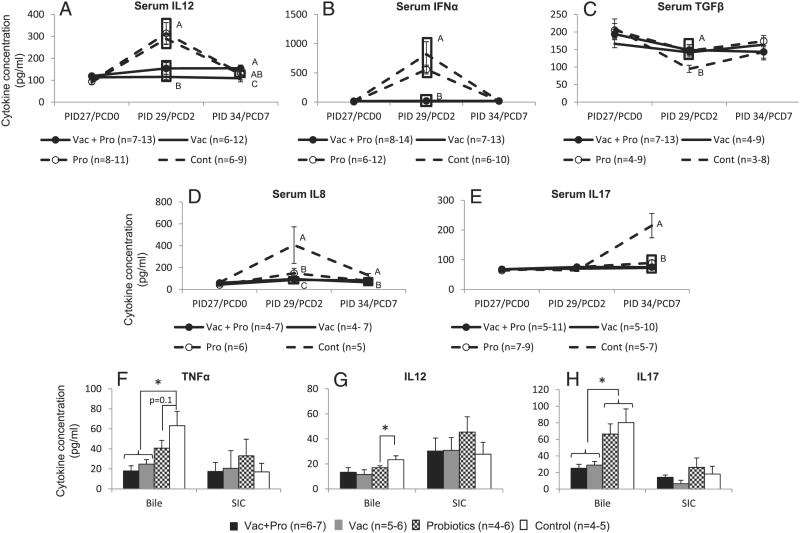
LGG+Bb12 colonization reduced proinflammatory and innate cytokines, and maintained regulatory cytokine responses post-VirHRV challenge in nonvaccinated pigs. Mean concentrations (± SEM) of IL-12 (Th1), IFN-α, and IL-8 (innate), TGF-β (Treg), and IL-17 (Th17) in serum of pigs from different groups (AE). Mean concentrations (± SEM) of TNF-α (proinflammatory), IL-12, and IL-17 in bile and small intestinal contents (SIC) of pigs from different groups (FH). Different alphabetical letters in (A)–(E) indicate significant differences (derived by nonparametric Kruskal–Wallis rank sum test, p < 0.05) at the same time point among treatment groups. The * in (F)–(H) indicate significant differences (derived by nonparametric Kruskal–Wallis rank sum test, p < 0.05) between treatment groups for bile and SIC. Cont, Nonvaccinated and noncolonized control; Pro, probiotic colonized only.

References

    1. Tate JE, Burton AH, Boschi-Pinto C, Steele AD, Duque J, Parashar UD. WHO-coordinated Global Rotavirus Surveillance Network. 2012. 2008 estimate of worldwide rotavirus-associated mortality in children younger than 5 years before the introduction of universal rotavirus vaccination programmes: a systematic review and meta-analysis. Lancet Infect Dis. 12:136–141. - PubMed
    1. Gray J. Rotavirus vaccines: safety, efficacy and public health impact. J Intern Med. 2011;270:206–214. - PubMed
    1. Licciardi PV, Tang ML. Vaccine adjuvant properties of probiotic bacteria. Discov Med. 2011;12:525–533. - PubMed
    1. Preidis GA, Hill C, Guerrant RL, Ramakrishna BS, Tannock GW, Versalovic J. Probiotics, enteric and diarrheal diseases, and global health. Gastroenterology. 2011;140:8–14. - PMC - PubMed
    1. Fanaro S, Chierici R, Guerrini P, Vigi V. Intestinal microflora in early infancy: composition and development. Acta Paediatr Suppl. 2003;91:48–55. - PubMed

Publication types

Substances