


Inflammatory bowel disease: An archetype disorder of outer environment sensor systems
- PMID: 23919214
- PMCID: PMC3729865
- DOI: 10.4292/wjgpt.v4.i3.41
Inflammatory bowel disease: An archetype disorder of outer environment sensor systems
Abstract
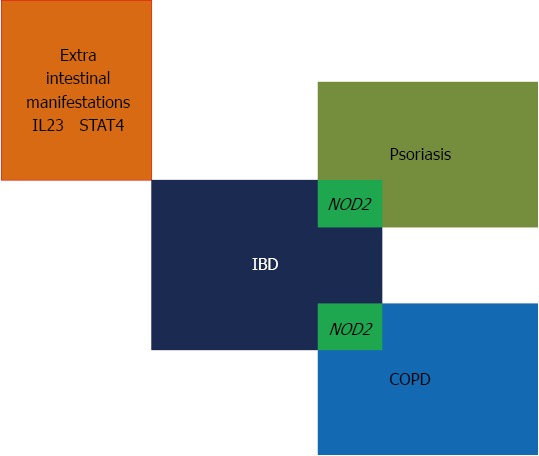
The pathogenesis of the two inflammatory bowel diseases (IBDs) phenotypes ulcerative colitis (UC) and Crohn's disease (CD) has remained elusive, thus frustrating attempts at defining a cure. IBD often presents as a complex inflammatory process wherein colon lesions (UC) or widespread ulceration and fissure (CD) might be accompanied by ancillary extra-intestinal manifestations involving the eye, skin, joints or liver, but also by full-blown "autoimmune" disorders from psoriasis and multiple sclerosis to rheumatoid arthritis; attempts at unraveling a link or a hierarchical order in these entities have proven almost fruitless. More recently, the input of genetics has suggested that the IBDs might be multi-organ inflammatory processes, elicited by a large number of low-penetrance susceptibility genes, with environmental factors needed to induce full-blown disease. At a noteworthy exception to this rule, the description of the nucleotide-oligomerization domain (NOD) gene mutations in CD came at the beginning of the 2000s: the NOD-LRR are part of a highly conserved microbial sensor system which respond to bacterial peptidoglycans by mounting an inflammatory response. At least in Caucasian patients, the prevalently loss-of-function mutation of NOD permitted to unexpectedly define CD as an immune deficiency state, and upon its recent description in apparently unrelated disorders such as the Blau syndrome (a granulomatous pediatric syndrome), and perhaps in psoriasis and chronic obstructive pulmonary disorders, has contributed to revolutionize our view of IBD and CD in particular. The latter affection, together with psoriasis and chronic pulmonary disease can now be included into a newly identified category named "barrier organ disease", wherein a barrier organ is defined as a large mucosal or epithelial surface with an abundant metagenomic microbial population and an underneath reactive tissue, the whole structure being in contact with the outer environment and capable to react to it. Personalized treatments and empowerment of research across different disease phenotypes should be the advantages of this novel mindset.
Keywords: Chronic pulmonary disease; Inflammatory bowel disease; Innate immunity; Nucleotide oligomerization domains; Psoriasis.
Figures
References
-
- Macpherson AJ, Geuking MB, McCoy KD. Innate and adaptive immunity in host-microbiota mutualism. Front Biosci (Schol Ed) 2012;4:685–698. - PubMed
-
- Gersemann M, Wehkamp J, Stange EF. Innate immune dysfunction in inflammatory bowel disease. J Intern Med. 2012;271:421–428. - PubMed
-
- Sachar DB, Walfish A. Inflammatory bowel disease: one or two diseases. Curr Gastroenterol Rep. 2013;15:298. - PubMed
-
- Cuthbert AP, Fisher SA, Mirza MM, King K, Hampe J, Croucher PJ, Mascheretti S, Sanderson J, Forbes A, Mansfield J, et al. The contribution of NOD2 gene mutations to the risk and site of disease in inflammatory bowel disease. Gastroenterology. 2002;122:867–874. - PubMed
LinkOut - more resources
Full Text Sources
Other Literature Sources
