Comparative Study
. 2013 Aug 7:13:113.
doi: 10.1186/1471-2229-13-113.

Novel candidate genes influencing natural variation in potato tuber cold sweetening identified by comparative proteomics and association mapping

Affiliations
Comparative Study

Novel candidate genes influencing natural variation in potato tuber cold sweetening identified by comparative proteomics and association mapping

Matthias Fischer et al. BMC Plant Biol. .

Abstract

Background: Higher plants evolved various strategies to adapt to chilling conditions. Among other transcriptional and metabolic responses to cold temperatures plants accumulate a range of solutes including sugars. The accumulation of the reducing sugars glucose and fructose in mature potato tubers during exposure to cold temperatures is referred to as cold induced sweetening (CIS). The molecular basis of CIS in potato tubers is of interest not only in basic research on plant adaptation to environmental stress but also in applied research, since high amounts of reducing sugars affect negatively the quality of processed food products such as potato chips. CIS-tolerance varies considerably among potato cultivars. Our objective was to identify by an unbiased approach genes and cellular processes influencing natural variation of tuber sugar content before and during cold storage in potato cultivars used in breeding programs. We compared by two-dimensional polyacrylamide gel electrophoresis the tuber proteomes of cultivars highly diverse for CIS. DNA polymorphisms in genomic sequences encoding differentially expressed proteins were tested for association with tuber starch content, starch yield and processing quality.

Results: Pronounced natural variation of CIS was detected in tubers of a population of 40 tetraploid potato cultivars. Significant differences in protein expression were detected between CIS-tolerant and CIS-sensitive cultivars before the onset as well as during cold storage. Identifiable differential proteins corresponded to protease inhibitors, patatins, heat shock proteins, lipoxygenase, phospholipase A1 and leucine aminopeptidase (Lap). Association mapping based on single nucleotide polymorphisms supported a role of Lap in the natural variation of the quantitative traits tuber starch and sugar content.

Conclusions: The combination of comparative proteomics and association genetics led to the discovery of novel candidate genes for influencing the natural variation of quantitative traits in potato tubers. One such gene was a leucine aminopeptidase not considered so far to play a role in starch sugar interconversion. Novel SNP's diagnostic for increased tuber starch content, starch yield and chip quality were identified, which are useful for selecting improved potato processing cultivars.


Figures
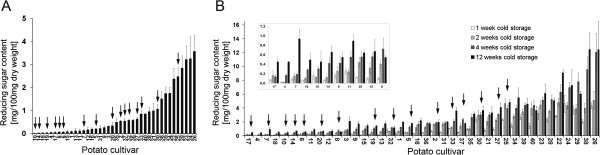
Figure 1
Figure 1
Reducing sugar content (RSC) in tubers of 40 cultivars during cold storage. RSC represents the amounts of glucose and fructose in freeze dried tuber tissue. Cultivars are coded by numbers shown in Additional file 1: Table S1. (A) RSC before cold storage. Cultivars are ranked according to increasing RSC. (B) RSC after 1, 2, 4 and 12 weeks of cold storage. Cultivars are ranked according to increasing RSC after 4 weeks of cold storage. The arrows indicate cultivars that contain at least one dosage of a leucine aminopeptidase allele, for which the SNP allele A2746 is characteristic. SNP2746 associated highly significant with tuber starch content, starch yield and chip quality after storage at 4°C (Table 3). The inset presents a magnification of the data obtained for cultivar 17 to cultivar 8.
Figure 2
Figure 2
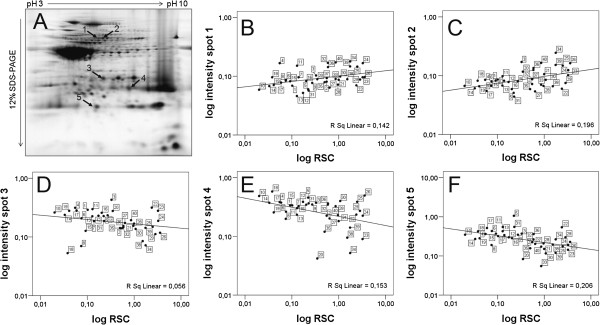
Correlation between mean protein spot intensity and reducing sugar content (RSC) in 40 cultivars without cold treatment. (A) Representative pattern of tuber proteins obtained by 2D-PAGE. Numbered arrows point to the five spots with significant correlation between mean spot intensity and RSC (Table 1). (B-F) Correlation plots of the logarithmic values of mean spot intensity versus RSC. Plots B, C, D, E and F correspond to spots 1, 2, 3, 4 and 5, respectively. Framed numbers indicate potato cultivars listed in Additional file 1: Table S1.
Figure 3
Figure 3
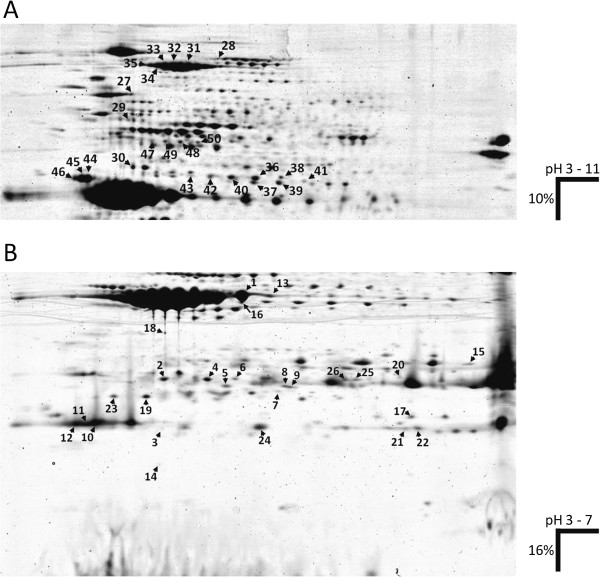
Protein spots showing differential expression between genotype pools CIS-t and CIS-s before and/or after cold treatment. A virtual tuber protein pattern was generated by fusing 2D-PAGE gel images from both genotype pools CIS-t and CIS-s at T0. Conditions for protein separation in the first and second dimension are shown on the right. The numbered arrow heads point to the position of the 50 differential proteins described in Table 2, Additional file 4: Table S4 and Additional file 5: Table S5. (A) Proteins from 40 to 200 kDa were separated on IPG strips with immobilized pH gradient of 3–11 in the first dimension (IEF) and by 10% Tris-glycine SDS-PAGE in the second dimension. (B) Proteins between 5 and 40 kDa were separated on pH 3–7 IPG strips in the first dimension and by 16% Tris-tricine polyacrylamide gels in the second dimension.
Figure 4
Figure 4
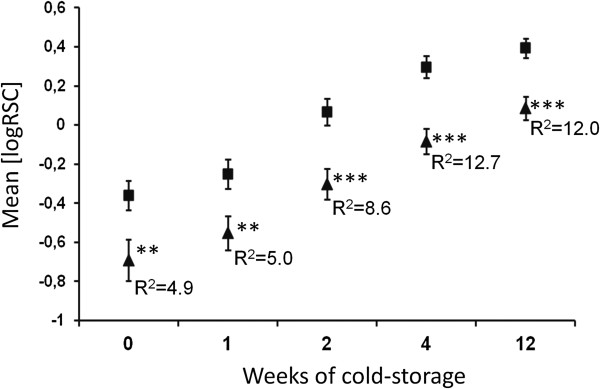
Effect of the SNP allele StLapN-A2746on average RSC of 40 cultivars during cold storage. Cultivars were grouped according to presence (triangles) or absence (squares) of SNP allele A2746. The genotypic groups were tested by ANOVA for significant differences between means of RSC (log transformed) before and after 1, 2, 4 and 12 weeks of cold storage. The mean RSC was different between the genotypic groups at all time points (**: 0.01 > p <0,001; ***: p < 0.001). The amount of variance explained by StLapN-SNP2746 (R2) at the different time points is given as percentage. R2 values increased during cold storage.

References

    1. Müller-Thurgau H. Über Zuckeranhäufung in Pflanzenteilen in Folge niederer Temperatur. Landwirtschaftliches Jahrbuch. 1882;11:751–828.
    1. Guy CL, Huber JLA, Huber SC. Sucrose phosphate synthase and sucrose accumulation at low-temperature. Plant Physiol. 1992;100(1):502–508. doi: 10.1104/pp.100.1.502. - DOI - PMC - PubMed
    1. Sowokinos JR. Biochemical and molecular control of cold-induced sweetening in potatoes. Am J Potato Res. 2001;78(3):221–236. doi: 10.1007/BF02883548. - DOI
    1. Malone JG, Mittova V, Ratcliffe RG, Kruger NJ. The response of carbohydrate metabolism in potato tubers to low temperature. Plant Cell Physiol. 2006;47(9):1309–1322. doi: 10.1093/pcp/pcj101. - DOI - PubMed
    1. Geigenberger P. Regulation of sucrose to starch conversion in growing potato tubers. J Exp Bot. 2003;54(382):457–465. doi: 10.1093/jxb/erg074. - DOI - PubMed

Publication types

LinkOut - more resources