Review
. 2013 Oct;10(8):809-17.
doi: 10.2174/15672050113109990156.

Impact of apolipoprotein E on Alzheimer's disease

Affiliations
Review

Impact of apolipoprotein E on Alzheimer's disease

Paul S Hauser et al. Curr Alzheimer Res. 2013 Oct.

Abstract

A key feature of Alzheimer's disease (AD) is deposition of extracellular amyloid plaque comprised chiefly of the amyloid β (Aβ) peptide. Studies of Aβ have shown that it may be catabolized by proteolysis or cleared from brain via members of the low-density lipoprotein receptor family. Alternatively, Aβ can undergo a conformational transition from α-helix to β-sheet, a conformer that displays a propensity to self-associate, oligomerize and form fibrils. Furthermore, β- sheet conformers catalyze conversion of other α-helical Aβ peptides to β-sheet, feeding the oligomer and fibril assembly process. A factor that influences the fate of Aβ in the extracellular space is apolipoprotein (apo) E. Polymorphism at position 112 or 158 in apoE give rise to three major isoforms. One isoform in particular, apoE4 (Arg at 112 and 158), has generated considerable interest since the discovery that it is the major genetic risk factor for development of late onset AD. Despite this striking correlation, the molecular mechanism underlying apoE4's association with AD remains unclear. A tertiary structural feature distinguishing apoE4 from apoE2 and apoE3, termed domain interaction, is postulated to affect the conformation and orientation of its' two independently folded domains. This feature has the potential to influence apoE4's interaction with Aβ, its sensitivity to proteolysis or its lipid accrual and receptor binding activities. Thus, domain interaction may constitute the principal molecular feature of apoE4 that predisposes carriers to late onset AD. By understanding the contribution of apoE4 to AD at the molecular level new therapeutic or prevention strategies will emerge.


Figures
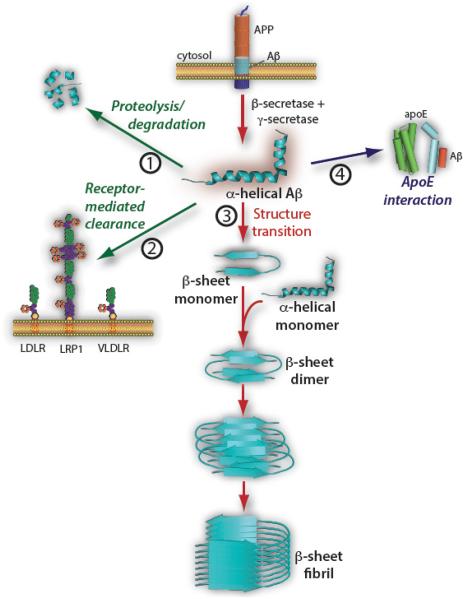
Fig. (1)
Fig. (1). Pathways of Aβ metabolism.
Soluble amyloid beta (Aβ) peptide is generated from proteolytic processing of amyloid precursor protein (APP) by the successive action of β- and γ-secretases in brain cells (top center). The level of Aβ production is counterbalanced by its degradation via protease digestion (Path 1) and receptor mediated endocytosis (Path 2). Alternatively, soluble α-helical Aβ may undergo a pathological transition to β-sheet conformer that promotes self-association and oligomerization (Path 3). How interaction between apolipoprotein (apoE) and Aβ (Path 4) influences Aβ metabolic fate is the subject of this review.
Fig. (2)
Fig. (2). Two-domain structural model of apoE.
Full-length apoE (299 amino acids) is composed of two independently folded structural domains. The 4-helix bundle structure of the N-terminal (NT) domain (X-ray crystal structure PDB ID:1LPE, Wilson et al., 1991) is connected to the modeled C-terminal (CT) domain by a flexible hinge segment that is sensitive to proteolysis. The NT domain contains the LDL receptor family binding recognition sequence (residues 136-150) while the CT domain is responsible for lipid binding and Aβ interaction.
Fig. (3)
Fig. (3). Putative isoform specific differences in NT – CT domain interaction.
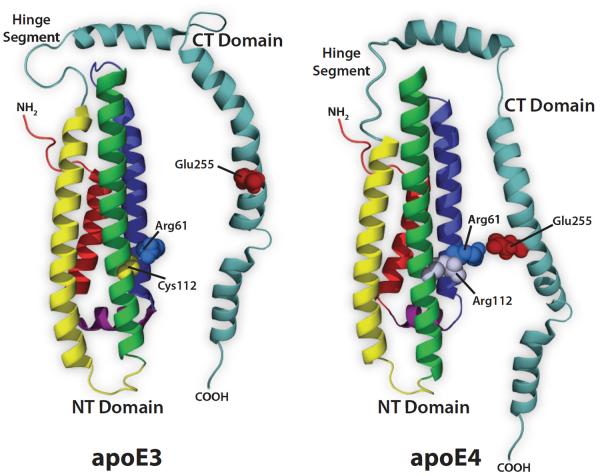
The NT domain 4-helix bundle is from the X-ray crystal structure of the isolated apoE3 and apoE4 domains (PDB ID:1NFN and PDB ID:1B68, respectively). The CT domain and hinge segment have been modeled for illustration (adapted from Zhong and Weisgraber (2009a)). Key residues, known to be involved in the isoform specific structural differences between apoE3 and apoE4 are indicated. In apoE4, the presence of Arg112 (compared with Cys112 in apoE3) on helix 3 changes the conformation of Arg61 on helix 2 to allow for greater NT and CT domain interaction via an Arg61-Glu255 salt bridge.
Fig. (4)
Fig. (4). Putative effects of apoE lipidation on Aβ metabolism.
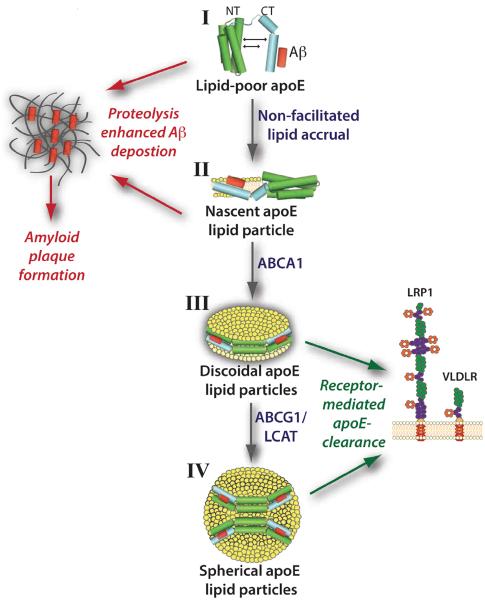
Lipid-poor apolipoprotein (apo) E is secreted from astrocytes and glial cells in brain and is lipidated in discrete stages (I-IV) by the collective action of ATP-binding cassette (ABC) transporter proteins (ABCA1 and ABCG1), lipid modifying enzymes and transfer proteins (e.g. lecithin:cholesterol acyltransferase (LCAT)). Poorly lipidated apoE (stage I) and nascent apoE particles (stage II) are more susceptible to proteolysis which may lead to greater Aβ deposition and enhanced plaque formation due to impaired clearance, whereas lipidated discoidal (stage III) and spherical (stage IV) apoE-containing lipoproteins are ligands for LDL receptor family members, potentially leading to enhanced binding and clearance of apoE-Aβ complexes from brain.

References

    1. Selkoe DJ. Preventing Alzheimer’s disease. Science. 2012;337(6101):1488–92. - PubMed
    1. Mawuenyega KG, Sigurdson W, Ovod V, Munsell L, Kasten T, Morris JC, et al. Decreased clearance of CNS beta-amyloid in Alzheimer’s disease. Science. 2010;330(6012):1774. - PMC - PubMed
    1. Deane R, Bell RD, Sagare A, Zlokovic BV. Clearance of amyloid-beta peptide across the blood-brain barrier: implication for therapies in Alzheimer’s disease. CNS Neurol Disord Drug Targets. 2009;8(1):16–30. - PMC - PubMed
    1. Holtzman DM, Herz J, Bu G. Apolipoprotein e and apolipoprotein e receptors: normal biology and roles in Alzheimer disease. Cold Spring Harb Perspect Med. 2012;2(3):a006312. - PMC - PubMed
    1. Xu J, Zhang JZ, Xiang Y. Molecular Dynamics Simulation and Computational Two-dimensional Infrared Spectroscopic Study of Model Amyloid ss-peptide Oligomers. J Phys Chem A. 2013 - PubMed