. 2013 Aug 6;4(4):e00360-13.
doi: 10.1128/mBio.00360-13.

Acinetobacter baumannii strain M2 produces type IV pili which play a role in natural transformation and twitching motility but not surface-associated motility

Affiliations

Acinetobacter baumannii strain M2 produces type IV pili which play a role in natural transformation and twitching motility but not surface-associated motility

Christian M Harding et al. mBio. .

Abstract

Acinetobacter baumannii is a Gram-negative, opportunistic pathogen. Recently, multiple A. baumannii genomes have been sequenced; these data have led to the identification of many genes predicted to encode proteins required for the biogenesis of type IV pili (TFP). However, there is no experimental evidence demonstrating that A. baumannii strains actually produce functional TFP. Here, we demonstrated that A. baumannii strain M2 is naturally transformable and capable of twitching motility, two classical TFP-associated phenotypes. Strains were constructed with mutations in pilA, pilD, and pilT, genes whose products have been well characterized in other systems. These mutants were no longer naturally transformable and did not exhibit twitching motility. These TFP-associated phenotypes were restored when these mutations were complemented. More PilA was detected on the surface of the pilT mutant than the parental strain, and TFP were visualized on the pilT mutant by transmission electron microscopy. Thus, A. baumannii produces functional TFP and utilizes TFP for both natural transformation and twitching motility. Several investigators have hypothesized that TFP might be responsible, in part, for the flagellum-independent surface-associated motility exhibited by many A. baumannii clinical isolates. We demonstrated that surface-associated motility was not dependent on the products of the pilA, pilD, and pilT genes and, by correlation, TFP. The identification of functional TFP in A. baumannii lays the foundation for future work determining the role of TFP in models of virulence that partially recapitulate human disease.

Importance: Several investigators have documented the presence of genes predicted to encode proteins required for the biogenesis of TFP in many A. baumannii genomes. Furthermore, some have speculated that TFP may play a role in the unique surface-associated motility phenotype exhibited by many A. baumannii clinical isolates, yet there has been no experimental evidence to prove this. Unfortunately, progress in understanding the biology and virulence of A. baumannii has been slowed by the difficulty of constructing and complementing mutations in this species. Strain M2, a recently characterized clinical isolate, is amenable to genetic manipulation. We have established a reproducible system for the generation of marked and/or unmarked mutations using a modified recombineering strategy as well as a genetic complementation system utilizing a modified mini-Tn7 element in strain M2. Using this strategy, we demonstrated that strain M2 produces TFP and that TFP are not required for surface-associated motility exhibited by strain M2.


Figures
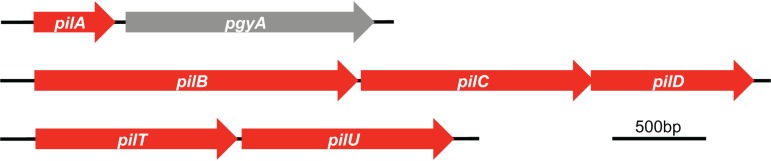
FIG 1
FIG 1
The pil gene loci in A. baumannii strain M2 employed in this study. Genes predicted to encode subunits of a TFP system in A. baumannii strain M2 are shown. We identified a pilA gene predicted to encode the major pilin subunit followed by pgyA, possibly coding for a type IV pilus O-glycosylase. Two other pil gene clusters were identified, (i) a pilBCD gene cluster, encoding a putative traffic ATPase (pilB), a putative inner membrane platform protein (pilC), and a putative prepilin peptidase (pilD), and (ii) a pilTU gene cluster, encoding two putative retraction ATPases.
FIG 2
FIG 2
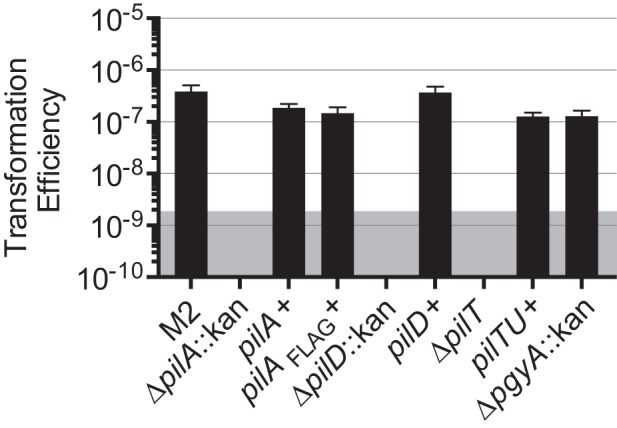
Natural transformation of strain M2 was reliant upon pil gene products. Strain M2, the pilA, pilD, and pilT isogenic mutants, and their respective complemented strains, including a ∆pilA strain complemented with the pilA gene fused to a FLAG tag, were tested for their transformation efficiencies. The pilA, pilD, and pilT mutants had transformation efficiencies below our level of detection, but the complemented strains, including the strain expressing PilA-FLAG, regained the natural transformation phenotype. The pgyA mutant also retained parental levels of transformation. The shaded area represents the level of detection of the assay. Transformation efficiency was calculated as the number of transformants/ml divided by the total CFU/ml for a given reaction. Bars show the means from three independent experiments with two technical replicates each, and error bars represent the standard errors of the means.
FIG 3
FIG 3
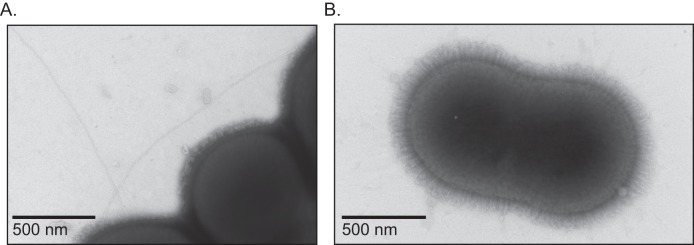
Observation of TFP on the ∆pilT mutant. (A) Type IV pilus-like appendages were readily observed on the surface of the ∆pilT mutant. (B) Type IV pilus-like appendages were not observed on the surface of a ∆pilT pilA::strAB mutant.
FIG 4
FIG 4
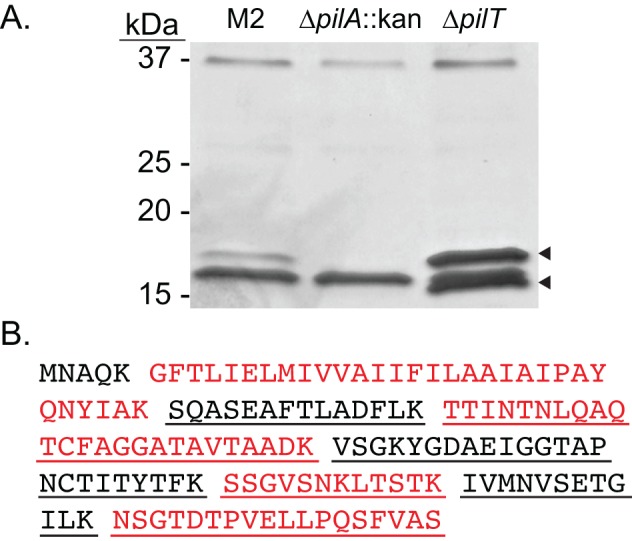
PilA, the major pilin subunit, is surface exposed. (A) The parental strain and the pilA and pilT mutant strains were resuspended in DPBS from L agar plates and vortexed to remove surface appendages. The sheared proteins were separated by SDS-PAGE, excised, and examined by MALDI-TOF mass spectrometry. The upper band in both the parental and pilT mutant fraction was identified as PilA. Interestingly, the lowest band present in the pilT mutant fraction was also identified as PilA. PilA was not identified in the pilA mutant fraction. (B) The primary amino acid sequence of the unprocessed prepilin, PilA, is shown. Predicted tryptic peptides are separated by spaces and shown in alternating colors for clarity. Underlined peptides were identified in both samples analyzed from the pilT mutant. The predominant band in the sample from the pilA mutant strain (also seen in the other preparations) is a predicted pilin produced by a chaperone/usher system. This is 87% identical to a putative biofilm synthesis protein (YP_001713377) in A. baumannii strain AYE.
FIG 5
FIG 5
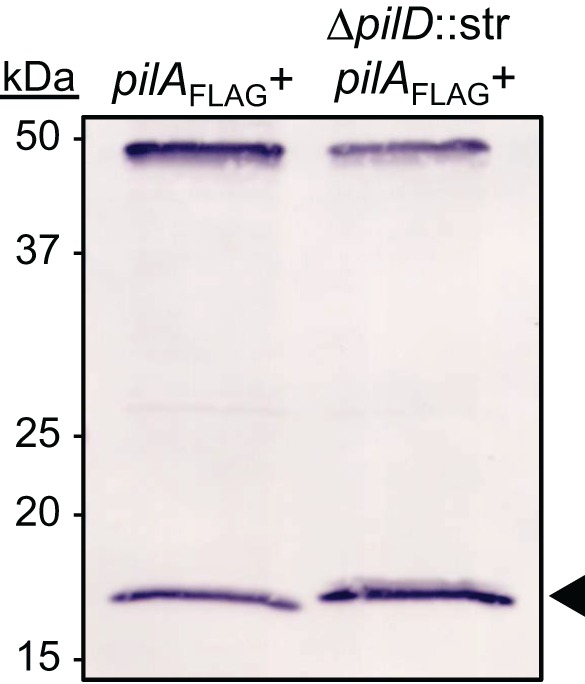
The strain M2 PilD homolog acted as a prepilin peptidase. Whole-cell lysates of the M2∆pilA::kan(pilA-FLAG+) and M2∆pilA::kanpilD::strAB(pilAFLAG+) strains were examined by Western blot analysis for processed and unprocessed PilA-FLAG. The nonspecific band around 50 kDa was included to demonstrate equal migration of proteins. PilA-FLAG from the M2∆pilA::kan(pilA-FLAG+) migrated to a slightly lower position than PilA-FLAG from M2∆pilA::kanpilD::strAB(pilAFLAG+). The leader peptide of PilA is predicted to be six amino acids.
FIG 6
FIG 6
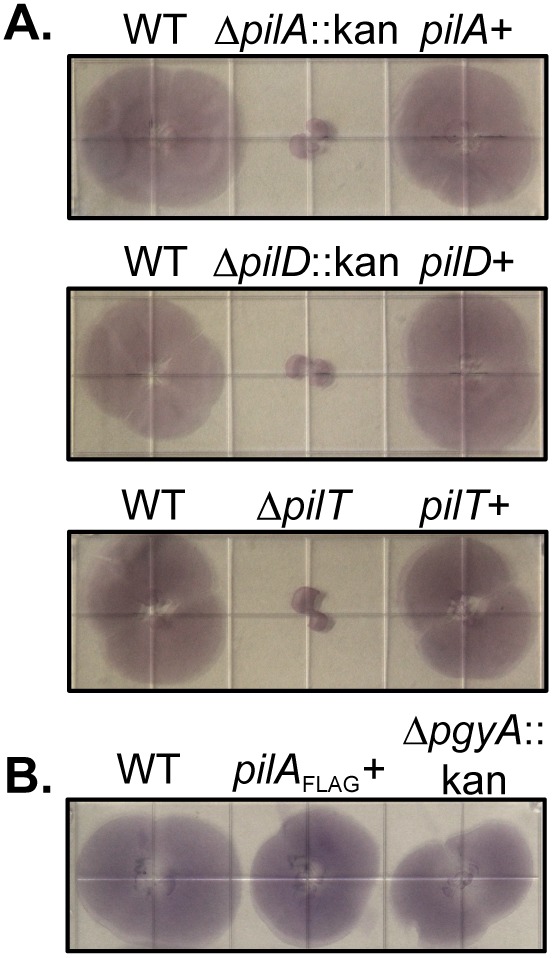
Twitching motility is reliant upon the pil gene products. (A) Twitching motility was observed at the agarose/plastic interface for M2 and the complemented mutants but not for the pilA, pilD, and pilT mutants. Each strain was inoculated by stabbing through the agarose to the surface of a plastic petri dish followed by incubation at 37°C for 18 h. The agarose was removed, and the nonadherent bacteria were removed by washing with PBS. The adherent bacteria were visualized by staining with 0.1% crystal violet. Each square in the grid on the plate is 13 mm wide. (B) The C-terminal FLAG tag on PilA did not impede twitching motility. The pgyA mutant retained the twitching motility phenotype.
FIG 7
FIG 7
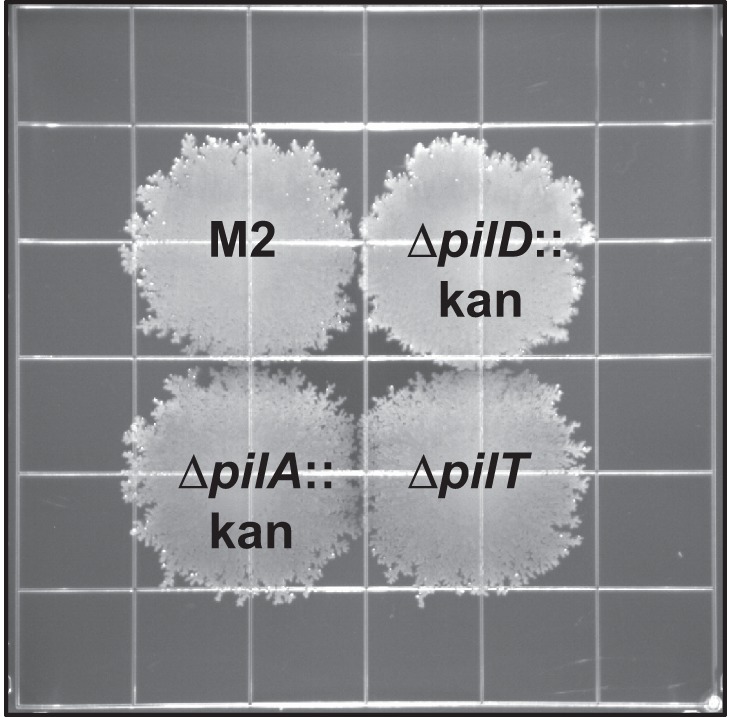
The pil gene products were not required for surface-associated motility. Strain M2 and the pilA, pilD, and pilT mutants were inoculated on the surface of a semisolid agarose plate (0.5%) and incubated for 18 h at 37°C. The pilA, pilD, and pilT mutant strains demonstrated no defect in surface-associated motility compared to the parental strain. Grids measure 13 mm2.

References

    1. Maragakis LL, Perl TM. 2008. Acinetobacter baumannii: epidemiology, antimicrobial resistance, and treatment options. Clin. Infect. Dis. 46:1254–1263 - PubMed
    1. Dijkshoorn L, Nemec A, Seifert H. 2007. An increasing threat in hospitals: multidrug-resistant Acinetobacter baumannii. Nat. Rev. Microbiol. 5:939–951 - PubMed
    1. Towner KJ. 2009. Acinetobacter: an old friend, but a new enemy. J. Hosp. Infect. 73:355–363 - PubMed
    1. Weber DJ, Rutala WA, Miller MB, Huslage K, Sickbert-Bennett E. 2010. Role of hospital surfaces in the transmission of emerging health care-associated pathogens: norovirus, Clostridium difficile, and Acinetobacter species. Am. J. Infect. Control 38:S25–S33 - PubMed
    1. Houang ET, Sormunen RT, Lai L, Chan CY, Leong AS. 1998. Effect of desiccation on the ultrastructural appearances of Acinetobacter baumannii and Acinetobacter lwoffii. J. Clin. Pathol. 51:786–788 - PMC - PubMed

Publication types

MeSH terms

Substances

LinkOut - more resources