


Aggressive hydration with lactated Ringer's solution reduces pancreatitis after endoscopic retrograde cholangiopancreatography
- PMID: 23920031
- PMCID: PMC3879172
- DOI: 10.1016/j.cgh.2013.07.026
Aggressive hydration with lactated Ringer's solution reduces pancreatitis after endoscopic retrograde cholangiopancreatography
Abstract
Background & aims: Pancreatitis is the most common serious complication of endoscopic retrograde cholangiopancreatography (ERCP). We performed a pilot study to determine whether aggressive periprocedural hydration with lactated Ringer's solution reduces the incidence of pancreatitis after ERCP.
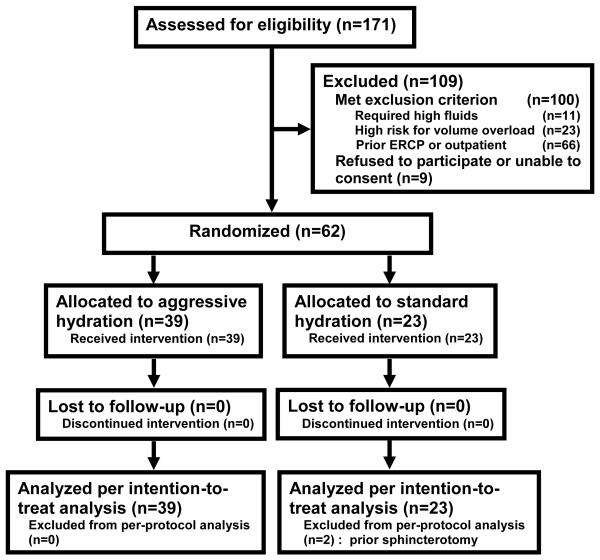
Methods: Patients who underwent first-time ERCP were randomly assigned to groups (2:1) that received aggressive hydration with lactated Ringer's solution (3 mL/kg/h during the procedure, a 20-mL/kg bolus after the procedure, and 3 mL/kg/h for 8 hours after the procedure, n = 39) or standard hydration with the same solution (1.5 mL/kg/h during and for 8 hours after procedure, n = 23). Serum levels of amylase, visual analogue pain scores (scale of 0-10), and volume overload were assessed at baseline and 2, 8, and 24 hours after ERCP. The primary end point, post-ERCP pancreatitis, was defined as hyperamylasemia (level of amylase >3 times the upper limit of normal) and increased epigastric pain (≥3 points on visual analogue scale) persisting for ≥24 hours after the procedure. Secondary end points included hyperamylasemia, increased pain, and volume overload.
Results: None of the patients who received aggressive hydration developed post-ERCP pancreatitis, compared with 17% of patients who received standard hydration (P = .016). Hyperamylasemia developed in 23% of patients who received aggressive hydration vs 39% of those who received standard hydration (P = .116, nonsignificant); increased epigastric pain developed in 8% of patients who received aggressive hydration vs 22% of those who received standard hydration (P = .146, nonsignificant). No patients had evidence of volume overload.
Conclusions: On the basis of a pilot study, aggressive intravenous hydration with lactated Ringer's solution appears to reduce the development of post-ERCP pancreatitis and is not associated with volume overload. ClinicalTrials.gov, Number: NCT 01758549.
Trial registration: ClinicalTrials.gov NCT01758549.
Keywords: CI; Clinical Trial; ERCP; Endoscopic Retrograde Cholangiopancreatography; Inflammation; Outcome; Pancreas; confidence interval; endoscopic retrograde cholangiopancreatography.
Copyright © 2014 AGA Institute. Published by Elsevier Inc. All rights reserved.
Figures
Comment in
-
Aggressive intravenous fluid resuscitation for preventing post-endoscopic retrograde cholangiopancreatography pancreatitis: finally on the right track.Clin Gastroenterol Hepatol. 2014 Feb;12(2):308-10. doi: 10.1016/j.cgh.2013.09.009. Epub 2013 Sep 10. Clin Gastroenterol Hepatol. 2014. PMID: 24036053 No abstract available.
-
Intravenous hydration for the prevention of post-endoscopic retrograde cholangiopancreatography pancreatitis.Gastroenterology. 2014 Feb;146(2):581-2. doi: 10.1053/j.gastro.2013.12.010. Epub 2013 Dec 17. Gastroenterology. 2014. PMID: 24355613 No abstract available.
References
-
- Sherman S, Blaut U, Watkins JL, et al. Does prophylactic administration of corticosteroid reduce the risk and severity of post-ERCP pancreatitis: a randomized, prospective, multicenter study. Gastrointest Endosc. 2003;58:23–9. - PubMed
-
- Andriulli A, Leandro G, Federici T, et al. Prophylactic administration of somatostatin or gabexate does not prevent pancreatitis after ERCP: an updated meta-analysis. Gastrointest Endosc. 2007;65:624–32. - PubMed
-
- Banks PA, Freeman ML. Practice guidelines in acute pancreatitis. Am J Gastroenterol. 2006;101:2379–400. - PubMed
-
- Kusterer K, Enghofer M, Zendler S, et al. Microcirculatory changes in sodium taurocholate-induced pancreatitis in rats. Am J Physiol. 1991;260:G346–51. - PubMed
Publication types
MeSH terms
Substances
Associated data
Grants and funding
LinkOut - more resources
Full Text Sources
Other Literature Sources
Medical
