Review
. 2013 Aug 6:347:f4827.
doi: 10.1136/bmj.f4827.

Clinical review. Frontotemporal dementia

Affiliations
Review

Clinical review. Frontotemporal dementia

Jason D Warren et al. BMJ. .
No abstract available


Conflict of interest statement

Competing interests: We have read and understood the BMJ Group policy on declaration of interests and declare the following interests: financial support for the submitted work from Wellcome Trust and the Medical Research Council. JDW has received research grants from the Wellcome Trust, Medical Research Council, and Alzheimer’s Research UK. JDR has previously received research grants from the Wellcome Trust. MNR receives a consultancy fee as a member of the Safety Monitoring Committees for Janssen Al/Pfizer and Servier (paid into departmental funds not to MNR personally) and his department receives a grant from Pfizer for phase III imaging analysis; he is a director of the NIHR Dementia and Neurodegenerative Diseases Research Network, president of the Association of British Neurologists, a member of Neurology Scientific Advisory Group, EMA and Neurology and Psychiatry Group MHRA, and a vice president of the Alzheimer’s Society.

Figures
None
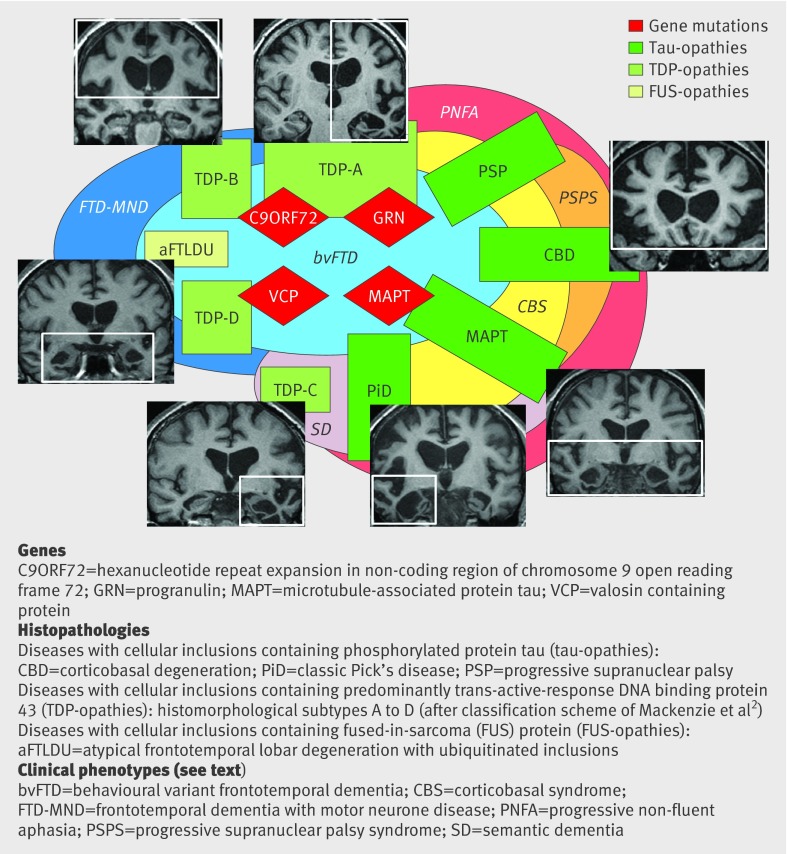
Fig 1 Molecular pathologies and phenotypic correlations in frontotemporal dementia. The schematic shows major genes causing frontotemporal dementia, histopathological substrates, and clinical phenotypes. Neuroanatomical profiles are shown as coronal magnetic resonance imaging sections (left hemisphere displayed on the right) abutting the corresponding pathological substrates, with regions of predominant regional atrophy demarcated by white rectangles. Genetic bases for pathological substrates and phenotypic associations of tissue pathologies are shown as intersecting (for example, mutations in the progranulin gene (GRN) are associated with TDP-43 type A (TDP-A) pathology, which may be associated with clinical syndromes of behavioural variant frontotemporal dementia (bvFTD), progressive non-fluent aphasia (PNFA), corticobasal syndrome (CBS), and frontotemporal dementia with motor neurone disease (FTD-MND)). Group functional neuroimaging studies have demonstrated involvement of intrinsic, large scale brain networks in FTD syndromes: a medial paralimbic network (including anterior cingulate, orbital frontal, and frontoinsular cortices) in bvFTD; an anterior temporal and inferior frontal network in semantic dementia ; and dorsally directed dominant hemisphere language networks in PNFA. However, the network correlates of particular molecular pathologies are less well established. This scheme arranges diseases according to whether they produce damage that is relatively more restricted to anterior (toward left of figure) areas or extends posteriorly (toward right of figure) within each cerebral hemisphere; whether damage within a hemisphere is more focally restricted to the temporal lobes (toward bottom of figure) or more distributed (toward top of figure); and according to the degree of asymmetry of involvement between the two hemispheres (more asymmetrical diseases shown more centrally)
None
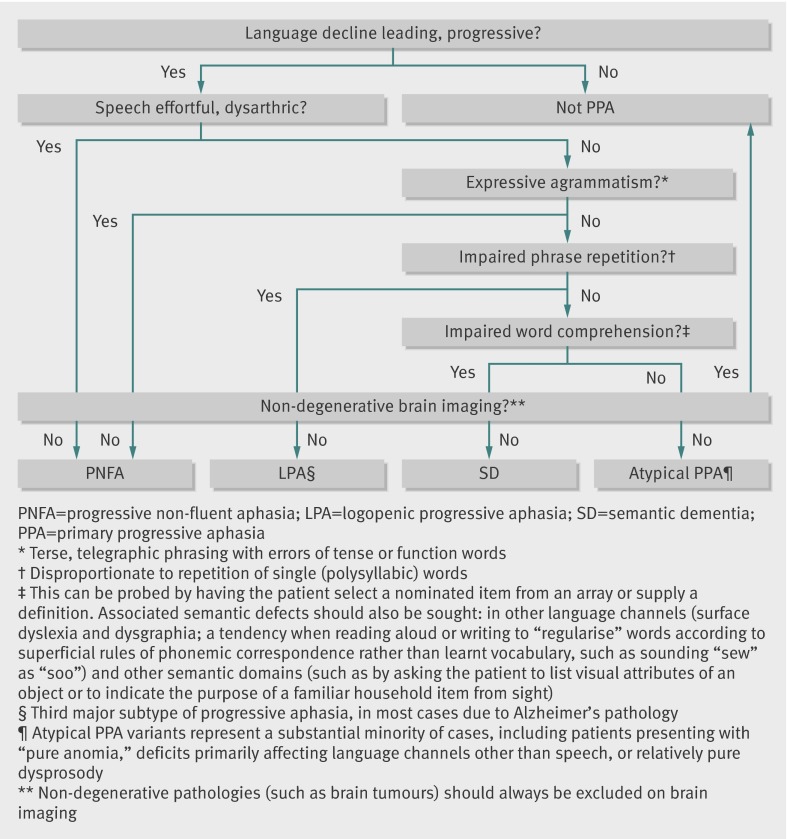
Fig 2 Bedside clinical assessment of the progressive aphasias: a simple algorithm (informed by current consensus criteria for progressive aphasia6) for syndromic diagnosis of patients presenting with progressive language decline. The clinical syndromic diagnosis should be supplemented by neuropsychological assessment, brain magnetic resonance imaging, and ancillary investigations including cerebrospinal fluid examination (see text)

References

    1. Rabinovici GD, Miller BL. Frontotemporal lobar degeneration: epidemiology, pathophysiology, diagnosis and management. CNS Drugs 2010;24:375-98. - PMC - PubMed
    1. Mackenzie IR, Neumann M, Baborie A. A harmonized classification system for FTD-TDP pathology. Acta Neuropathol 2011;122:111-3. - PMC - PubMed
    1. Rohrer JD, Guerreiro R, Vandrovcova J, Uphill J, Reiman D, Beck J, et al. The heritability and genetics of frontotemporal lobar degeneration. Neurology 2009;73:1451-6. - PMC - PubMed
    1. Rohrer JD, Warren JD. Phenotypic signatures of genetic frontotemporal dementia. Curr Opin Neurol 2011;24:542-9. - PubMed
    1. Rascovsky K, Hodges JR, Knopman D, Mendez MF, Kramer JH, Neuhaus J, et al. Sensitivity of revised diagnostic criteria for the behavioural variant of frontotemporal dementia. Brain 2011;134:2456-77. - PMC - PubMed

Publication types

MeSH terms