. 2013 Oct;163(2):591-9.
doi: 10.1104/pp.113.224055. Epub 2013 Aug 6.

Calcium-dependent protein kinase CPK6 positively functions in induction by yeast elicitor of stomatal closure and inhibition by yeast elicitor of light-induced stomatal opening in Arabidopsis

Affiliations

Calcium-dependent protein kinase CPK6 positively functions in induction by yeast elicitor of stomatal closure and inhibition by yeast elicitor of light-induced stomatal opening in Arabidopsis

Wenxiu Ye et al. Plant Physiol. 2013 Oct.

Abstract

Yeast elicitor (YEL) induces stomatal closure that is mediated by a Ca(2+)-dependent signaling pathway. A Ca(2+)-dependent protein kinase, CPK6, positively regulates activation of ion channels in abscisic acid and methyl jasmonate signaling, leading to stomatal closure in Arabidopsis (Arabidopsis thaliana). YEL also inhibits light-induced stomatal opening. However, it remains unknown whether CPK6 is involved in induction by YEL of stomatal closure or in inhibition by YEL of light-induced stomatal opening. In this study, we investigated the roles of CPK6 in induction by YEL of stomatal closure and inhibition by YEL of light-induced stomatal opening in Arabidopsis. Disruption of CPK6 gene impaired induction by YEL of stomatal closure and inhibition by YEL of light-induced stomatal opening. Activation by YEL of nonselective Ca(2+)-permeable cation channels was impaired in cpk6-2 guard cells, and transient elevations elicited by YEL in cytosolic-free Ca(2+) concentration were suppressed in cpk6-2 and cpk6-1 guard cells. YEL activated slow anion channels in wild-type guard cells but not in cpk6-2 or cpk6-1 and inhibited inward-rectifying K(+) channels in wild-type guard cells but not in cpk6-2 or cpk6-1. The cpk6-2 and cpk6-1 mutations inhibited YEL-induced hydrogen peroxide accumulation in guard cells and apoplast of rosette leaves but did not affect YEL-induced hydrogen peroxide production in the apoplast of rosette leaves. These results suggest that CPK6 positively functions in induction by YEL of stomatal closure and inhibition by YEL of light-induced stomatal opening in Arabidopsis and is a convergent point of signaling pathways for stomatal closure in response to abiotic and biotic stress.


Figures
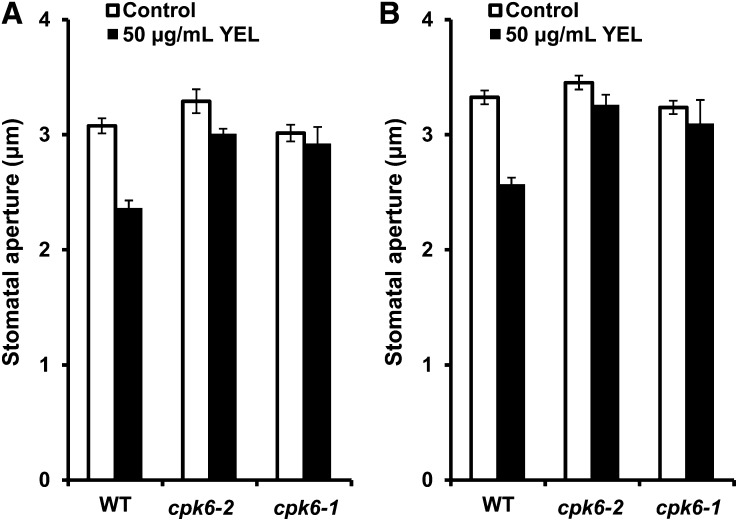
Figure 1.
Figure 1.
Induction by YEL of stomatal closure and inhibition by YEL of light-induced stomatal opening in the wild type and cpk6-1 and cpk6-2 mutants. A, YEL-induced stomatal closure in the wild type (WT) and cpk6-1 and cpk6-2 mutants. B, Inhibition by YEL of light-induced stomatal opening in the wild type and cpk6-1 and cpk6-2 mutants. Averages from three independent experiments (90 total stomata per bar) are shown. Error bars represent ses (n = 3).
Figure 2.
Figure 2.
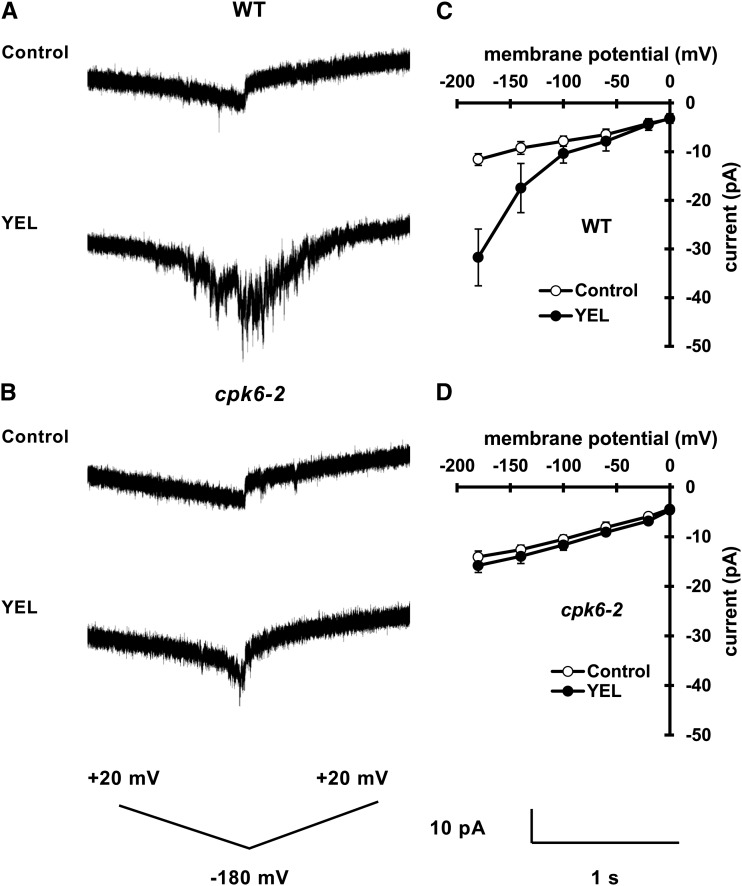
YEL activation of ICa currents in wild-type and cpk6-2 GCPs. A, ICa currents in wild-type (WT) GCPs treated without YEL (top trace) or with 50 µg mL–1 YEL (bottom trace). B, ICa currents in cpk6-2 GCPs treated without YEL (top trace) or with 50 µg mL–1 YEL (bottom trace). C, Current-voltage relationship for YEL activation of ICa currents in wild-type GCPs (n = 5) as recorded in A (white circles, control; black circles, 50 µg mL–1 YEL). D, Current-voltage relationship for YEL activation of ICa currents in cpk6-2 GCPs (n = 5) as recorded in B (white circles, control; black circles, 50 µg mL–1 YEL). A ramp voltage protocol from +20 to –180 mV (holding potential, 0 mV; ramp speed, 200 mV s–1) was used. After making whole-cell configuration, GCPs were recorded 16 times to get averages for control. After adding YEL extracellularly, the GCPs were recorded for 16 times to get averages for the YEL treatment. The interpulse period was 1 min.
Figure 3.
Figure 3.
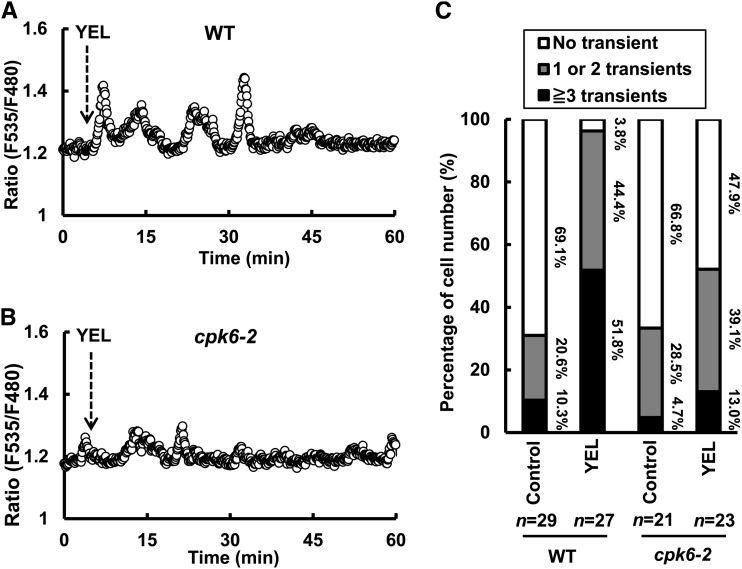
YEL-induced transient [Ca2+]cyt elevations in wild-type and cpk6-2 guard cells expressing YC3.6. A, A representative trace of fluorescence emission ratios (535/480 nm) showing 50 µg mL–1 YEL-induced transient [Ca2+]cyt elevations in wild-type (WT) guard cells. B, A representative trace of fluorescence emission ratios (535/480 nm) showing 50 µg mL–1 YEL-induced transient [Ca2+]cyt elevations in cpk6-2 guard. C, Percentage of number of guard cells showing different number of transient [Ca2+]cyt elevations in wild-type and cpk6-2 guard cells. [Ca2+]cyt elevations were counted when changes in fluorescence emission ratios were more than or equal to 0.1 from the baseline.
Figure 4.
Figure 4.
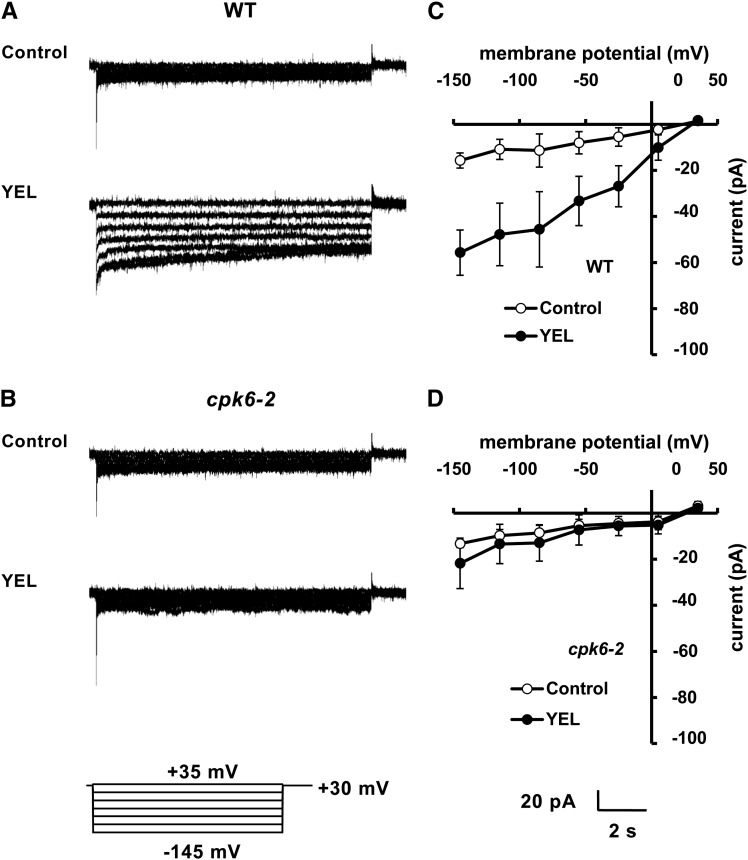
YEL activation of S-type currents in wild-type (WT) and cpk6-2 GCPs. A, S-type currents in wild-type GCPs treated without (top trace) or with 50 µg mL–1 YEL (bottom trace). B, S-type currents in cpk6-2 GCPs treated without (top trace) or with 50 µg mL–1 YEL (bottom trace). C, Steady-state current-voltage relationship for YEL activation of S-type currents in wild-type GCPs as recorded in A (white circles, control; black circles, YEL). D, Steady-state current-voltage relationship for YEL activation of S-type currents in cpk6-2 GCPs as recorded in B (white circles, control; black circles, YEL). The voltage protocol was stepped up from +35 mV to –145 mV in 30-mV decrements (holding potential, +30 mV). GCPs were treated with YEL for 2 h before recordings. Each datum point was obtained from five GCPs. Error bars represent ses.
Figure 5.
Figure 5.
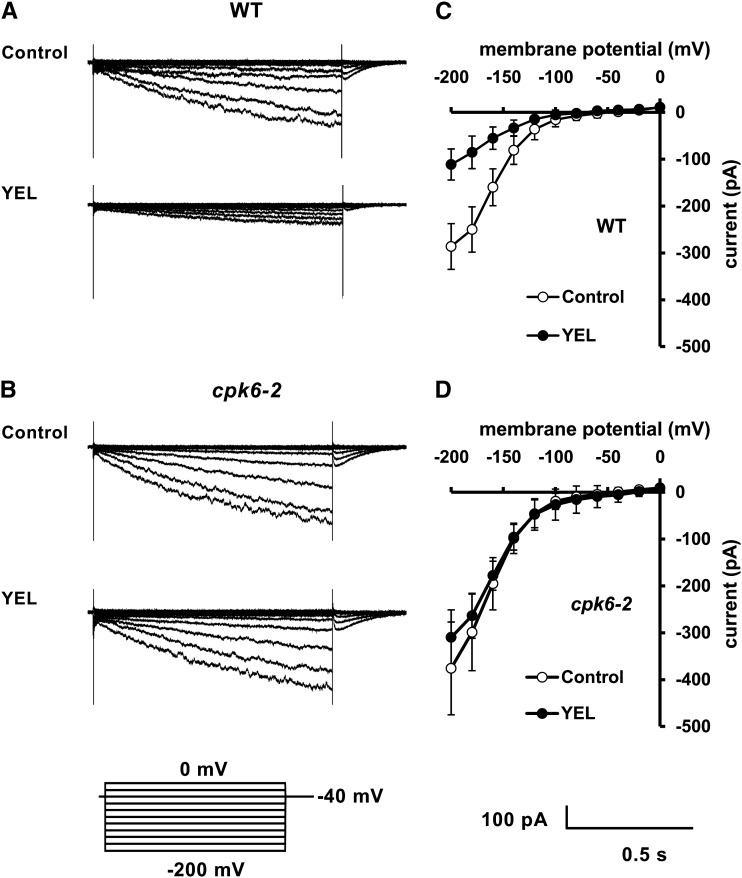
YEL inhibition of Kin currents in wild-type (WT) and cpk6-2 GCPs. A, Kin currents in wild-type GCPs treated without (top trace) or with 50 µg mL–1 YEL (bottom trace). B, Kin currents in cpk6-2 GCPs treated without (top trace) or with 50 µg mL–1 YEL (bottom trace). C, Steady-state current-voltage relationship for YEL inhibition of Kin currents in wild-type GCPs as recorded in A (white circles, control; black circles, YEL). D, Steady-state current-voltage relationship for YEL inhibition of Kin currents in cpk6-2 GCPs as recorded in B (white circles, control; black circles, YEL). The voltage protocol was stepped up from 0 to –200 mV in 20-mV decrements (holding potential, –40 mV). GCPs were treated with YEL for 2 h before recordings. Each datum point was obtained from at least seven GCPs. Error bars represent ses.
Figure 6.
Figure 6.
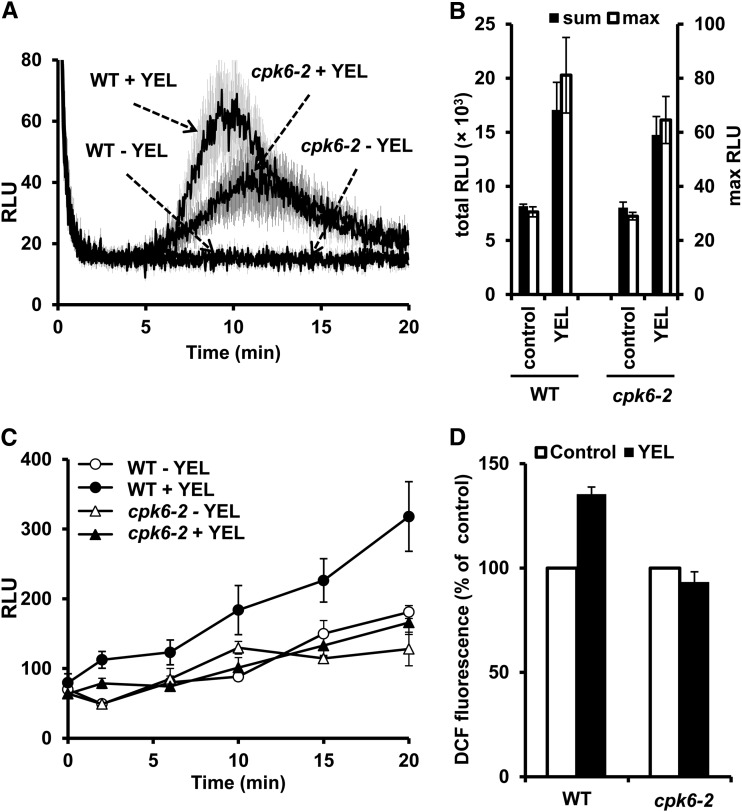
YEL-induced H2O2 production in apoplast of leaf tissues and H2O2 accumulation in apoplast of leaf tissues and guard cells. A, H2O2 production induced by 50 µg mL–1 YEL in apoplast of leaf tissues of the wild type (WT) and cpk6-2 mutant. B, Total and maximal H2O2 production induced by YEL as recorded in A. The luminescence was measured between 1 and 20 min after adding YEL, where the luminescence at each sampling point was integrated for 2 s. “Total RLU” is the sum of luminescence between 1 and 20 min, and “max RLU” is the highest luminescence. C, H2O2 accumulation induced by 50 µg mL–1 YEL in the apoplast of leaf tissues of the wild type and cpk6-2 mutant. D, H2O2 accumulation induced by 50 µg mL–1 YEL in guard cells of the wild type and cpk6-2 mutant. H2O2 accumulation was expressed as the percentage of 2',7'-dichlorofluorescein (DCF) fluorescence levels. Averages from three independent experiments (more than 150 total guard cells per bar in total) are shown.

References

    1. Allen GJ, Chu SP, Harrington CL, Schumacher K, Hoffmann T, Tang YY, Grill E, Schroeder JI. (2001) A defined range of guard cell calcium oscillation parameters encodes stomatal movements. Nature 411: 1053–1057 - PubMed
    1. Brandt B, Brodsky DE, Xue S, Negi J, Iba K, Kangasjärvi J, Ghassemian M, Stephan AB, Hu H, Schroeder JI. (2012) Reconstitution of abscisic acid activation of SLAC1 anion channel by CPK6 and OST1 kinases and branched ABI1 PP2C phosphatase action. Proc Natl Acad Sci USA 109: 10593–10598 - PMC - PubMed
    1. Garcia-Mata C, Gay R, Sokolovski S, Hills A, Lamattina L, Blatt MR. (2003) Nitric oxide regulates K+ and Cl– channels in guard cells through a subset of abscisic acid-evoked signaling pathways. Proc Natl Acad Sci USA 100: 11116–11121 - PMC - PubMed
    1. Geiger D, Maierhofer T, Al-Rasheid KAS, Scherzer S, Mumm P, Liese A, Ache P, Wellmann C, Marten I, Grill E, et al. (2011) Stomatal closure by fast abscisic acid signaling is mediated by the guard cell anion channel SLAH3 and the receptor RCAR1. Sci Signal 4: ra32. - PubMed
    1. Geiger D, Scherzer S, Mumm P, Marten I, Ache P, Matschi S, Liese A, Wellmann C, Al-Rasheid KA, Grill E, et al. (2010) Guard cell anion channel SLAC1 is regulated by CDPK protein kinases with distinct Ca2+ affinities. Proc Natl Acad Sci USA 107: 8023–8028 - PMC - PubMed

MeSH terms

Substances

LinkOut - more resources