


Structural basis of the C1q/C1s interaction and its central role in assembly of the C1 complex of complement activation
- PMID: 23922389
- PMCID: PMC3752233
- DOI: 10.1073/pnas.1311113110
Structural basis of the C1q/C1s interaction and its central role in assembly of the C1 complex of complement activation
Erratum in
-
Correction for Venkatraman Girija et al., Structural basis of the C1q/C1s interaction and its central role in assembly of the C1 complex of complement activation.Proc Natl Acad Sci U S A. 2016 Oct 25;113(43):E6722-E6723. doi: 10.1073/pnas.1615704113. Epub 2016 Oct 10. Proc Natl Acad Sci U S A. 2016. PMID: 27791042 Free PMC article. No abstract available.
Abstract
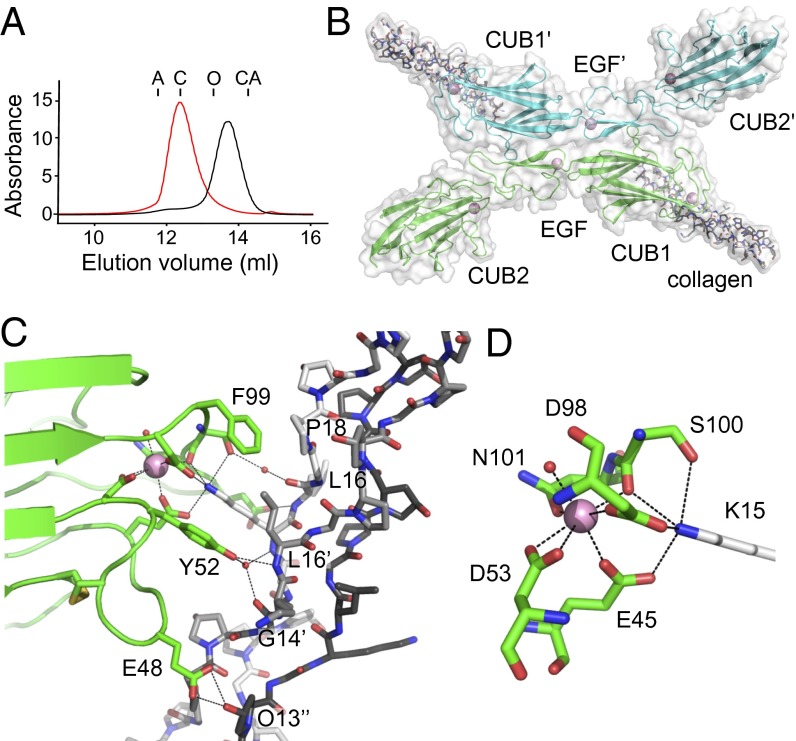
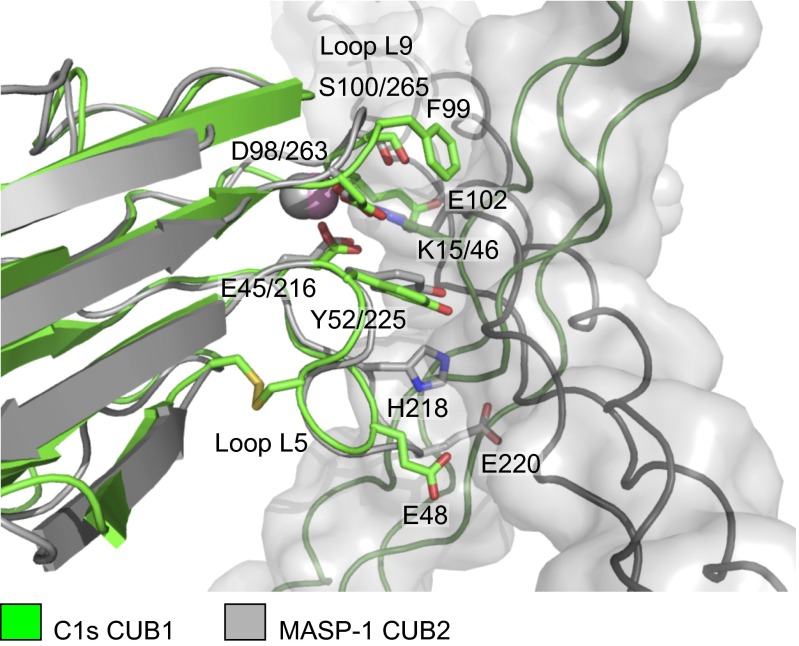
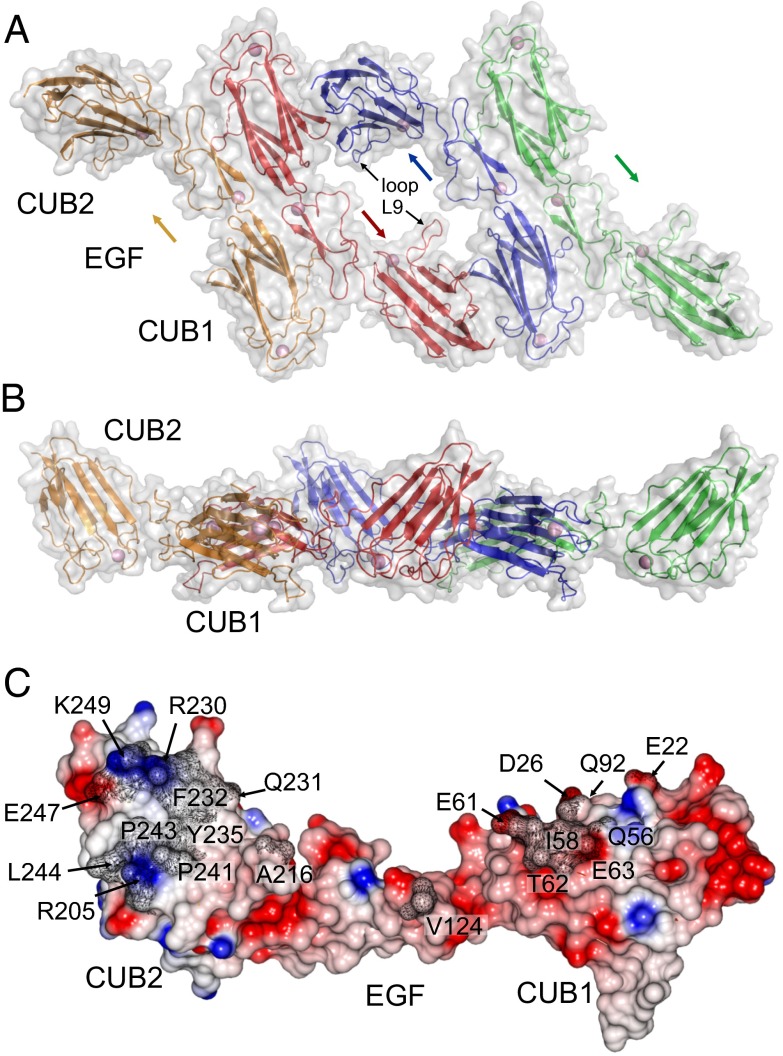
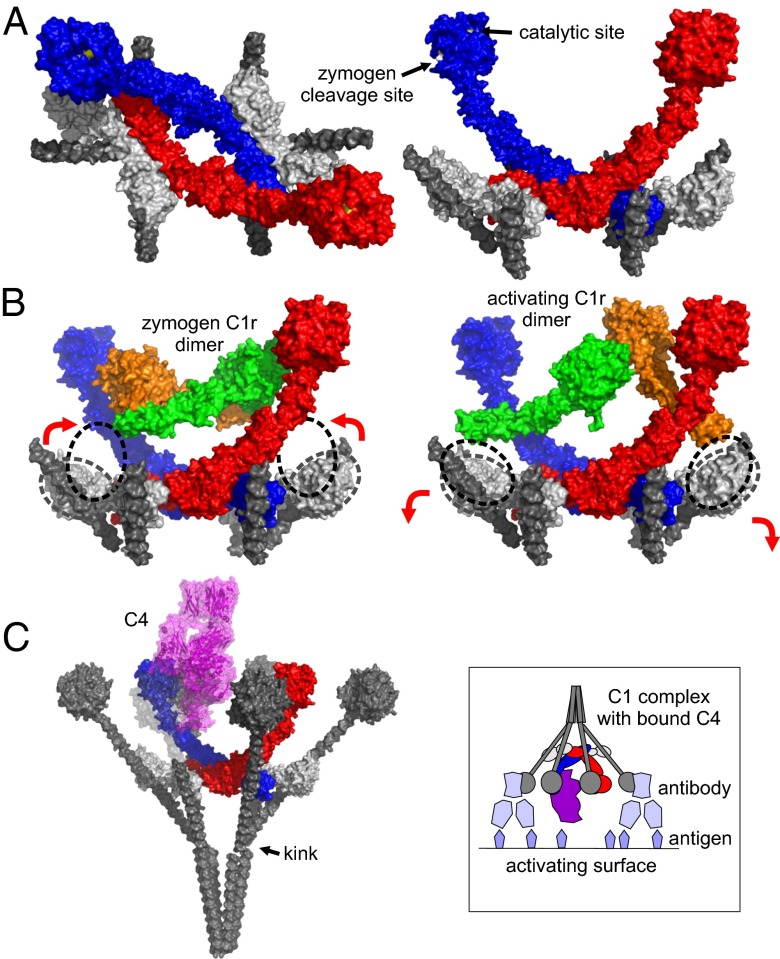
Complement component C1, the complex that initiates the classical pathway of complement activation, is a 790-kDa assembly formed from the target-recognition subcomponent C1q and the modular proteases C1r and C1s. The proteases are elongated tetramers that become more compact when they bind to the collagen-like domains of C1q. Here, we describe a series of structures that reveal how the subcomponents associate to form C1. A complex between C1s and a collagen-like peptide containing the C1r/C1s-binding motif of C1q shows that the collagen binds to a shallow groove via a critical lysine side chain that contacts Ca(2+)-coordinating residues. The data explain the Ca(2+)-dependent binding mechanism, which is conserved in C1r and also in mannan-binding lectin-associated serine proteases, the serine proteases of the lectin pathway activation complexes. In an accompanying structure, C1s forms a compact ring-shaped tetramer featuring a unique head-to-tail interaction at its center that replicates the likely arrangement of C1r/C1s polypeptides in the C1 complex. Additional structures reveal how C1s polypeptides are positioned to enable activation by C1r and interaction with the substrate C4 inside the cage-like assembly formed by the collagenous stems of C1q. Together with previously determined structures of C1r fragments, the results reported here provide a structural basis for understanding the early steps of complement activation via the classical pathway.
Keywords: innate immunity; structural biology.
Conflict of interest statement
The authors declare no conflict of interest.
Figures
References
-
- Forneris F, Wu J, Gros P. The modular serine proteases of the complement cascade. Curr Opin Struct Biol. 2012;22(3):333–341. - PubMed
-
- Gregory LA, Thielens NM, Arlaud GJ, Fontecilla-Camps JC, Gaboriaud C. X-ray structure of the Ca2+-binding interaction domain of C1s. Insights into the assembly of the C1 complex of complement. J Biol Chem. 2003;278(34):32157–32164. - PubMed
Publication types
MeSH terms
Substances
Associated data
- Actions
- Actions
- Actions
- Actions
Grants and funding
LinkOut - more resources
Full Text Sources
Other Literature Sources
Miscellaneous
