


Survey of familial glaucoma shows a high incidence of cytochrome P450, family 1, subfamily B, polypeptide 1 (CYP1B1) mutations in non-consanguineous congenital forms in a Spanish population
- PMID: 23922489
- PMCID: PMC3733905
Survey of familial glaucoma shows a high incidence of cytochrome P450, family 1, subfamily B, polypeptide 1 (CYP1B1) mutations in non-consanguineous congenital forms in a Spanish population
Abstract
Purpose: To identify myocilin (MYOC) and cytochrome P450, family 1, subfamily B, polypeptide 1 (CYP1B1) mutations in a Spanish population with different clinical forms of familial glaucoma or ocular hypertension (OHT).
Methods: Index patients from 226 families participated in this study. Patients were diagnosed with familial glaucoma or OHT by complete ophthalmologic examination. Screening for MYOC mutations was performed in 207 index patients: 96 with adult-onset primary open-angle glaucoma (POAG), 21 with primary congenital glaucoma (PCG), 18 with juvenile-onset open-angle glaucoma (JOAG), five with Axenfeld-Rieger syndrome (ARS), and 67 with other types of glaucoma. One hundred two of the families (including all those in whom a MYOC mutation was detected) were also screened for CYP1B1 mutations: 45 POAG, 25 PCG, 21 JOAG, four ARS, and seven others.
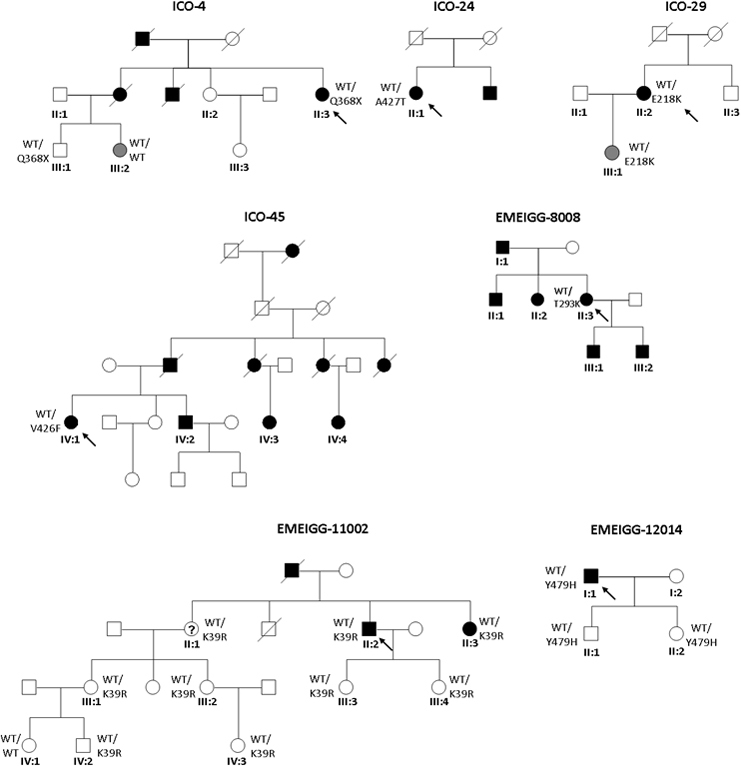
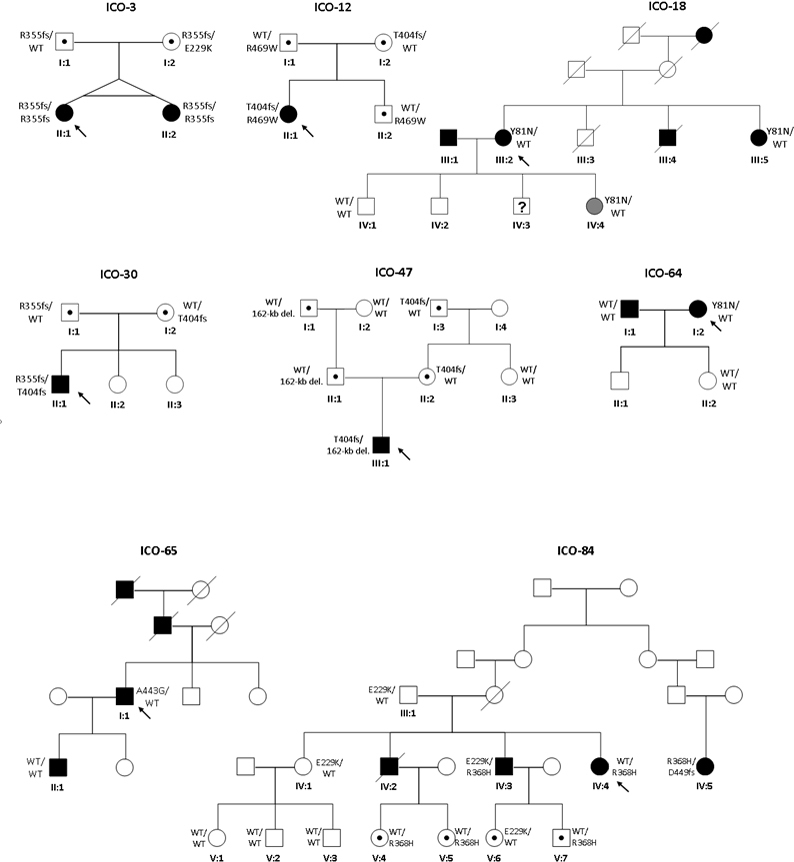
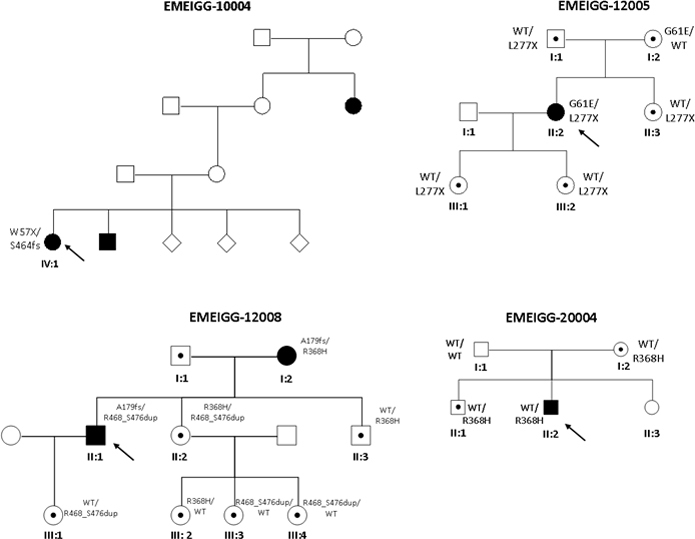
Results: We examined 292 individuals (patients and relatives) with a positive family history of glaucoma or OHT. We identified two novel MYOC variants, p.Lys39Arg and p.Glu218Lys, in two families with POAG, and six previously reported MYOC mutations in seven families with POAG (four), JOAG (one), PCG (one), and normotensive glaucoma (one). CYP1B1 mutations were found in 16 index patients with PCG (nine), POAG (three), JOAG (two), and ARS (two).
Conclusions: The high percentage (9/25=36%) of mutations in CYP1B1 found in non-consanguineous patients with congenital glaucoma mandates genetic testing. However, the percentage of mutations (9/207=4.4%) in MYOC associated with glaucoma is relatively low in our population. The variable phenotype expression of glaucoma, even in families, cannot be explained with a digenic mechanism between MYOC and CYP1B1.
Figures
References
-
- Several authors. Special Issue. (Glaucoma Review) Invest Ophthalmol Vis Sci. 2012;53:53.
-
- Lander ES, Shork NJ. Genetic dissection of complex traits. Science. 1994;265:2037–48. - PubMed
-
- Stone EM, Fingert JH, Alward WL, Nguyen TD, Polansky JR, Sunden SL, Nishimura D, Clark AF, Nystuen A, Nichols BE, Mackey DA, Ritch R, Kalenak JW, Craven ER, Sheffield VC. Identification of a gene that causes primary open angle glaucoma. Science. 1997;275:668–70. - PubMed
-
- Stoilov I, Akarsu AN, Sarfarazi M. Identification of three different truncating mutations in cytochrome P4501B1 (CYP1B1) as the principal cause of primary congenital glaucoma (Buphthalmos) in families linked to the GLC3A locus on some 2p21. Hum Mol Genet. 1997;6:641–7. - PubMed
-
- Rezaie T, Child A, Hitchings R, Brice G, Miller L, Coca-Prados M, Heon E, Krupin T, Ritch R, Kreutzer D, Crick RP, Sarfarazi M. Adult-onset primary open-angle glaucoma caused by mutations in optineurin. Science. 2002;295:1077–9. - PubMed
Publication types
MeSH terms
Substances
Supplementary concepts
LinkOut - more resources
Full Text Sources
Medical