


ALK-rearranged lung cancer in Chinese: a comprehensive assessment of clinicopathology, IHC, FISH and RT-PCR
- PMID: 23922677
- PMCID: PMC3724879
- DOI: 10.1371/journal.pone.0069016
ALK-rearranged lung cancer in Chinese: a comprehensive assessment of clinicopathology, IHC, FISH and RT-PCR
Abstract
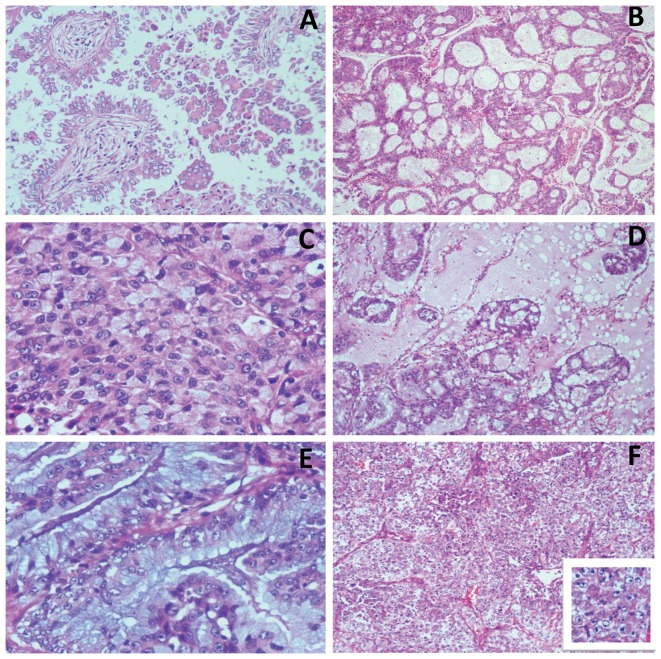
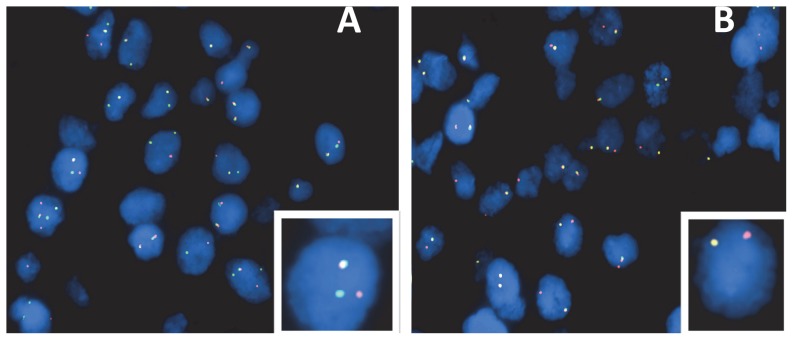
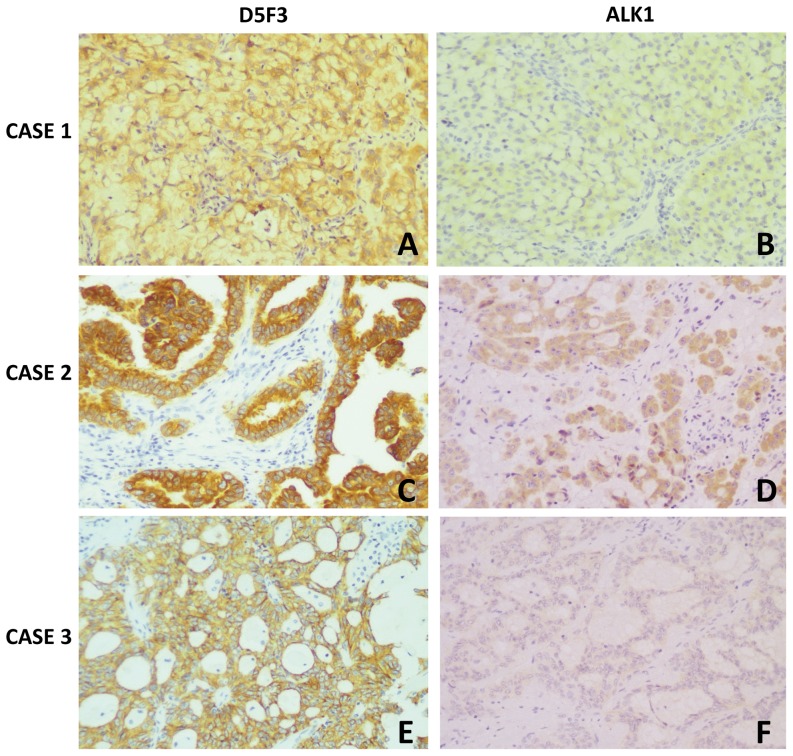
Approximately 3-7% of non-small cell lung cancers harbor an anaplastic lymphoma kinase (ALK) gene fusion, constituting a new molecular subtype of lung cancer that responds to crizotinib, an ALK inhibitor. Although previous studies have evaluated ALK-rearranged lung cancers, the comprehensive analysis of lung cancer in Chinese has not well assessed. Herein, we identified 44 cases of ALK-rearranged samples by fluorescent in-situ hybridization (FISH), immunohistochemistry (IHC), and reverse transcription polymerase chain reaction (RT-PCR) in a large number of surgically resected lung cancers. All 44 ALK-rearranged lung cancers were adenocarcinomas, with 2 cases having additional focal squamous components. The goal was to analyse the clinicopathological features of ALK-rearranged lung adenocarcinomas. Our data showed that a cribriform structure, prominent extracellular mucus and any type of mucous cell pattern may be either sensitive or specific to predict an ALK rearrangement. We used FISH as the standard detection method. We compared the ALK rearrangement accuracy of FISH, RT-PCR and IHC. RT-PCR could define both the ALK fusion partner and the fusion variant, but seemed unable to detect all translocations involving the ALK gene. It is noteworthy that IHC using the D5F3 antibody (Cell Signaling Technology) showed higher sensitivity and specificity than the ALK1 antibody (Dako). Therefore, we conclude that IHC remains a cost-effective and efficient technique for diagnosing ALK rearrangements and that D5F3 can be the optimal screening antibody in clinical practice.
Conflict of interest statement
Figures
References
-
- Soda M, Choi YL, Enomoto M, Takada S, Yamashita Y, et al. (2007) Identification of the transforming EML4-ALK fusion gene in non-small-cell lung cancer. Nature 448 7153: 561–566. - PubMed
-
- Kim H, Yoo SB, Choe JY, Paik JH, Xu X, et al. (2011) Detection of ALK gene rearrangement in non-small cell lung cancer: a comparison of fluorescence in situ hybridization and chromogenic in situ hybridization with correlation of ALK protein expression. J Thorac Oncol 6 8: 1359–1366. - PubMed
-
- Paik JH, Choe G, Kim H, Choe JY, Lee HJ, et al. (2011) Screening of anaplastic lymphoma kinase rearrangement by immunohistochemistry in non-small cell lung cancer: correlation with fluorescence in situ hybridization. J Thorac Oncol 6 3: 466–472. - PubMed
-
- Inamura K, Takeuchi K, Togashi Y, Hatano S, Ninomiya H, et al. (2009) EML4-ALK lung cancers are characterized by rare other mutations, a TTF-1 cell lineage, an acinar histology, and young onset. Mod Pathol 22 4: 508–15. - PubMed
Publication types
MeSH terms
Substances
LinkOut - more resources
Full Text Sources
Other Literature Sources
Medical
