


Incidence and prevalence of tuberculosis among household contacts of pulmonary tuberculosis patients in a peri-urban population of South Delhi, India
- PMID: 23922784
- PMCID: PMC3724886
- DOI: 10.1371/journal.pone.0069730
Incidence and prevalence of tuberculosis among household contacts of pulmonary tuberculosis patients in a peri-urban population of South Delhi, India
Abstract
Background: Tuberculosis (TB), caused by Mycobacterium tuberculosis, is one of the leading causes of mortality and morbidity across all age groups throughout the world, especially in developing countries.
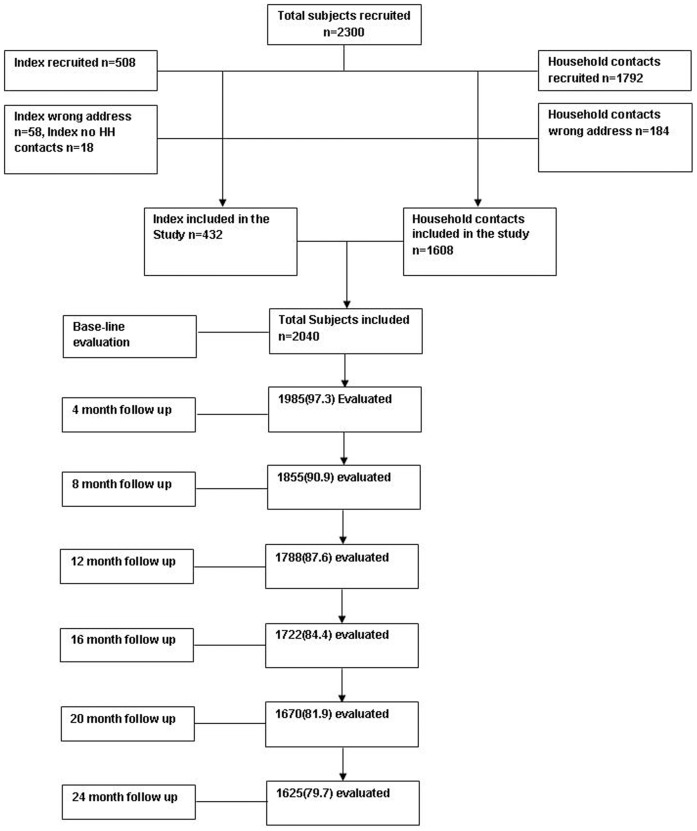
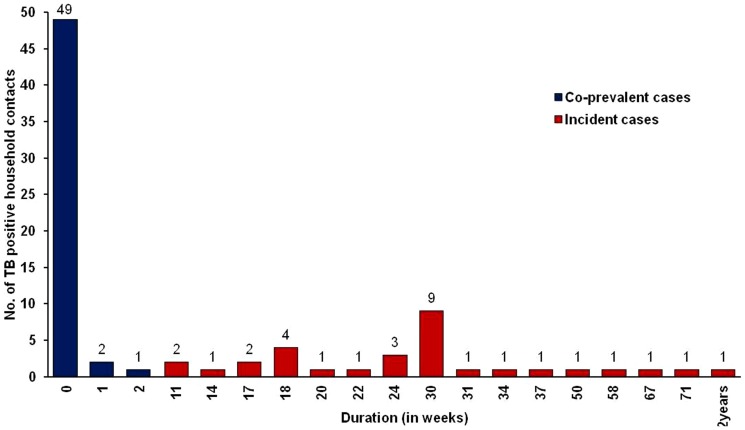
Methodology/principal findings: In this study, we have included 432 open index cases with their 1608 household contacts in a prospective cohort study conducted from May 2007 to March 2009. The follow-up period was 2 years. All Index cases were diagnosed on the basis of suggestive signs and symptoms and sputum being AFB positive. Among the 432 index patients, 250 (57.9%) were males and 182 (42.1%) females; with mean age of 34 ± 14.4 yr and 26 ± 11.1 yr, respectively. Out of 1608 household contacts, 866 (53.9%) were males and 742 (46.1%) females; with mean age of 26.5 ± 15.8 and 26.5 ± 16.0 yr, respectively. Of the total 432 households, 304 (70.4%) had ≤ 4 members and 128 (29.6%) had ≥ 5 members. The median size of the family was four. Of the 1608 contacts, 1206 were able to provide sputum samples, of whom 83 (6.9%) were found MTB culture positive. Household contacts belonging to adult age group were predominantly (74, 89.2%) infected as compared to the children (9, 10.8%). On screening the contact relationship status with index patients, 52 (62.7%) were first-degree relatives, 18 (34.6%) second-degree relatives and 12 (14.5%) spouses who got infected from their respective index patients. Co-prevalent and incident tuberculosis was found in 52 (4.3%) and 31 (2.6%) contacts, respectively. In incident cases, the diagnosis could be made between 4 to 24 months of follow-up, after their baseline evaluation.
Conclusion: Active household contact investigation is a powerful tool to detect and treat tuberculosis at early stages and the only method to control TB in high-TB-burden countries.
Conflict of interest statement
Figures
References
-
- World Health Organization (2011) Global tuberculosis control. WHO Report. Geneva. Available at http://www.who.int/tb/publications/global_report/2011/gtbr11_full.pdf. Accessed on June 14, 2013.
-
- American Thoracic Society and Centers for Disease Control and Prevention (2000) Diagnostic standards and classification of tuberculosis in adults and children. Am J Respir Crit Care Med 161: 1376–1395. - PubMed
-
- Kenyon TA, Creek T, Laserson K, Makhoa M, Chimidza N, et al. (2002) Risk factors for transmission of Mycobacterium tuberculosis from HIV infected tuberculosis patients, Botswana. Int J Tuberc Lung Dis 6: 843–850. - PubMed
-
- Sinfield R, Nyirenda M, Haves S, Molyneux EM, Graham SM (2006) Risk factors for TB infection and disease in young childhood contacts in Malawi. Ann Trop Paediatr 26: 205–213. - PubMed
-
- Triasih R, Rutherford M, Lestari T, Utarini A, Robertson CF, et al. (2012) Contact investigation of children exposed to tuberculosis in South East Asia: A Systematic Review. J Trop Med doi-10.1155/2012/301808.epub 2011 NOV 15, accessed on June 14, 2013. - DOI - PMC - PubMed
Publication types
MeSH terms
LinkOut - more resources
Full Text Sources
Other Literature Sources
