


The mental health consequences of the recession: economic hardship and employment of people with mental health problems in 27 European countries
- PMID: 23922801
- PMCID: PMC3724888
- DOI: 10.1371/journal.pone.0069792
The mental health consequences of the recession: economic hardship and employment of people with mental health problems in 27 European countries
Abstract
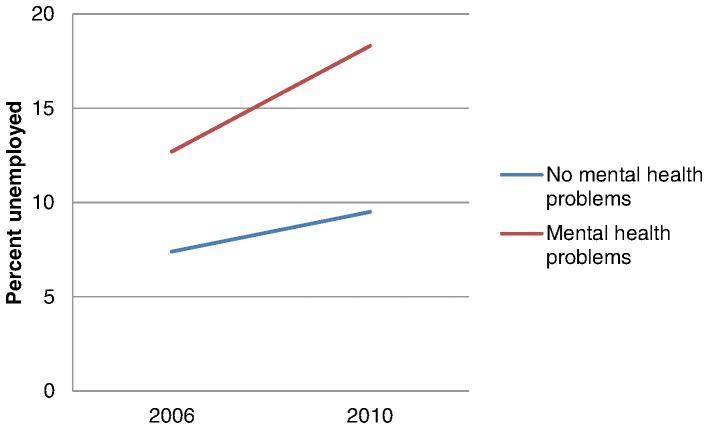
Objectives: A period of economic recession may be particularly difficult for people with mental health problems as they may be at higher risk of losing their jobs, and more competitive labour markets can also make it more difficult to find a new job. This study assesses unemployment rates among individuals with mental health problems before and during the current economic recession.
Methods: Using individual and aggregate level data collected from 27 EU countries in the Eurobarometer surveys of 2006 and 2010, we examined changes in unemployment rates over this period among individuals with and without mental health problems.
Results: Following the onset of the recession, the gap in unemployment rates between individuals with and without mental health problems significantly widened (odds ratio: 1.12, 95% confidence interval: 1.03, 1.34). This disparity became even greater for males, and individuals with low levels of education. Individuals with mental health problems living in countries with higher levels of stigmatizing attitudes regarding dangerousness of people with mental illness were more vulnerable to unemployment in 2010, but not 2006. Greater agreement that people with mental health problems have themselves to blame, was associated with lower likelihood of unemployment for individuals with and without mental health problems.
Conclusion: These findings study suggest that times of economic hardship may intensify social exclusion of people with mental health problems, especially males and individuals with lower education. Interventions to combat economic exclusion and to promote social participation of individuals with mental health problems are even more important during times of economic crisis, and these efforts should target support to the most vulnerable groups.
Conflict of interest statement
Figures
References
-
- Mechanic D, Blider S, McAlpine DD (2002) Employing persons with serious mental illness. Health Aff (Millwood) 21: 242–253. - PubMed
-
- Zhang X, Zhao X, Harris A (2009) Chronic diseases and labour force participation in Australia. J Health Econ 28: 91–108. - PubMed
-
- Dewa CS, McDaid D, Ettner SL (2007) An international perspective on worker mental health problems: who bears the burden and how are costs addressed? Can J Psychiatry 52: 346–356. - PubMed
Publication types
MeSH terms
Grants and funding
LinkOut - more resources
Full Text Sources
Other Literature Sources
Medical
Research Materials
Miscellaneous
