


Electronic health record-based assessment of oral corticosteroid use in a population of primary care patients with asthma: an observational study
- PMID: 23924393
- PMCID: PMC3846655
- DOI: 10.1186/1710-1492-9-27
Electronic health record-based assessment of oral corticosteroid use in a population of primary care patients with asthma: an observational study
Abstract
Background: Oral corticosteroid prescriptions are often used in clinical studies as an indicator of asthma exacerbations. However, there is rarely the ability to link a prescription to its associated diagnosis. The objective of this study was to characterize patterns of oral corticosteroid prescription orders for asthma patients using an electronic health record database, which links each prescription order to the diagnosis assigned at the time the order was placed.
Methods: This was a retrospective cohort study of the electronic health records of asthma patients enrolled in the Geisinger Health System from January 1, 2001 to August 23, 2010. Eligible patients were 12-85 years old, had a primary care physician in the Geisinger Health System, and had asthma. Each oral corticosteroid order was classified as being prescribed for an asthma-related or non-asthma-related condition based on the associated diagnosis. Asthma-related oral corticosteroid use was classified as either chronic or acute. In patient-level analyses, we determined the number of asthma patients with asthma-related and non-asthma-related prescription orders and the number of patients with acute versus chronic use. Prescription-level analyses ascertained the percentages of oral corticosteroid prescription orders that were for asthma-related and non-asthma-related conditions.
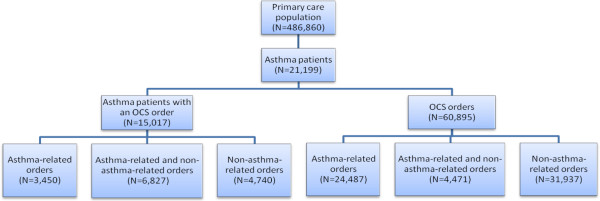
Results: Among the 21,199 asthma patients identified in the electronic health record database, 15,017 (70.8%) had an oral corticosteroid prescription order. Many patients (N = 6,827; 45.5%) had prescription orders for both asthma-related and non-asthma-related conditions, but some had prescription orders exclusively for asthma-related (N = 3,450; 23.0%) or non-asthma-related conditions (N = 4,740; 31.6%). Among the patients receiving a prescription order, most (87.5%) could be classified as acute users. A total of 60,355 oral corticosteroid prescription orders were placed for the asthma patients in this study-31,397 (52.0%) for non-asthma-related conditions, 24,487 (40.6%) for asthma-related conditions, and 4,471 (7.4%) for both asthma-related and non-asthma-related conditions.
Conclusions: Oral corticosteroid prescriptions for asthma patients are frequently ordered for conditions unrelated to asthma. A prescription for oral corticosteroids may be an unreliable marker of asthma exacerbations in retrospective studies utilizing administrative claims data. Investigators should consider co-morbid conditions for which oral corticosteroid use may also be indicated and/or different criteria for assessing oral corticosteroid use for asthma.
Figures
References
-
- National Asthma Education and Prevention Program Expert Panel. Guidelines for the diagnosis and management of asthma: full report. National heart, lung, and blood Institute. J Allergy Clin Immunol. 2007;120(5 Suppl):S94–138. - PubMed
-
- Reddel HK, Taylor DR, Bateman ED, Boulet LP, Boushey HA, Busse WW, Casale TB, Chanez P, Enright PL, Gibson PG. et al. An official american thoracic society/european respiratory society statement: asthma control and exacerbations: standardizing endpoints for clinical asthma trials and clinical practice. Am J Respir Crit Care Med. 2009;180:59–99. doi: 10.1164/rccm.200801-060ST. - DOI - PubMed
-
- Schatz M, Nakahiro R, Jones CH, Roth RM, Joshua A, Petitti D. Asthma population management: development and validation of a practical 3-level risk stratification scheme. Am J Manag Care. 2004;10:25–32. - PubMed
LinkOut - more resources
Full Text Sources
Other Literature Sources
