. 2013 Sep 26;501(7468):560-3.
doi: 10.1038/nature12476. Epub 2013 Aug 7.

Limited airborne transmission of H7N9 influenza A virus between ferrets

Affiliations

Limited airborne transmission of H7N9 influenza A virus between ferrets

Mathilde Richard et al. Nature. .

Abstract

Wild waterfowl form the main reservoir of influenza A viruses, from which transmission occurs directly or indirectly to various secondary hosts, including humans. Direct avian-to-human transmission has been observed for viruses of subtypes A(H5N1), A(H7N2), A(H7N3), A(H7N7), A(H9N2) and A(H10N7) upon human exposure to poultry, but a lack of sustained human-to-human transmission has prevented these viruses from causing new pandemics. Recently, avian A(H7N9) viruses were transmitted to humans, causing severe respiratory disease and deaths in China. Because transmission via respiratory droplets and aerosols (hereafter referred to as airborne transmission) is the main route for efficient transmission between humans, it is important to gain an insight into airborne transmission of the A(H7N9) virus. Here we show that although the A/Anhui/1/2013 A(H7N9) virus harbours determinants associated with human adaptation and transmissibility between mammals, its airborne transmissibility in ferrets is limited, and it is intermediate between that of typical human and avian influenza viruses. Multiple A(H7N9) virus genetic variants were transmitted. Upon ferret passage, variants with higher avian receptor binding, higher pH of fusion, and lower thermostability were selected, potentially resulting in reduced transmissibility. This A(H7N9) virus outbreak highlights the need for increased understanding of the determinants of efficient airborne transmission of avian influenza viruses between mammals.


Conflict of interest statement

The authors declare no competing financial interest.

Figures
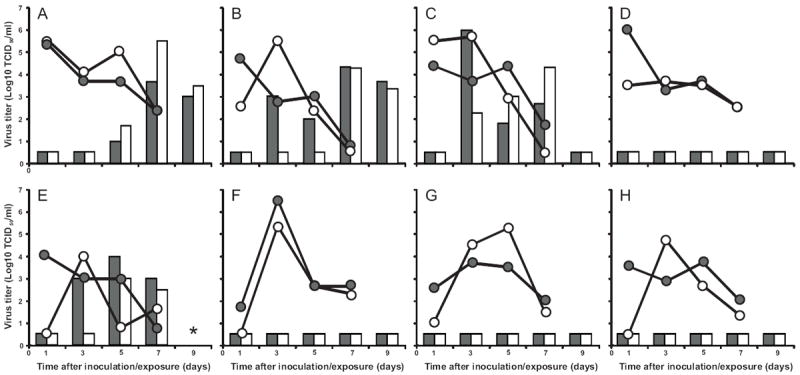
Figure 1
Figure 1
Airborne transmission of AN1 viruses between ferrets. Transmission experiments are shown for AN1 virus isolate in four ferret pairs (F1-F4) in panels A-D. A nose swab sample from the recipient ferret F1 at 7 dpe was used for the transmission experiments in four ferret pairs (F5-F8) shown in panels E-H. Data for individual transmission experiments is shown in each panel, with virus shedding in inoculated and airborne virus–exposed animals shown as lines and bars, respectively. Black circles and bars represent shedding from the throat; white circles and bars represent shedding from the nose. The asterisk indicates the lack of swab collection at 9 dpe for the recipient ferret euthanized at 8 dpe. The lower limit of detection is 0.5 log10 TCID50/mL.
Figure 2
Figure 2
Cartoon representation of a model of the trimer structure of HA of AN1 (green) and AN1N123D,N149D(cyan) bound to α2.6 (A) and α2.3 linked sialic acids (B). The structure of the three-sugar glycan NeuAcα2,6Galβ1-4GlcNAc (A) and NeuAcα2,3Galβ1-4GlcNAc (B) were docked into the H7 receptor binding site (RBS). The glycans and the amino acids substitutions discussed in the text are shown as sticks. Amino acids N123 and N149 are adjacent to the RBS and, in AN1, do not interact directly with the three-sugar glycans that are depicted in the figure. The mutations cause small changes in the position of some of the residues around the receptor binding site, notably R121 and D148, and additionally for the α2,6 linked glycan, residues S128 and Q213. The D123 mutant can form stronger interactions with the sidechain of R121 restricting the movement and orientating its sidechain to point towards the RBS and interact with the glycan. In AN1, N149 interacts with the neighbouring residue, D148, restricting its orientation. The D149 mutant allows the sidechain of D148 to rearrange and interact with the glycan. These changes allow both the α2,6- and α2,3-linked glycans to alter position and form more interactions with the HA. All residues are labelled in H7 numbering.

Comment in

References

    1. Webster RG, Bean WJ, Gorman OT, Chambers TM, Kawaoka Y. Evolution and ecology of influenza A viruses. Microbiol Rev. 1992;56:152–179. - PMC - PubMed
    1. Beigel JH, et al. Avian influenza A (H5N1) infection in humans. N Engl J Med. 2005;353:1374–1385. - PubMed
    1. Hirst M, et al. Novel avian influenza H7N3 strain outbreak, British Columbia. Emerg Infect Dis. 2004;10:2192–2195. - PMC - PubMed
    1. Fouchier RA, et al. Avian influenza A virus (H7N7) associated with human conjunctivitis and a fatal case of acute respiratory distress syndrome. Proc Natl Acad Sci USA. 2004;101:1356–1361. - PMC - PubMed
    1. Ostrowsky B, et al. Low pathogenic avian influenza A (H7N2) virus infection in immunocompromised adult, New York, USA, 2003. Emerg Infect Dis. 2012;18:1128–1131. - PMC - PubMed

Publication types

MeSH terms

Substances
