. 2012 Apr 25:4:e4f972cffe82c0.
doi: 10.1371/4f972cffe82c0.

A mixed fixed ratio/progressive ratio procedure reveals an apathy phenotype in the BAC HD and the z_Q175 KI mouse models of Huntington's disease

Affiliations

A mixed fixed ratio/progressive ratio procedure reveals an apathy phenotype in the BAC HD and the z_Q175 KI mouse models of Huntington's disease

Stephen Oakeshott et al. PLoS Curr. .

Abstract

Apathy, characterized by generally reduced interest in and likelihood to perform goal-directed actions, is a recognized symptom of Huntington's disease (HD), a devastating neurological disorder caused by a CAG repeat expansion of the Htt gene located on chromosome 4. The present experiments used a modified progressive ratio task that incorporated a fixed-ratio schedule of reinforcement component to assess consummatory behavior, and a progressive-ratio schedule component that required increasing numbers of lever-presses for successive reinforcers (0.01 ml of evaporated milk). The studies revealed an apathetic phenotype in two mouse models of HD, with decreased response rates either overall or only at higher ratio requirements in the progressive-ratio component relative to wild-type controls. Based on the procedure used (within-session fixed- and progressive-ratio components), it is proposed that an observed phenotype can be ascribed either specifically to reduced motivation to work for food reinforcement or more generally to deficits in consummatory behavior. This procedure provides a simple means to assess this type of phenotype in rodents, with issues in consummatory vs. incentive motivation reflected in general alterations in fixed- versus progressive alterations on an escalating-ratio schedules respectively, providing translational measures of the amotivation/apathy construct of the human realm to the homologous construct of incentive motivation in preclinical models of human disease.


Figures
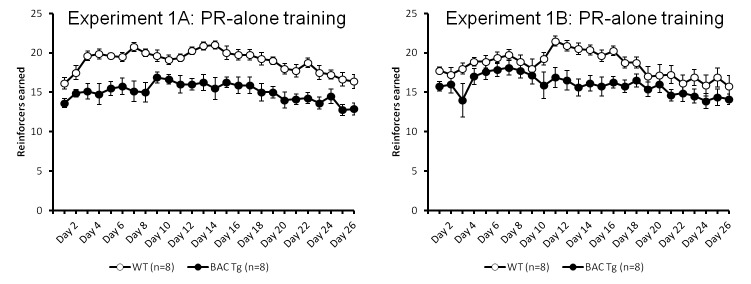
Number of reinforcers earned during progressive ratio training across sessions in Experiments 1A (left panel) and 1B (right panel)
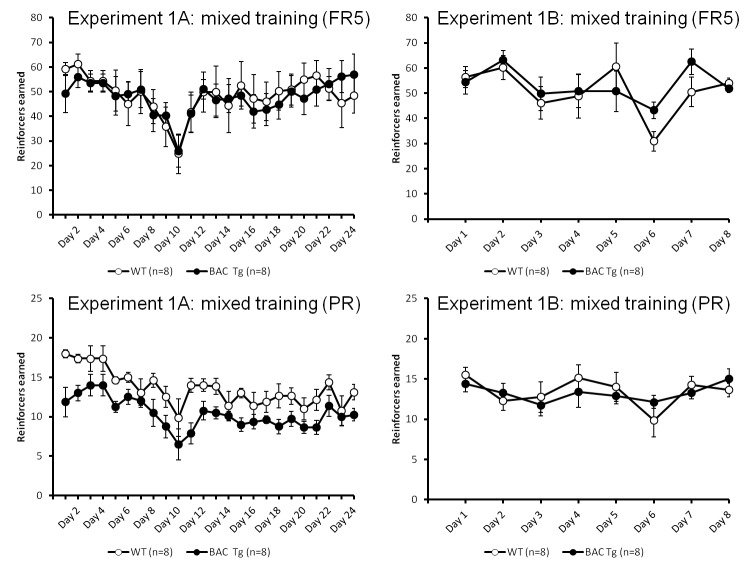
Summarized data from mixed FR5/PR training across sessions in Experiment 1A (left panels) and Experiment 1B (right panels)
Data from the 10 min FR5 training period are presented in the upper panels, while data from the 80 min PR training period are presented in the lower panels.
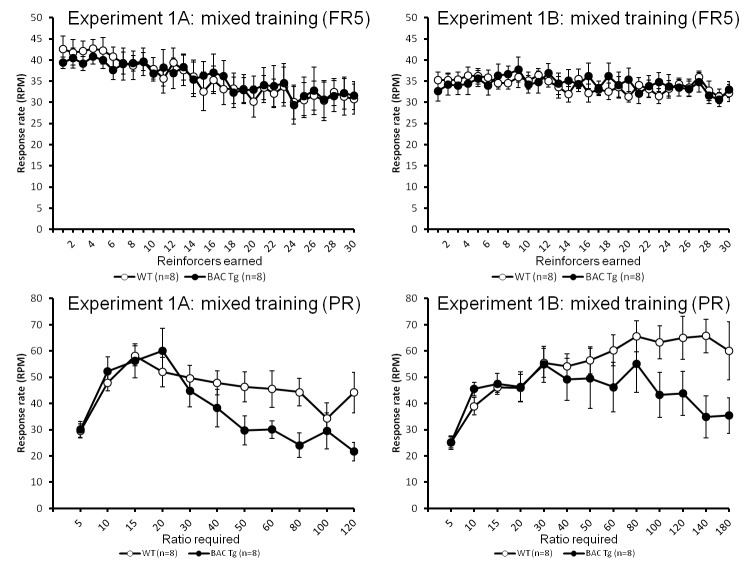
Collapsed response rate data from the final 8 sessions of FR5/PR training broken down by reinforcer for Experiment 1A (left panels) and Experiment 1B (right panels)
Data from the FR5 training period (upper panels) are labeled per reinforcer earned, while those from the PR training period (lower panels) are instead labeled by the ratio requirement, such that each datapoint indicates the mean response rate while working on that ratio.
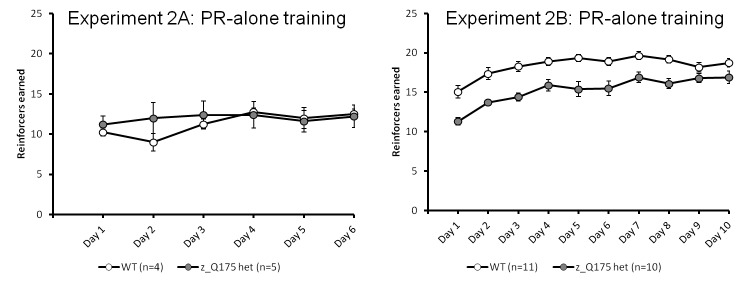
Number of reinforcers earned during progressive ratio training across sessions in Experiments 2A (left panel) and 2B (right panel)
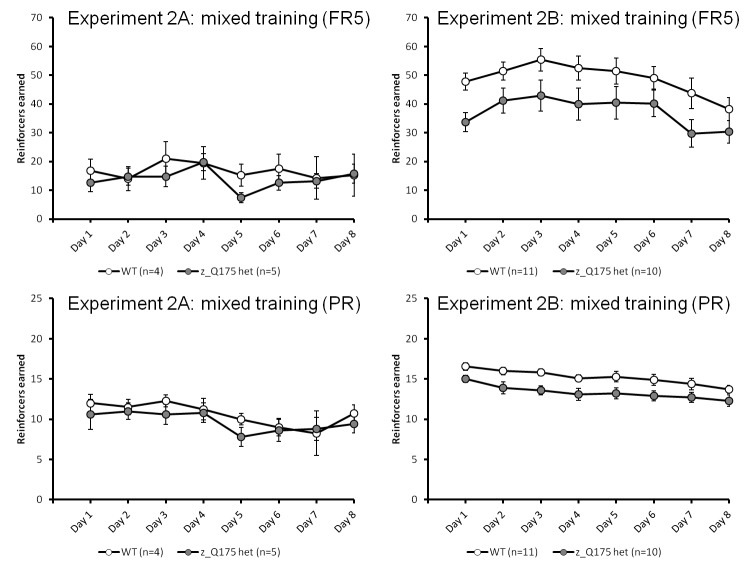
Summarized data from mixed FR5/PR training across sessions in Experiment 2A (left panels) and Experiment 2B (right panels)
Data from the initial FR5 training period are presented in the upper panels, while data from the PR training period are presented in the lower panels.
Collapsed response rate data from the 8 sessions of FR5/PR training broken down by reinforcer for Experiment 2A (left panels) and Experiment 2B (right panels)
Data from the FR5 training period (upper panels) are labeled per reinforcer earned, while those from the PR training period (lower panels) are instead labeled by the ratio requirement, such that each datapoint indicates the mean response rate while working on that ratio.

References

    1. Roos RA, Hermans J, Vegter-van der Vlis M, van Ommen GJ, Bruyn GW (1993) Duration of illness in Huntington's disease is not related to age at onset. J Neurol Neurosurg Psychiatry 56: 98-100. - PMC - PubMed
    1. Craufurd D, Snowden J (2002) Neuropsychological and neuropsychiatric aspects of Huntington’s Disease In: Bates G, Harper PS, Jones L, editors. Huntington's Disease. Oxford: Oxford University Press. pp. 62-94.
    1. Ishizaki J, Mimura M (2011) Dysthymia and apathy: diagnosis and treatment. Depress Res Treat 2011: 893905. - PMC - PubMed
    1. Caine ED, Shoulson I (1983) Psychiatric syndromes in Huntington's disease. Am J Psychiatry 140: 728-733. - PubMed
    1. Marin RS, Biedrzycki RC, Firinciogullari S (1991) Reliability and validity of the apathy evaluation scale. Psychiatry Research 38: 143-162. - PubMed

LinkOut - more resources