. 2013:4:2267.
doi: 10.1038/ncomms3267.

The TFEB orthologue HLH-30 regulates autophagy and modulates longevity in Caenorhabditis elegans

Affiliations

The TFEB orthologue HLH-30 regulates autophagy and modulates longevity in Caenorhabditis elegans

Louis R Lapierre et al. Nat Commun. 2013.

Abstract

Autophagy is a cellular recycling process that has an important anti-aging role, but the underlying molecular mechanism is not well understood. The mammalian transcription factor EB (TFEB) was recently shown to regulate multiple genes in the autophagy process. Here we show that the predicted TFEB orthologue HLH-30 regulates autophagy in Caenorhabditis elegans and, in addition, has a key role in lifespan determination. We demonstrate that hlh-30 is essential for the extended lifespan of Caenorhabditis elegans in six mechanistically distinct longevity models, and overexpression of HLH-30 extends lifespan. Nuclear localization of HLH-30 is increased in all six Caenorhabditis elegans models and, notably, nuclear TFEB levels are augmented in the livers of mice subjected to dietary restriction, a known longevity-extending regimen. Collectively, our results demonstrate a conserved role for HLH-30 and TFEB in autophagy, and possibly longevity, and identify HLH-30 as a uniquely important transcription factor for lifespan modulation in Caenorhabditis elegans.


Conflict of interest statement

Competing financial interests: The authors declare no competing financial interests.

Figures

Figure 1
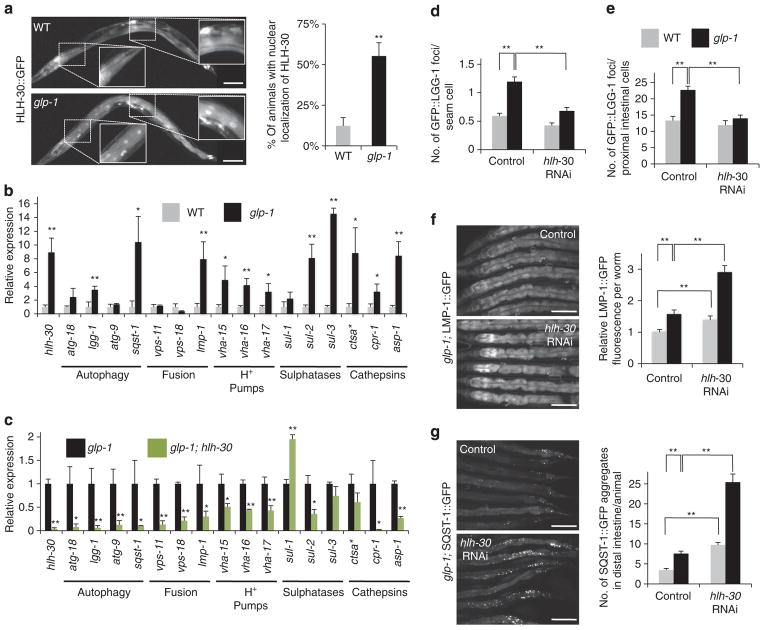
Figure 1. HLH-30 regulates autophagy in germline-less C. elegans
(a) Nuclear localization of HLH-30 was visualized by fluorescence microscopy in day 1 adult wild-type (WT) (upper panel) and glp-1(e2141) (lower panel) animals expressing HLH-30::GFP raised at the non-permissive temperature (25 °C). Inserts show enlarged intestinal cells. Graph shows percentage of animals with HLH-30 in the nuclei of intestinal cells (four biological replicates, ~50 animals each, mean±s.d., **P<0.01, Student’s t-test). Magnification ×100; scale bar, 100 μm. (b) Expression of hlh-30 and putative autophagy-related and lysosomal target genes was measured by quantitative PCR (qPCR) in day 1 adult WT and glp-1(e2141) animals raised at 25 °C (mean±s.d. of three biological replicates, *P<0.05, **P<0.01, Student’s t-test). (c) Expression of hlh-30 and putative autophagy-related and lysosomal target genes was measured by qPCR in day 1 adult glp-1(e2141) and glp-1(e2141); hlh-30(tm1978) animals raised at 25 °C (mean±s.d. of three biological replicates, *P<0.05, **P<0.01, Student’s t-test). ctsa* is a cathepsin A orthologue (cosmid C08H9.1 (ref. 30)). See Supplementary Fig. 1 for qPCR analyses of hlh-30(tm1978) (control for c) and WT and glp-1(e2141) animals fed bacteria expressing hlh-30 dsRNA. (d, e) GFP::LGG-1 punctae were quantified in (d) hypodermal seam cells or (e) proximal intestinal cells of L3 larvae of WT and glp-1(e2141) animals. Animals were fed bacteria expressing control or hlh-30 dsRNA for two generations at 20 °C. Eggs were then transferred to plates seeded with the appropriate dsRNA-expressing bacteria at 25 °C and analysed at the L3 larval stage (mean±s.e.m. of ~300 seam cells and ~25 intestines, **P<0.01, Student’s t-test). (f, g) glp-1(e2141) animals expressing (f) LMP-1::GFP or (g) SQST-1::GFP were raised at the non-permissive temperature (25 °C) and fed bacteria expressing control or hlh-30 dsRNA from hatching. Micrographs of the posterior intestine were taken on day 1 of adulthood, and LMP-1::GFP fluorescence (mean±s.d. of ~10 animals, **P<0.01, Student’s t-test) and SQST-1::GFP foci (mean±s.d. of ~30 animals, **P<0.01, Student’s t-test) were quantified. Experiments were performed at least three times with similar results. See Supplementary Fig. S2a, c for images of whole animals and Supplementary Fig. S2b,d for replicates. Magnification, ×200; scale bar, 100 μm.
Figure 2
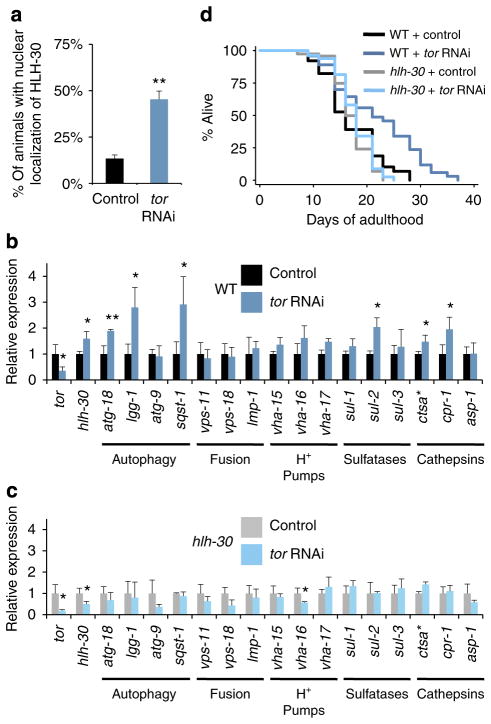
Figure 2. HLH-30 is required for TOR inhibition to extend C. elegans lifespan
(a) Nuclear localization of HLH-30 was quantified in day 1 adult animals expressing HLH-30::GFP. Animals were fed bacteria expressing control or tor dsRNA from hatching and raised at 20 °C (three biological replicates, ~50 animals each, mean±s.d., **P<0.01, Student’s t-test). (b, c) Expression of putative autophagy-related and lysosomal target genes was measured by quantitative PCR in day 1 (b) WT (N2) and (c) hlh-30(tm1978) animals fed bacteria expressing control or tor dsRNA from hatching (20 °C). Data are mean±s.d. of biological triplicates. *P<0.05, **P<0.01; Student’s t-test. (d) Lifespan analysis of WT animals and hlh-30(tm1978) mutants fed bacteria expressing control or tor dsRNA from day 1 of adulthood was carried out at 20 °C. See Supplementary Table S3 for details of lifespan analyses and replicate experiments.
Figure 3
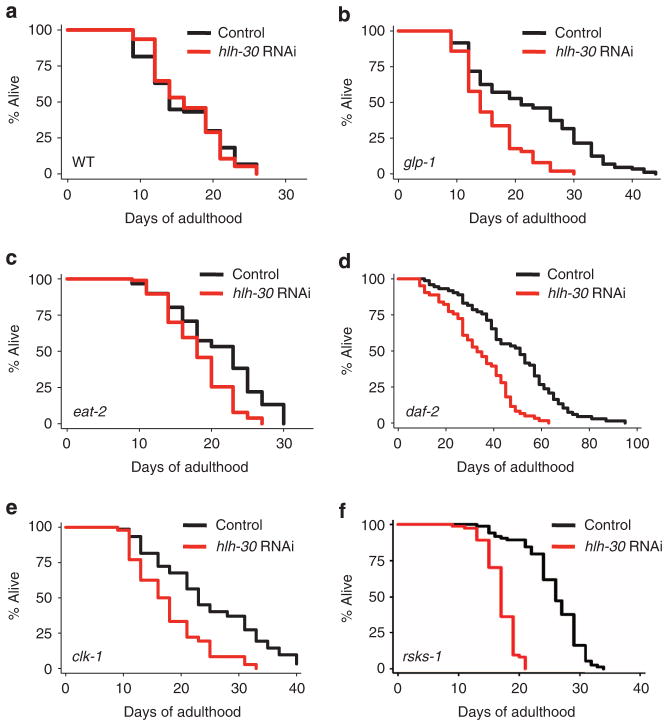
Figure 3. HLH-30 is required for the long lifespan of multiple longevity mutants
Lifespan analyses of (a) WT (N2) and (b) germline-less glp-1(e2141) animals raised at the non-permissive temperature (25 °C) and fed bacteria expressing control or hlh-30 dsRNA from day 1 of adulthood were carried out at 20 °C. Lifespan analyses of (c) dietary-restricted eat-2(ad1116) mutants, (d) insulin/IGF-1 receptor daf-2(e1370) mutants, (e) mitochondrial respiration clk-1(e2519) mutants and (f) mRNA translation rsks-1(sv31) mutants, fed bacteria expressing control or hlh-30 dsRNA from day 1 of adulthood (c, d, f) or larval L4 stage (e), were carried out at 20 °C. See Supplementary Table S2 for details of lifespan analyses including at least three independent experiments.
Figure 4
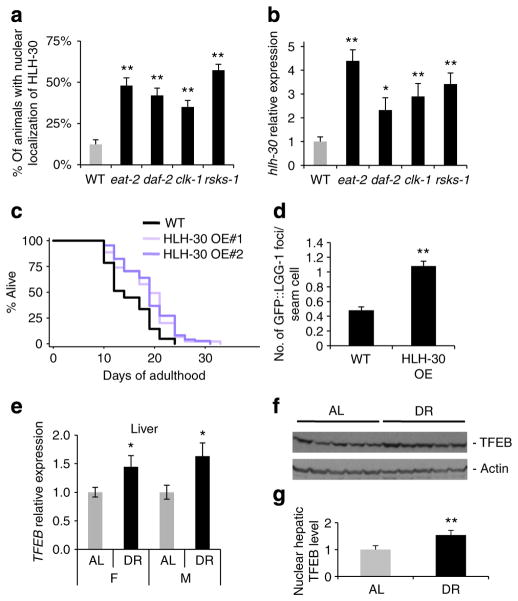
Figure 4. HLH-30 and TFEB are similarly regulated in nematode and mouse longevity models
(a) Expression of hlh-30 was measured by quantitative PCR (qPCR) in day 1 adult WT (N2), eat-2(ad1116) (dietary restriction, DR), daf-2(e1370) (insulin/IGF-1 signaling), clk-1(e2519) (mitochondrial respiration) and rsks-1(sv31) (mRNA translation) animals (mean±s.d. of three biological replicates, *P<0.05, Student’s t-test). (b) Nuclear localization of HLH-30 was quantified in day 1 adult WT, eat-2, daf-2, clk-1 and rsks-1 mutants (mean±s.d. of four biological replicates, ~50 animals each, **P<0.01, analysis of variance). (c) Lifespan analysis of WT and transgenic animals overexpressing HLH-30::GFP, and raised and maintained on OP50 was carried out at 20 °C. See Supplementary Table S7 for details of lifespan analyses and replicate experiments. (d) GFP::LGG-1 punctae were quantified in hypodermal seam cells of WT animals or animals overexpressing HLH-30 (n>300, ±s.e.m., **P<0.01, Student’s t-test). The increase in GFP::LGG-1 punctae observed in animals overexpressing HLH-30 could be reversed by atg-18 RNAi treatment (data not shown). (e) TFEB expression was measured by qPCR in the livers of 4.5-month-old female (F) and male (M) mice fed AL or subjected to DR for 5.5 weeks starting at 3 months of age (mean±s.e.m. of ~20 mice per group, *P<0.05, Student’s t-test). (f) TFEB protein was detected by western blotting of nuclear fractions from the livers of five female and five male mice fed AL or subjected to DR. Actin was included as a fractionation control and was detected only in the cytosolic fraction. See Supplementary Fig. S8 for additional controls. (g) TFEB protein levels in Fig. 4f were quantified by densitometry and normalized to actin (mean±s.d., *P<0.05, Student’s t-test).

References

    1. Lapierre LR, Hansen M. Lessons from C. elegans: signaling pathways for longevity. Trends Endocrinol Metab. 2012;23:637–644. - PMC - PubMed
    1. Rubinsztein DC, Marino G, Kroemer G. Autophagy and aging. Cell. 2011;146:682–695. - PubMed
    1. Gelino S, Hansen M. Autophagy—an emerging anti-aging mechanism. J Clin Exp Pathol. 2012;(Suppl 4) pii.006. - PMC - PubMed
    1. Lapierre LR, Gelino S, Melendez A, Hansen M. Autophagy and lipid metabolism coordinately modulate life span in germline-less C. elegans. Curr Biol. 2011;21:1507–1514. - PMC - PubMed
    1. Sheaffer KL, Updike DL, Mango SE. The target of rapamycin pathway antagonizes pha-4/FoxA to control development and aging. Curr Biol. 2008;18:1355–1364. - PMC - PubMed

Publication types

Substances