


Grip strength and its determinants among older people in different healthcare settings
- PMID: 23926093
- PMCID: PMC3918578
- DOI: 10.1093/ageing/aft118
Grip strength and its determinants among older people in different healthcare settings
Abstract
Background: low muscle strength is central to geriatric syndromes including sarcopenia and frailty. It is well described in community-dwelling older people, but the epidemiology of grip strength of older people in rehabilitation or long-term care has been little explored.
Objective: to describe grip strength of older people in rehabilitation and nursing home settings.
Design: cross-sectional epidemiological study.
Setting: three healthcare settings in one town.
Subjects: hundred and one inpatients on a rehabilitation ward, 47 community rehabilitation referrals and 100 nursing home residents.
Methods: grip strength, age, height, weight, body mass index, number of co-morbidities and medications, Barthel score, Mini-Mental State Examination (MMSE), nutritional status and number of falls in the last year were recorded.
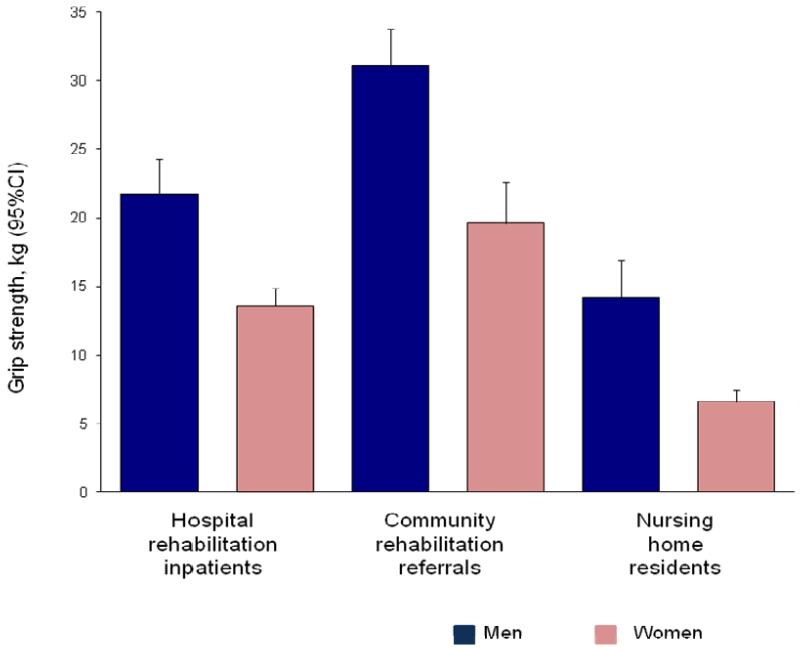
Results: grip strength differed substantially between healthcare settings for both men and women (P < 0.0001). Nursing home residents had the lowest age-adjusted mean grip strength and community rehabilitation referrals the highest. Broadly higher grip strength was associated in univariate analyses with younger age, greater height and weight, fewer comorbidities, higher Barthel score, higher MMSE score, better nutritional status and fewer falls. However, after mutual adjustment for these factors, the difference in grip strength between settings remained significant. The Barthel score was the characteristic most strongly associated with grip strength.
Conclusions: older people in rehabilitation and care home settings had lower grip strength than reported for those living at home. Furthermore grip strength varied widely between healthcare settings independent of known major influences. Further research is required to ascertain whether grip strength may help identify people at risk of adverse health outcomes within these settings.
Keywords: grip strength; healthcare setting; nursing home; older people; rehabilitation.
Figures
References
-
- Syddall H, Cooper C, Martin F, Briggs R, Aihie SA. Is grip strength a useful single marker of frailty? Age Ageing. 2003 Nov;32(6):650–6. - PubMed
-
- Choquette S, Bouchard DR, Doyon CY, Senechal M, Brochu M, Dionne IJ. Relative strength as a determinant of mobility in elders 67-84 years of age. a nuage study: nutrition as a determinant of successful aging. J Nutr Health Aging. 2010 Mar;14(3):190–5. - PubMed
-
- Rantanen T, Guralnik JM, Foley D, Masaki K, Leveille S, Curb JD, et al. Midlife hand grip strength as a predictor of old age disability. JAMA. 1999 Feb 10;281(6):558–60. - PubMed
Publication types
MeSH terms
Grants and funding
LinkOut - more resources
Full Text Sources
Other Literature Sources
Medical
