. 2013 Aug 7;33(32):13094-100.
doi: 10.1523/JNEUROSCI.2144-13.2013.

Matching dynamics of presynaptic and postsynaptic scaffolds

Affiliations

Matching dynamics of presynaptic and postsynaptic scaffolds

Arava Fisher-Lavie et al. J Neurosci. .

Abstract

Synapses undergo substantial activity-dependent and independent remodeling over time scales of minutes, hours, and days. Presumably, changes in presynaptic properties should be matched by corresponding changes in postsynaptic properties and vice versa. Wherever measured, presynaptic and postsynaptic molecular properties tend to correlate, yet these correlations are often quite imperfect, raising questions as the origins of such mismatches: Are these the outcome of "single snapshot" analyses of asynchronous remodeling processes? Alternatively, do these indicate that synapses genuinely vary in the "stoichiometries" of their presynaptic and postsynaptic molecular contents? If so, are these "stoichiometries" preserved over time? To address these questions, we followed the matching dynamics of the presynaptic active-zone molecule Munc13-1 and the postsynaptic molecule PSD-95 in networks of cultured cortical mouse neurons. We find that presynaptic and postsynaptic remodeling were generally well correlated, but the degree of this correlation was highly variable, with little and even negative correlation observed at some synapses. No evidence was found that remodeling in one compartment consistently preceded remodeling in the other. Interestingly, even though the Munc13-1 and PSD-95 contents of individual synapses changed considerably over 15-22 h, Munc13-1/PSD-95 ratios, which varied over a fourfold range, were well conserved over these durations. These findings indicate that the "stoichiometries" of presynaptic and postsynaptic molecules can genuinely differ among synapses and that synapses can maintain their specific stoichiometries even in face of extensive presynaptic and postsynaptic remodeling.


Figures
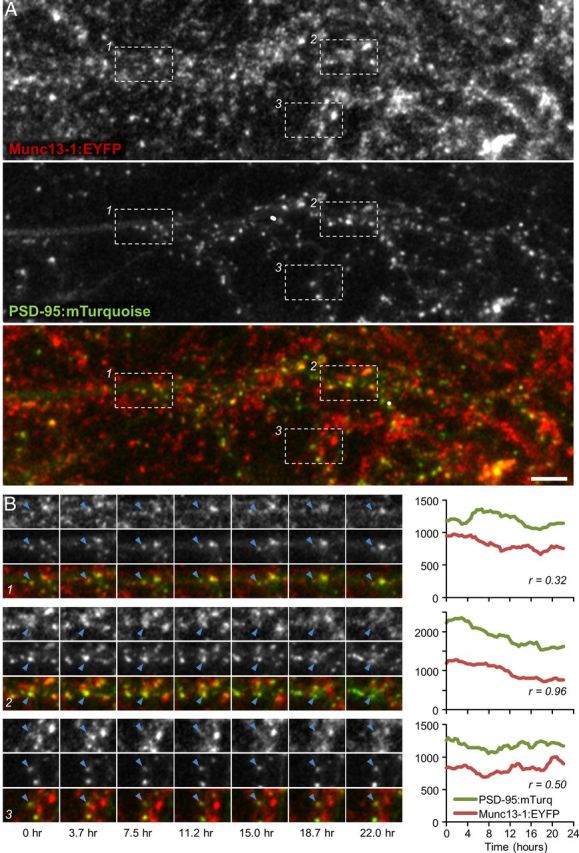
Figure 1.
Figure 1.
Concurrent remodeling of presynaptic and postsynaptic compartments. A, Cortical neurons in primary culture prepared from Munc13-1:EYFP KI neurons (top), in which sparse expression of PSD95:mTurq was induced (middle). Scale bar, 10 μm. B, Time lapse images of three synapses (blue arrowheads) enclosed within rectangles in A. Fluorescence intensity profiles for Munc13-1:EYFP and PSD-95:mTurq and temporal correlation coefficients (Pearson's r) for these profiles are shown to their right.
Figure 2.
Figure 2.
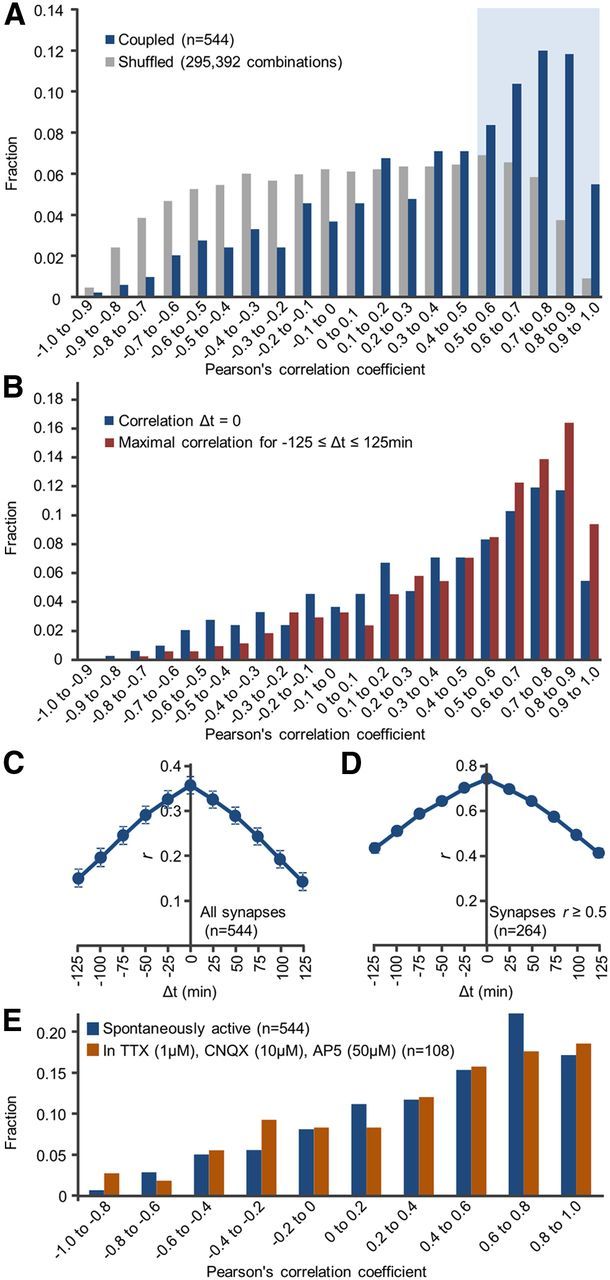
Temporal correlations between Munc13-1:EYFP and PSD95:mTurq at individual synapses. A, Distribution of temporal correlation coefficients for all synapses (“coupled”; red) and for all combinations of unassociated Munc13-1:EYFP and PSD-95:mTurq puncta (“shuffled”; gray, 295,392 combinations). Blue area represents synapses for which r ≥ 0.5. B, Distribution of best correlation coefficients obtainable by temporally offsetting changes in one compartment in respect to other by ±125 min. C, Mean ± SEM cross-correlation values for all synapses. D, Only for synapses for which r ≥ 0.5. E, Distribution of temporal correlation coefficients in the presence of pharmacological agents that block glutamatergic synapses and network activity.
Figure 3.
Figure 3.
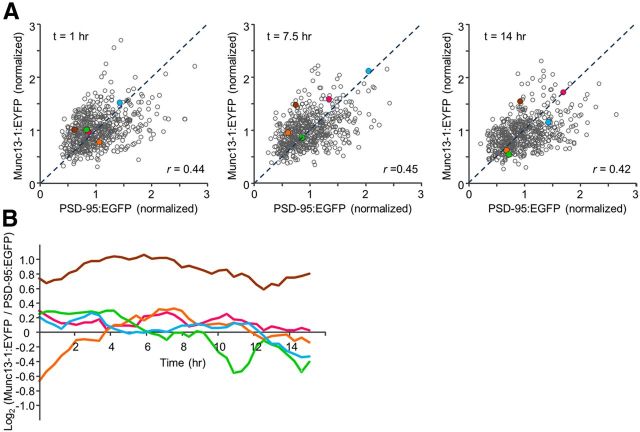
Changes in Munc13-1:EYFP/PSD-95:mTurq ratios over time. A, Normalized fluorescence values of Munc13-1:EYFP and PSD-95:mTurq plotted against each other at three different times. Five particular synapses are color coded in all three plots (all from the r ≥ 0.5 population shown in Fig. 2A). Dashed lines indicate unity ratios. B, Changes over time in Munc13-1:EYFP/PSD-95:mTurq ratios (on a Log2 scale) for the same five color-coded puncta. For some synapses, these ratios (“stoichiometries”) were rather stable, whereas for others they were more variable.
Figure 4.
Figure 4.
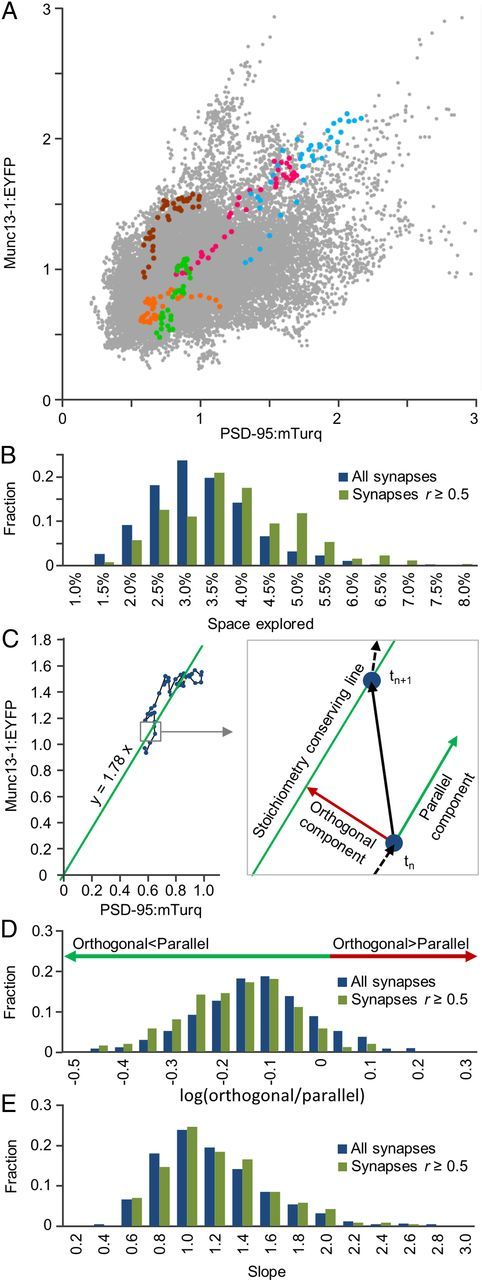
Synapses conserve specific but variable Munc13-1:EYFP/PSD-95:mTurq “stoichiometries.” A, Parameter space of Munc13-1:EYFP/PSD-95:mTurq fluorescence values, obtained by plotting these values for all synapses at all time points. Data for the five synapses of Figure 3 are shown according to same color code. B, Distributions of fractional parameter space area explored by individual synapses. C, Decomposition of exploration into parallel and orthogonal components relative to “stoichiometry-conserving lines.” The slopes of these lines were calculated separately for each synapse by linear regression, forcing the offset constant to zero. D, Distributions of orthogonal/parallel travel ratios. There is a strong bias toward ratios < 1.0. E, Distributions of “stoichiometry-conserving line” slopes.

References

    1. Branco T, Staras K. The probability of neurotransmitter release: variability and feedback control at single synapses. Nat Rev Neurosci. 2009;10:373–383. doi: 10.1038/nrn2634. - DOI - PubMed
    1. Branco T, Staras K, Darcy KJ, Goda Y. Local dendritic activity sets release probability at hippocampal synapses. Neuron. 2008;59:475–485. doi: 10.1016/j.neuron.2008.07.006. - DOI - PMC - PubMed
    1. Fisher-Lavie A, Zeidan A, Stern M, Garner CC, Ziv NE. Use dependence of presynaptic tenacity. J Neurosci. 2011;31:16770–16780. doi: 10.1523/JNEUROSCI.3384-11.2011. - DOI - PMC - PubMed
    1. Frank CA, Kennedy MJ, Goold CP, Marek KW, Davis GW. Mechanisms underlying the rapid induction and sustained expression of synaptic homeostasis. Neuron. 2006;52:663–677. doi: 10.1016/j.neuron.2006.09.029. - DOI - PMC - PubMed
    1. Gerrow K, Triller A. Synaptic stability and plasticity in a floating world. Curr Opin Neurobiol. 2010;20:631–639. doi: 10.1016/j.conb.2010.06.010. - DOI - PubMed

Publication types

MeSH terms

LinkOut - more resources