Global eradication rates for Helicobacter pylori infection: systematic review and meta-analysis of sequential therapy
- PMID: 23926315
- PMCID: PMC3736972
- DOI: 10.1136/bmj.f4587
Global eradication rates for Helicobacter pylori infection: systematic review and meta-analysis of sequential therapy
Abstract
Objective: To do a systematic review and meta-analysis of studies comparing sequential therapy for eradication of Helicobacter pylori with pre-existing and new therapies, thus providing a glimpse of eradication success worldwide.
Design: Systematic review and meta-analysis.
Data sources: Medline, Embase, and Cochrane Central Register of Controlled Trials up to May 2013; abstract books of major European, American, and Asian gastroenterological meetings.
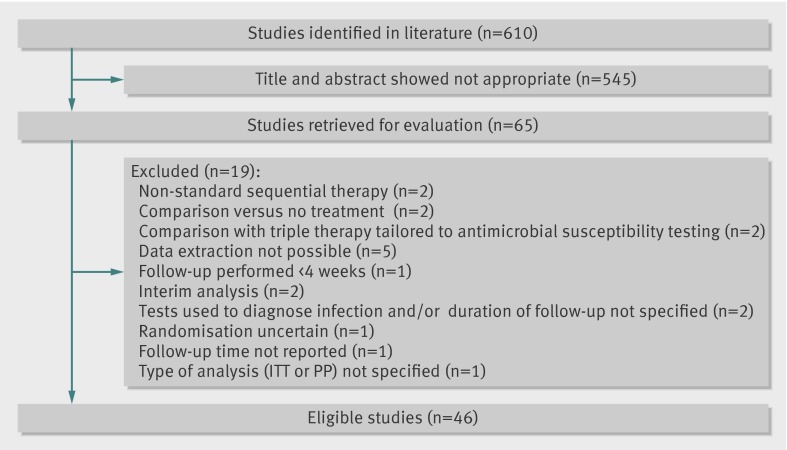
Study selection: Randomised controlled trials in previously untreated adults, in which sequential therapy was compared with a pre-existing or new therapy.
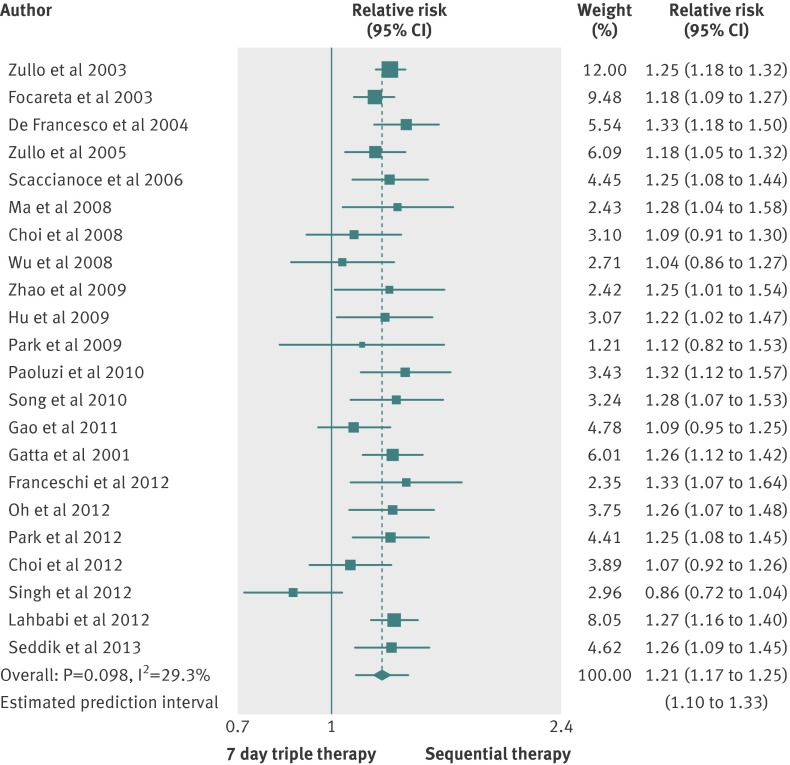
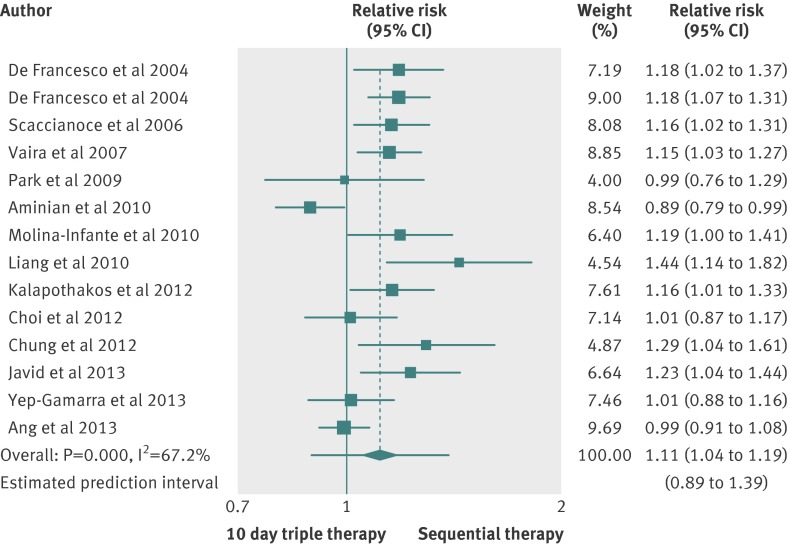
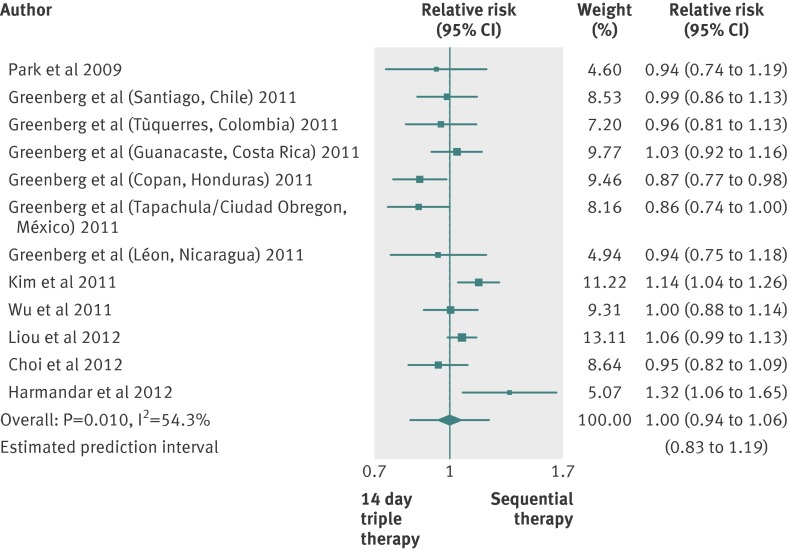
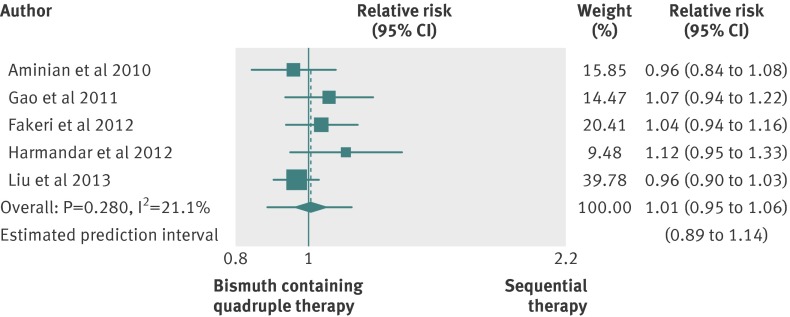
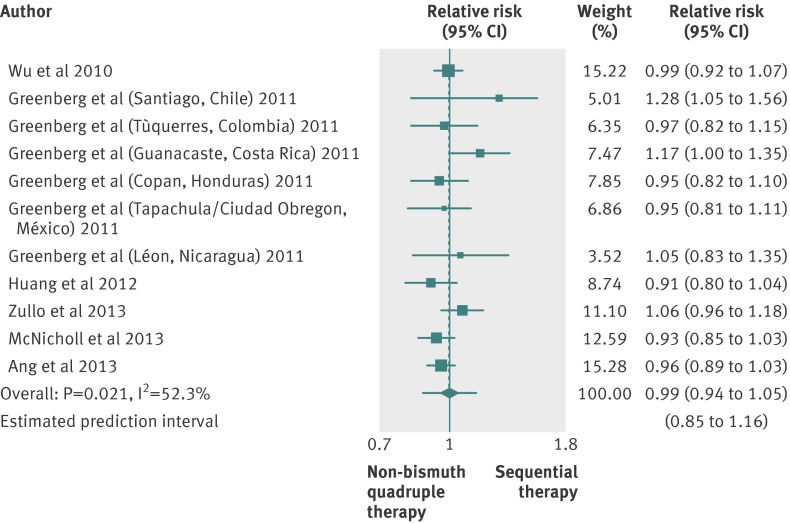
Results: 46 randomised controlled trials were reviewed and analysed. 5666 patients were randomised to sequential therapy and 7866 to other (established and new) treatments. The overall eradication rate of sequential therapy was 84.3% (95% confidence interval 82.1% to 86.4%). Sequential therapy was superior to seven day triple therapy (relative risk 1.21, 95% confidence interval 1.17 to 1.25; I(2)=29.3%; number needed to treat 6, 95% confidence interval 5% to 7%), marginally superior to 10 day triple therapy (1.11, 1.04 to 1.19; I(2)= 67.2%; NNT 10, 7 to 15), but not superior to 14 day triple therapy (1.00, 0.94 to 1.06; I(2)=54.3%), bismuth based therapy (1.01, 0.95 to 1.06; I(2)=21.1%), and non-bismuth based therapy (0.99, 0.94 to 1.05; I(2)=52.3%). Data on eradication according to pre-treatment antimicrobial susceptibility testing were available in eight studies, and sequential therapy was able to eradicate 72.8% (61.6% to 82.8%) of the strains resistant to clarithromycin.
Conclusions: Eradication rates with pre-existing and new therapies for H pylori are suboptimal. Regional monitoring of resistance rates should help to guide treatment, and new agents for treatment need to be developed.
Conflict of interest statement
Competing interests: All authors have completed the ICMJE uniform disclosure form at
Figures
References
-
- McColl KE. Clinical practice: Helicobacter pylori infection. N Engl J Med 2010;362:1597-604. - PubMed
-
- Malfertheiner P, Megraud F, O’Morain CA, Atherton J, Axon AT, Bazzoli F, et al. Management of Helicobacter pylori infection-the Maastricht IV/ Florence consensus report. Gut 2012;61:646-64. - PubMed
-
- Chey WD, Wong BC. American College of Gastroenterology guideline on the management of Helicobacter pylori infection. Am J Gastroenterol 2007;102:1808-25. - PubMed
-
- Megraud F, Coenen S, Versporten A, Kist M, Lopez-Brea M, Hirschl AM, et al. Helicobacter pylori resistance to antibiotics in Europe and its relationship to antibiotic consumption. Gut 2013;62:34-42. - PubMed
-
- Vakil N. Helicobacter pylori treatment: a practical approach. Am J Gastroenterol 2006;101:497-9. - PubMed
Publication types
MeSH terms
Substances
LinkOut - more resources
Full Text Sources
Other Literature Sources
Medical