


Advanced drug delivery to the lymphatic system: lipid-based nanoformulations
- PMID: 23926431
- PMCID: PMC3732201
- DOI: 10.2147/IJN.S41521
Advanced drug delivery to the lymphatic system: lipid-based nanoformulations
Abstract
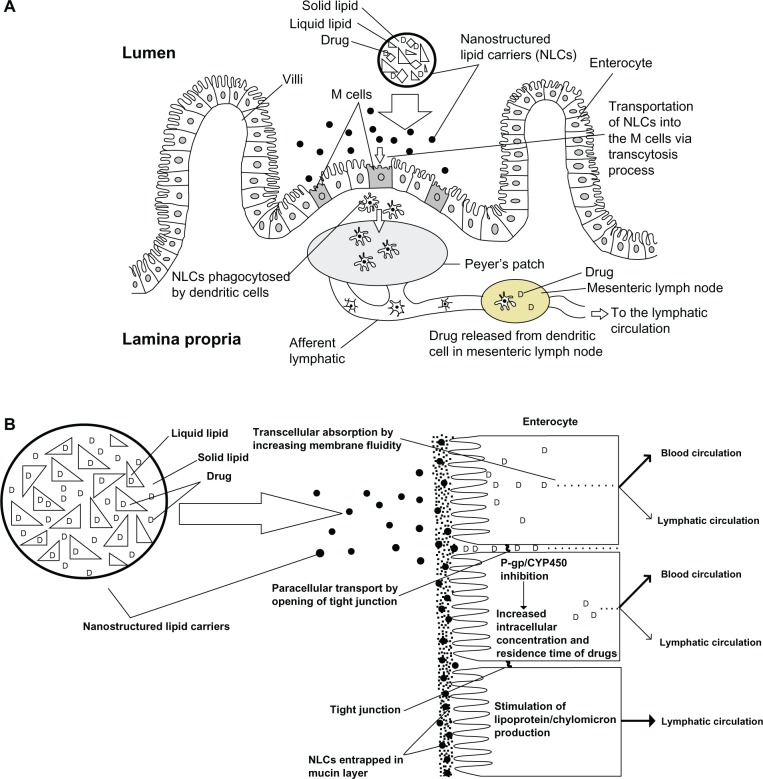
The delivery of drugs and bioactive compounds via the lymphatic system is complex and dependent on the physiological uniqueness of the system. The lymphatic route plays an important role in transporting extracellular fluid to maintain homeostasis and in transferring immune cells to injury sites, and is able to avoid first-pass metabolism, thus acting as a bypass route for compounds with lower bioavailability, ie, those undergoing more hepatic metabolism. The lymphatic route also provides an option for the delivery of therapeutic molecules, such as drugs to treat cancer and human immunodeficiency virus, which can travel through the lymphatic system. Lymphatic imaging is useful in evaluating disease states and treatment plans for progressive diseases of the lymph system. Novel lipid-based nanoformulations, such as solid lipid nanoparticles and nanostructured lipid carriers, have unique characteristics that make them promising candidates for lymphatic delivery. These formulations are superior to colloidal carrier systems because they have controlled release properties and provide better chemical stability for drug molecules. However, multiple factors regulate the lymphatic delivery of drugs. Prior to lymphatic uptake, lipid-based nanoformulations are required to undergo interstitial hindrance that modulates drug delivery. Therefore, uptake and distribution of lipid-based nanoformulations by the lymphatic system depends on factors such as particle size, surface charge, molecular weight, and hydrophobicity. Types of lipid and concentration of the emulsifier are also important factors affecting drug delivery via the lymphatic system. All of these factors can cause changes in intermolecular interactions between the lipid nanoparticle matrix and the incorporated drug, which in turn affects uptake of drug into the lymphatic system. Two lipid-based nanoformulations, ie, solid lipid nanoparticles and nanostructured lipid carriers, have been administered via multiple routes (subcutaneous, pulmonary, and intestinal) for targeting of the lymphatic system. This paper provides a detailed review of novel lipid-based nanoformulations and their lymphatic delivery via different routes, as well as the in vivo and in vitro models used to study drug transport in the lymphatic system. Physicochemical properties that influence lymphatic delivery as well as the advantages of lipid-based nanoformulations for lymphatic delivery are also discussed.
Keywords: blood circulation; lymphatic system; nanostructured lipid carriers; solid lipid nanoparticles.
Figures
References
-
- O’Driscol CM. Anatomy and physiology of the lymphatics. In: Charman WN, Stella VJ, editors. Lymphatic Transport of Drugs. Boca Raton, FL: CRC Press Inc; 1992.
-
- McCarter MD, Clarke JH, Harken AH. Lymphangiogenesis is pivotal to the trials of a successful cancer metastasis. Surgery. 2004;135:121–124. - PubMed
-
- Pantel K, Brakenhoff RH. Dissecting the metastatic cascade. Nat Rev Cancer. 2004;4:448–456. - PubMed
Publication types
MeSH terms
Substances
LinkOut - more resources
Full Text Sources
Other Literature Sources
