. 2013 Aug;4(4):270-90.
doi: 10.1177/2040620713498161.

Genetic predispositions to childhood leukemia

Affiliations

Genetic predispositions to childhood leukemia

Elliot Stieglitz et al. Ther Adv Hematol. 2013 Aug.

Abstract

While the majority of leukemia cases occur in the absence of any known predisposing factor, there are germline mutations that significantly increase the risk of developing hematopoietic malignancies in childhood. In this review article, we describe a number of these mutations and their clinical features. These predispositions can be broadly classified as those leading to bone marrow failure, those involving tumor suppressor genes, DNA repair defects, immunodeficiencies or other congenital syndromes associated with transient myeloid disorders. While leukemia can develop as a secondary event in the aforementioned syndromes, there are also several syndromes that specifically lead to the development of leukemia as their primary phenotype. Many of the genes discussed in this review can also be somatically mutated in other cancers, highlighting the importance of understanding shared alterations and mechanisms underpinning syndromic and sporadic leukemia.

Keywords: cancer syndrome; genetic predisposition; germline; hematologic malignancy; leukemia; oncogene; tumor suppressor.


Conflict of interest statement

Conflict of interest statement: The authors declare no conflicts of interest in preparing this article.

Figures

Figure 1.
Figure 1.
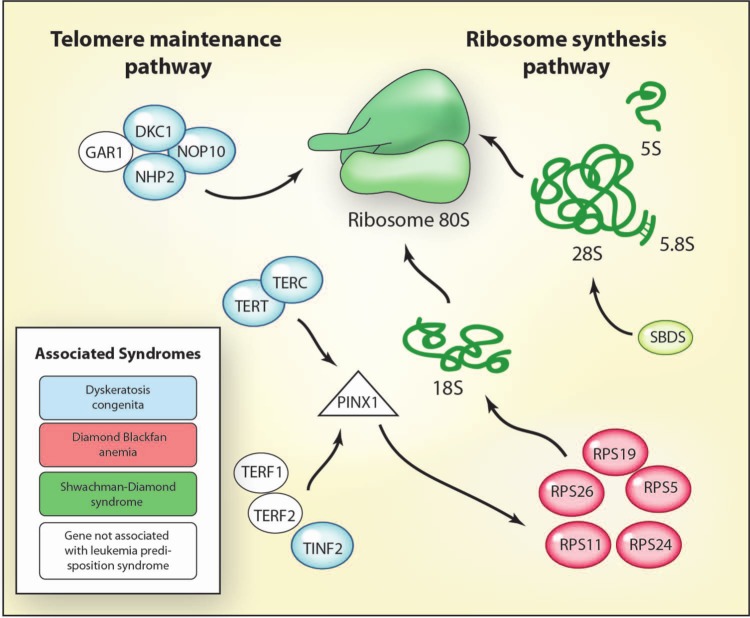
Germline syndromes associated with the telomere maintenance and ribosome synthesis pathways. Schematic diagram detailing the interaction between the telomere maintenance and the ribosome biogenesis pathways. The telomerase complex includes a telomerase reverse transcriptase (TERT) domain as well as a telomerase RNA component (TERC) which enables it to add a six-nucleotide sequence, 5’-TTAGGG, to the 3’ strand of chromosomes [Walne and Dokal, 2009]. Ribosome synthesis involves synthesis of ribosomal proteins in the nucleus, processing of ribosomal RNA, and assembly of ribosomal proteins with subsequent transport into the cytoplasm [Ellis and Gleizes, 2011]. Color coding indicates a specific association between a mutated gene and a syndrome that predisposes people to childhood leukemia. Syndromes include dyskeratosis congenita (OMIM 127550, 305000, 224230); Diamond Blackfan anemia (OMIM 105650); and Shwachman–Diamond syndrome (OMIM 260400). Illustration courtesy of Alessandro Baliani. Copyright © 2013. Adapted with permissions from Ahmed and Dokal [2009].
Figure 2.
Figure 2.
Germline syndromes associated with the Ras signaling pathway. Schematic diagram showing the GM-CSF receptor spanning the phospholipid bilayer. After stimulation with a cytokine, the receptor propagates a signaling cascade through the Ras-MAPK, CBL, and JAK-STAT pathways. Neurofibromin, encoded by the gene NF1 is a negative regulator of the Ras pathway by binding to activated Ras and catalyzing GTP hydrolysis, thereby returning Ras to the inactive GDP-bound state. Overall, 1 in 10,000 individuals are affected with an inherited syndrome that is caused by a mutation in the Ras pathway [Tidyman and Rauen, 2012]. Color coding indicates a specific association between a mutated gene and a syndrome that predisposes children to leukemia. Syndromes include: Noonan syndrome (OMIM 163950); NF1 (OMIM 162200), and CBL syndrome (OMIM 613563). Illustration courtesy of Alessandro Baliani. Copyright © 2013. GDP, guanidine diphosphate; GM-CSF, granulocyte macrophage colony-stimulating factor; GTP, guanidine triphosphate; JAK-STAT, Janus kinase signal transducers and activators of transcription; MAPK, mitogen-activated protein kinase; NF1, neurofibromatosis type 1.
Figure 3.
Figure 3.
Germline syndromes associated with the DNA repair pathway. Schematic diagram depicting aspects of the DNA repair pathway. Depending on the type of DNA damage that occurs, various pathways including mismatch repair, nucleotide excision repair, base excision repair, homologous recombination repair, and nonhomologous end joining can be employed by cells to repair damaged DNA [Branzei and Foiani, 2008]. Color coding indicates a specific association between a mutated gene and a syndrome that predisposes children to leukemia. Syndromes include Fanconi anemia (OMIM 227650 and 227645 are the two most common types); ataxia telangiectasia (OMIM 208900); Bloom syndrome (OMIM 210900); Nijmegen breakage syndrome (OMIM 251260); and Werner syndrome (OMIM 277700). Illustration courtesy of Alessandro Baliani. Copyright © 2013. Adapted with permissions from Ahmed and Dokal [2009].

References

    1. Ahmed M., Dokal I. (2009) Understanding aplastic anaemia/bone-marrow failure syndromes. Paediatr Child Health 19: 351–357
    1. Ahmed M., Rahman N. (2006) ATM and breast cancer susceptibility. Oncogene 25: 5906–5911 - PubMed
    1. Albers C., Paul D., Schulze H., Freson K., Stephens J., Smethurst P., et al. (2012) Compound inheritance of a low-frequency regulatory SNP and a rare null mutation in exon-junction complex subunit RBM8A causes TAR syndrome. Nat Genet 44: 435–439 - PMC - PubMed
    1. Albert M., Notarangelo L., Ochs H. (2011) Clinical spectrum, pathophysiology and treatment of the Wiskott–Aldrich syndrome. Curr Opin Hematol 18: 42–48 - PubMed
    1. Alter B. (2007) Diagnosis, genetics, and management of inherited bone marrow failure syndromes. Hematology Am Soc Hematol Educ Program 2007: 29–39 - PubMed