Review
. 2013 Aug;16(4):452-8.
doi: 10.1016/j.mib.2013.07.003. Epub 2013 Aug 5.

The metabolic roles of the endosymbiotic organelles of Toxoplasma and Plasmodium spp

Affiliations
Review

The metabolic roles of the endosymbiotic organelles of Toxoplasma and Plasmodium spp

Lilach Sheiner et al. Curr Opin Microbiol. 2013 Aug.

Abstract

The apicoplast and the mitochondrion of Apicomplexa cooperate in providing essential metabolites. Their co-evolution during the ancestral acquisition of a plastid and subsequent loss of photosynthesis resulted in divergent metabolic pathways compared with mammals and plants. This is most evident in their chimerical haem synthesis pathway. Toxoplasma and Plasmodium mitochondria operate canonical tricarboxylic acid (TCA) cycles and electron transport chains, although the roles differ between Toxoplasma tachyzoites and Plasmodium erythrocytic stages. Glutamine catabolism provides TCA intermediates in both parasites. Isoprenoid precursor synthesis is the only essential role of the apicoplast in Plasmodium erythrocytic stages. An apicoplast-located fatty acid synthesis is dispensable in these stages, which instead predominantly salvage fatty acids, while in Plasmodium liver stages and in Toxoplasma tachyzoites fatty acid synthesis is an essential role of the plastid.


Figures

Figure 1
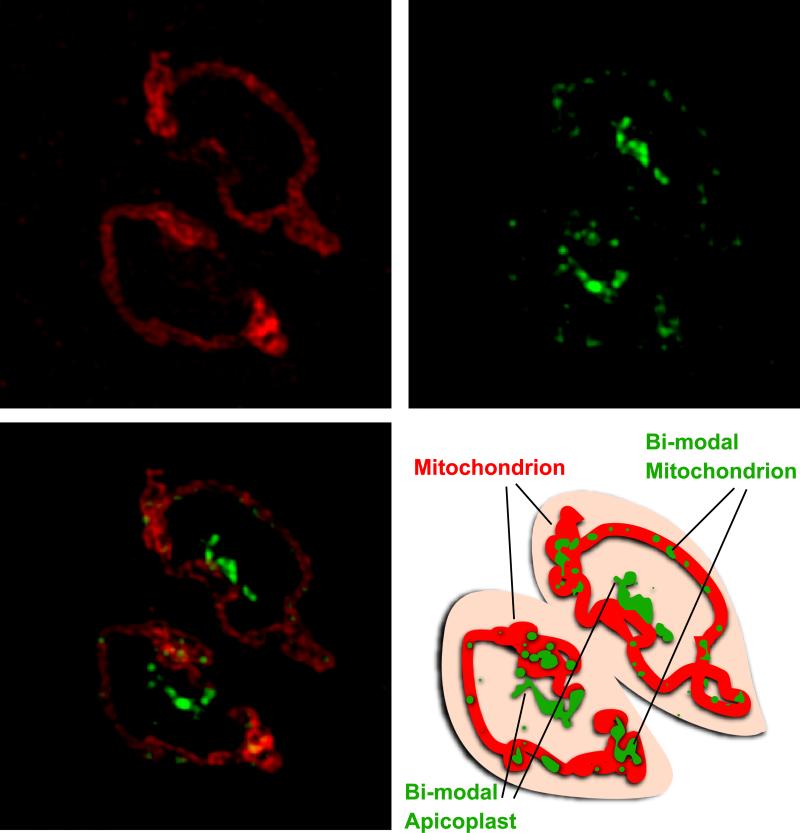
Figure 1. Fluorescence image of the mitochondrion and the apicoplast of Toxoplasma gondii
The staining of a mitochondrial protein (TGME49_215430, [11], red) that localizes to the organelle periphery (Sheiner, unpublished data) together with a bimodally targeted mitochondrial luminal and apicoplast protein (TGME49_283830, Sheiner unpublished data, green) shows the tight proximity between the two organelles. The co-staining of the mitochondria demonstrates the difference in morphology between the luminal and peripheral compartments. TGME49_283830 (green) represents one of many examples of bimodal targeting between the two organelles. The scheme on the right depicts the outline of the two Toxoplasma tachyzoites. Bar is 1νm.
Figure 2
Figure 2. Schematic outline of the acquisition and evolution of the mitochondrion and the apicoplast of Apicomplexa
(1) Development of a protein import system (purple arrows show flow of proteins from their genomic place of encoding to their subcellular localization) was an important event in the evolution of a mitochondrion in the ancestor of all eukaryotes. This was accompanied by extensive gene transfer to the nuclear genome (green arrows indicate the transfer of genes to another genome or their complete loss). An algal cell (light blue) carrying a plastid (red) then began an endosymbiotic relationship with a protist host. (2) Again protein import systems were established supporting the extensive gene transfer to the nuclear genome and allowing nuclear control over a newly enslaved organelle. A stable collaboration between the two symbionts (blue arrow) drove the loss of some redundant genes (green arrows). (3) A subsequent loss of photosynthesis (green arrow) affected the distribution of tasks, such as haem synthesis, between the two organelles (blue arrow). (4) Finally the two symbionts now present in apicomplexan parasites are synchronized in their biogenesis and are tightly associated, although the biological role of this association remains unclear. (M) mitochondrion, (P) plastid, (N) nucleus, (Nm) nucleomorph.
Figure 3
Figure 3. TCA and mtETC in Plasmodium erythrocytic stages and in T. gondii tachyzoites
Pyruvate from glycolysis, glutamate and gamma aminobutyric acid (GABA) from glutamine metabolism all serve as major starting points for the Plasmodium (thin black arrows, and a thin blue arrow representing a putative pathway) and Toxoplasma (thin black and red arrows) TCA cycles. Electrons from the oxidative steps in the cycle are donated to the mtETC (represented as broken arrows). Components of the mtETC are shown in purple with their names noted on the left. The asterisk notes that not all the subunits of the Apicomplexa ATP-synthase are identifiable in their genomes.
Figure 4
Figure 4. A chimerical haem biosynthesis pathway in Apicomplexa
The acquisition of photosynthesis and then its subsequent loss resulted in shifts as to which compartment was the main user of tetrapyrroles in the cell, and with it the location of principal responsibility for synthesis. The resulting pathway is distributed between the mitochondrion (orange), cytosol (gray) and apicoplast (red). Similarly, the enzymes involved are of different origins within the original endosymbiont [31]: either the red-algal plastid (pink) or cytoplasm (gray).

References

    1. Kobayashi T, Sato S, Takamiya S, Komaki-Yasuda K, Yano K, Hirata A, Onitsuka I, Hata M, Mi-ichi F, Tanaka T, et al. Mitochondria and apicoplast of Plasmodium falciparum: behaviour on subcellular fractionation and the implication. Mitochondrion. 2007;7:125–132. - PubMed
    1. Nishi M, Hu K, Murray JM, Roos DS. Organellar dynamics during the cell cycle of Toxoplasma gondii. J Cell Sci. 2008;121:1559–1568. - PMC - PubMed
    1. van Dooren GG, Kennedy AT, McFadden GI. The use and abuse of heme in apicomplexan parasites. Antioxid Redox Signal. 2012;17:634–656. - PubMed
    1. Macrae JI, Sheiner L, Nahid A, Tonkin C, Striepen B, McConville MJ. Mitochondrial Metabolism of Glucose and Glutamine Is Required for Intracellular Growth of Toxoplasma gondii. Cell Host Microbe. 2012;12:682–692. [This study demonstrate directly that the TCA cycle is fully active in Toxoplasma tachyzoites and discovers a GABA shunt as a part of their metabolic network.] - PMC - PubMed
    1. Seeber F, Limenitakis J, Soldati-Favre D. Apicomplexan mitochondrial metabolism: a story of gains, losses and retentions. Trends Parasitol. 2008;24:468–478. - PubMed

Publication types