


Tricuspid annular plane systolic excursion in the assessment of right ventricular function in children and adolescents after repair of tetralogy of Fallot
- PMID: 23928091
- PMCID: PMC4336673
- DOI: 10.1016/j.echo.2013.06.022
Tricuspid annular plane systolic excursion in the assessment of right ventricular function in children and adolescents after repair of tetralogy of Fallot
Abstract
Background: Assessing right ventricular (RV) performance is essential for patients with tetralogy of Fallot (TOF). The aim of this study was to investigate the reliability and validity of tricuspid annular plane systolic excursion (TAPSE) against cardiac magnetic resonance imaging measures and cardiopulmonary exercise testing.
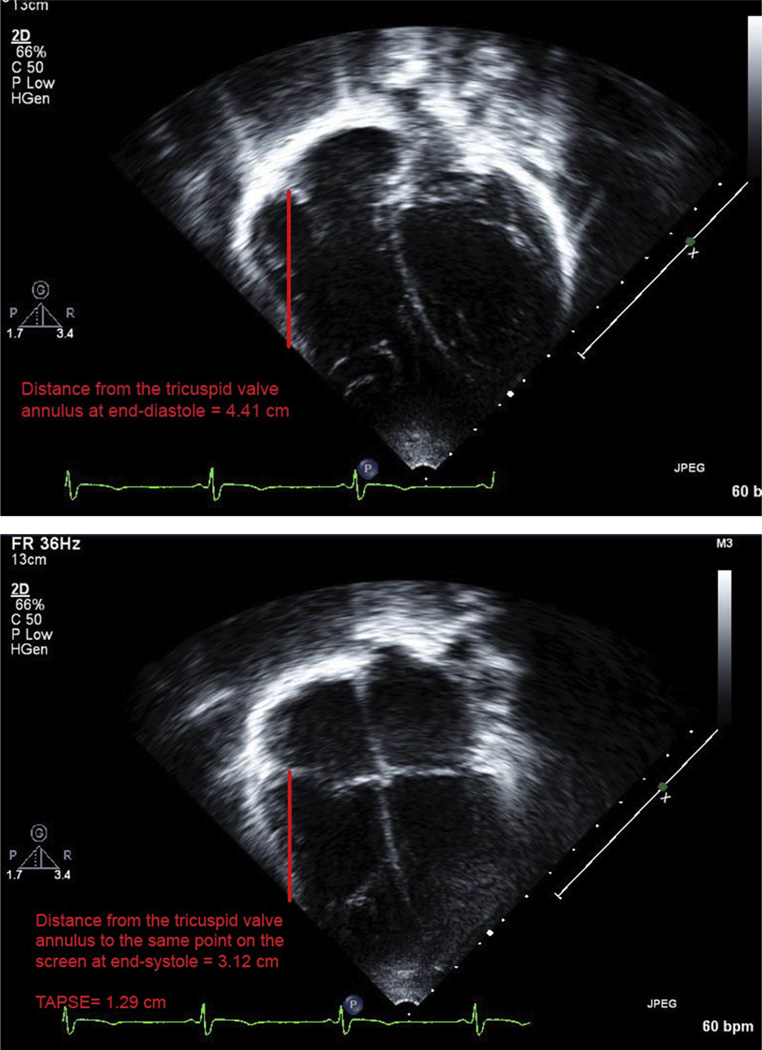
Methods: A retrospective study was performed in 125 outpatients with repaired TOF with available protocol-driven echocardiography, cardiac magnetic resonance imaging, and exercise stress testing obtained as part of a cross-sectional study. TAPSE was measured on the two-dimensional apical four-chamber view on echocardiography by two readers. Multivariate linear regression was used to examine the association between TAPSE and measures of RV function and exercise capacity.
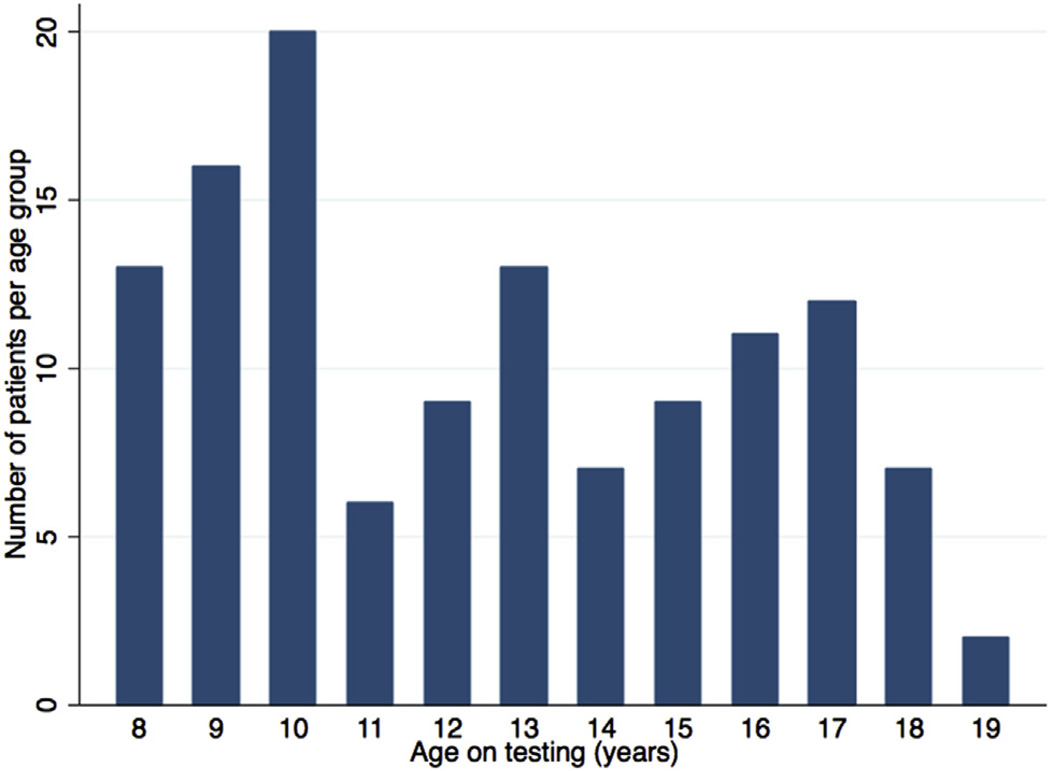
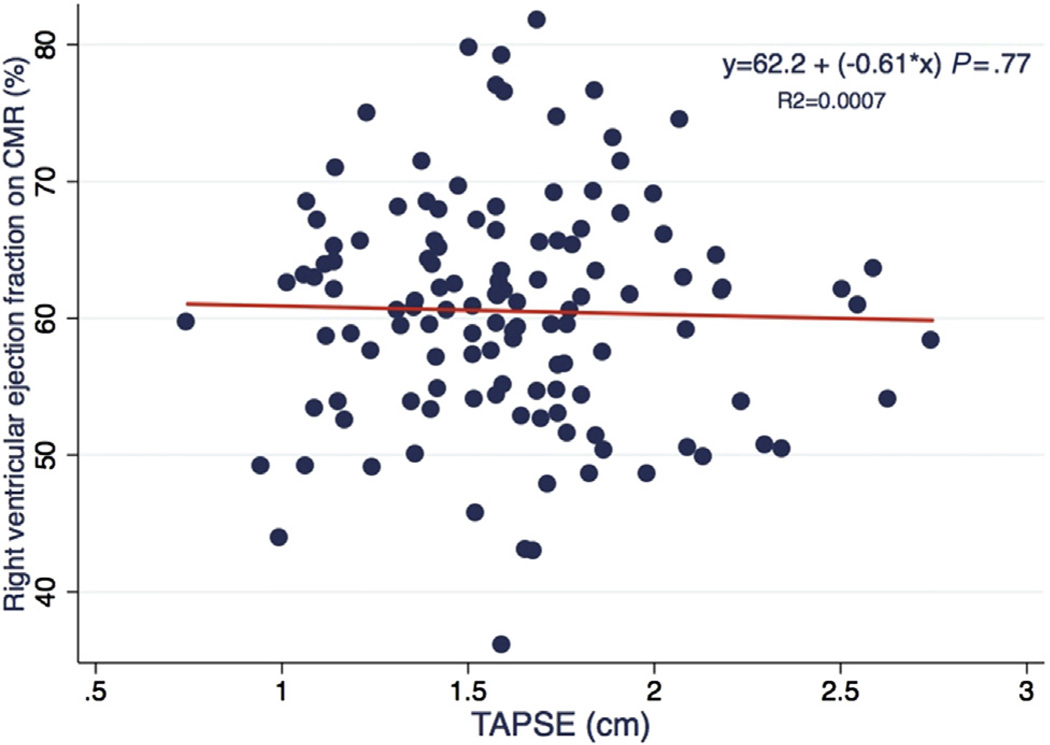
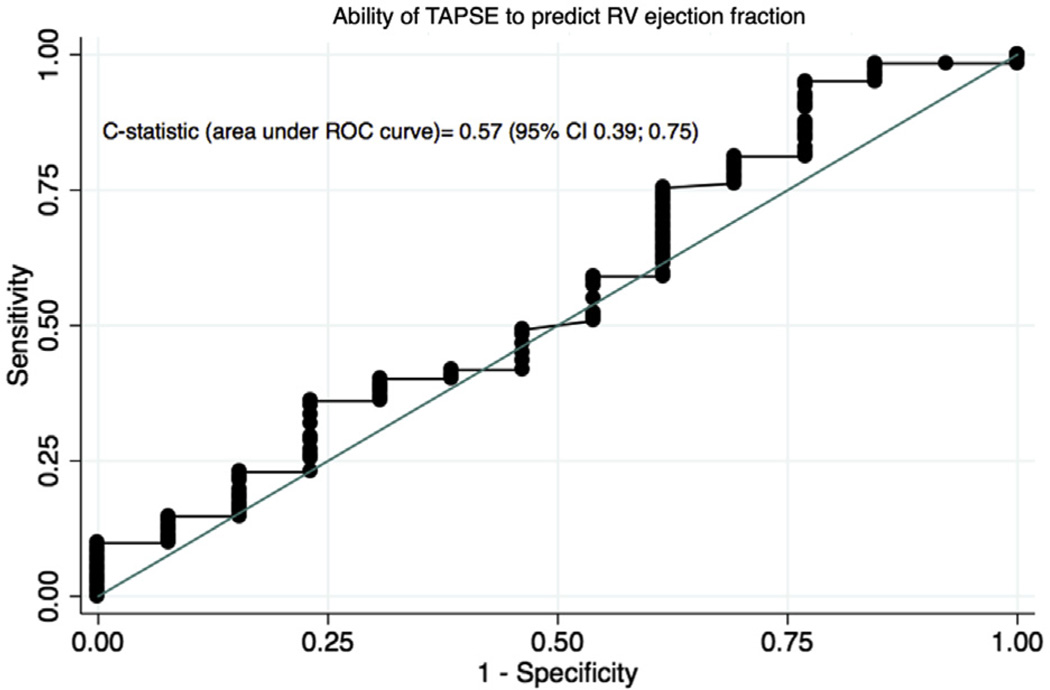
Results: The mean age was 12.6 ± 3.3 years, 41 patients (33%) were female, and 104 (83%) were white. TAPSE averaged 1.6 ± 0.37 cm, with an interreader intraclass correlation coefficient of 0.78 (n = 18). TAPSE was significantly associated with cardiac magnetic resonance-based RV stroke volume after adjustment for gender and body surface area (β = 13.8; 95% confidence interval, 2.25-25.30; P = .02). TAPSE was not associated with cardiac magnetic resonance-based RV ejection fraction (P = .77). On exercise testing, TAPSE was not associated with peak oxygen consumption, percentage of predicted oxygen consumption, oxygen pulse, or the ventilatory equivalent for carbon dioxide in patients with maximal exercise stress testing (n = 73 [58%]).
Conclusions: TAPSE is reproducibly measured by echocardiography in patients with TOF. It is not associated with RV ejection fraction or exercise performance, and its association with RV stroke volume may be confounded by body size. On the basis of these results, TAPSE is not representative of global RV performance in patients with TOF.
Keywords: 2D; BSA; Body surface area; CI; CMR; Carbon dioxide production; Cardiac magnetic resonance; Confidence interval; EST; Echocardiography; Exercise; Exercise stress testing; ICC; Intraclass correlation coefficient; Magnetic resonance imaging; Oxygen consumption; Predicted percentage of maximum oxygen consumption; RV; RVEDV; RVEF; RVESV; Right ventricular; Right ventricular ejection fraction; Right ventricular end-diastolic volume; Right ventricular end-systolic volume; TAPSE; TOF; Tetralogy of Fallot; Tricuspid annular plane systolic excursion; Two-dimensional; VE/Vco(2); Vco(2); Ventilatory equivalent of carbon dioxide; Vo(2); Vo(2)max%.
Copyright © 2013 American Society of Echocardiography. Published by Mosby, Inc. All rights reserved.
Figures
References
-
- Bouzas B, Kilner PJ, Gatzoulis MA. Pulmonary regurgitation: not a benign lesion. Eur Heart J. 2005;26:433–439. - PubMed
-
- Redington AN. Determinants and assessment of pulmonary regurgitation in tetralogy of Fallot: practice and pitfalls. Cardiol Clin. 2006;24:631–639. - PubMed
-
- Lang RM, Bierig M, Devereux RB, Flachskampf FA, Foster E, Pellikka PA, et al. Recommendations for chamber quantification: a report from the American Society of Echocardiography’s Guidelines and Standards Committee and the Chamber Quantification Writing Group, developed in conjunction with the European Association of Echocardiography, a branch of the European Society of Cardiology. J Am Soc Echocardiogr. 2005;18:1440–1463. - PubMed
-
- Kaul S, Tei C, Hopkins JM, Shah PM. Assessment of right ventricular function using two-dimensional echocardiography. Am Heart J. 1984;107:526–531. - PubMed
-
- Carlsson M, Ugander M, Heiberg E, Arheden H. The quantitative relationship between longitudinal and radial function in left, right, and total heart pumping in humans. AmJ Physiol Heart Circ Physiol. 2007;293:H636–H644. - PubMed
Publication types
MeSH terms
Grants and funding
LinkOut - more resources
Full Text Sources
Other Literature Sources
Research Materials
