. 2013 Sep;20(9):521-30.
doi: 10.1038/cgt.2013.49. Epub 2013 Aug 9.

The role of cyclophosphamide in enhancing antitumor efficacy of an adenovirus oncolytic vector in subcutaneous Syrian hamster tumors

Affiliations

The role of cyclophosphamide in enhancing antitumor efficacy of an adenovirus oncolytic vector in subcutaneous Syrian hamster tumors

B A Young et al. Cancer Gene Ther. 2013 Sep.

Abstract

We have previously reported that intratumoral injection of VRX-007--an Ad5 (a species C adenovirus)-based vector overexpressing adenovirus death protein--can suppress the growth of subcutaneous HaK (hamster renal cancer) tumors. VRX-007 replication and tumor growth inhibition are enhanced when the hamsters are immunosuppressed by a high dose of cyclophosphamide (CP), an immunosuppressive and chemotherapeutic agent. Here, we report that continuous immunosuppression with CP was not required for increased oncolytic activity of VRX-007 because short-term dosing or continuous dosing with the drug yielded similar antitumor results. Prolonged viral replication was found only in animals on continuous CP treatment. We used 007-Luc, a replication-competent, luciferase-expressing vector similar to VRX-007, to investigate the replication of the vector over time. Tumor growth inhibition was similar in hamsters given CP treatment either 1 week before or 1 week after 007-Luc injection, which suggests that CP exerts its antitumor efficacy independently of vector therapy. 007-Luc did not spread far from the inoculation site, even in immunosuppressed, CP-treated animals. Our results indicate that the enhanced effectiveness that is produced by the combination of VRX-007 and CP therapies is due to their two independent mechanisms and that they do not have to be given simultaneously for the improved outcome.


Figures
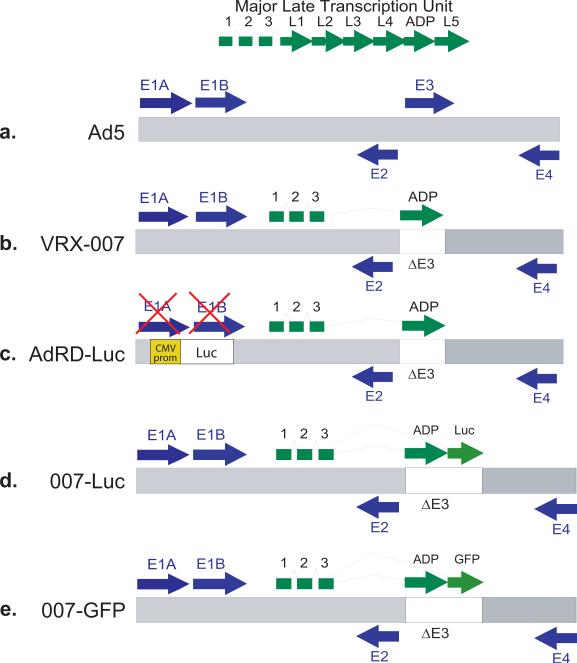
Figure 1
Figure 1. Schematics of the genomes of the vectors used in these studies
(a) Ad5. The gray bar represents the double-stranded DNA genome, and the arrows represent transcription units. The major late transcription unit is expressed similarly by VRX-007, 007-Luc, and 007-GFP. (b) VRX-007. This vector is identical to Ad5 except that most of the E3 transcription unit is deleted and replaced with the adp gene. (c) AdRD-Luc. This vector is identical to VRX-007 except that the E1 transcription unit is deleted, rendering the virus replication-defective, and the luciferase gene is inserted instead, expressed from a CMV promoter. (d) 007-Luc. This vector is identical to VRX-007, except that the luciferase gene is inserted just downstream to adp. (e) 007-GFP. This vector is identical to VRX-007, except that the gfp gene is inserted just downstream to adp.
Figure 2
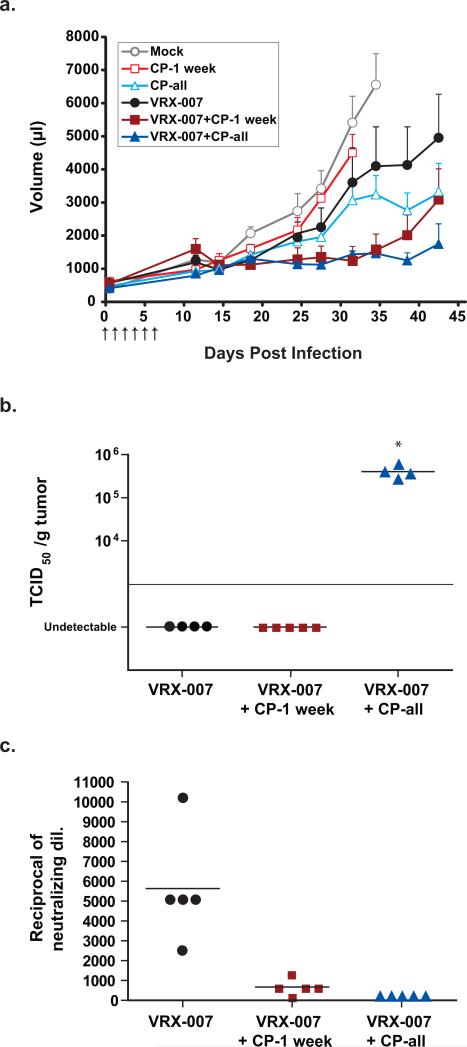
Figure 2. Long term immunosuppression with CP is not required for the combined effect of VRX-007 and CP against tumor growth
HaK tumors were injected with 1×10¹⁰ PFU of VRX-007 or PBS (mock group) for 6 consecutive days. The arrows in panel a represent days on which the virus was injected. CP was given intraperitoneally biweekly starting one week before infection. The CP-1 week groups were taken off CP at the time of infection, and the CP-all groups were given CP biweekly for the duration of the study. The mock and CP-1 week groups were sacrificed on days 31 and 34, respectively, due to excessive tumor burden. The experiment was terminated at 44 days post infection because of animal welfare considerations. (a) Mean tumor volume. Error bars represent mean + SE, and the numbers of animals per group were as follows: 9 (mock); 8 (VRX-007+CP-1 week); 7 (CP-1 week); 6 (VRX-007 and CP-all); 4 (VRX-007 + CP-all). There was a significant difference in tumor growth suppression between the mock group and either of the VRX-007 + CP groups (P<0.003). There was no significant difference between VRX-007 + CP-1 week and VRX-007 + CP-all at any time throughout the study (P>0.10 throughout). (b) Virus titers in the tumor. Tumor samples for TCID50 assay were taken at time of death, 44 days post infection. (*P=0.0286) (c) Serum neutralizing antibody titers. An anti-Ad neutralizing antibody assay was performed for the serum collected at 44 days post infection (P < 0.02 for all groups compared to each other).
Figure 3
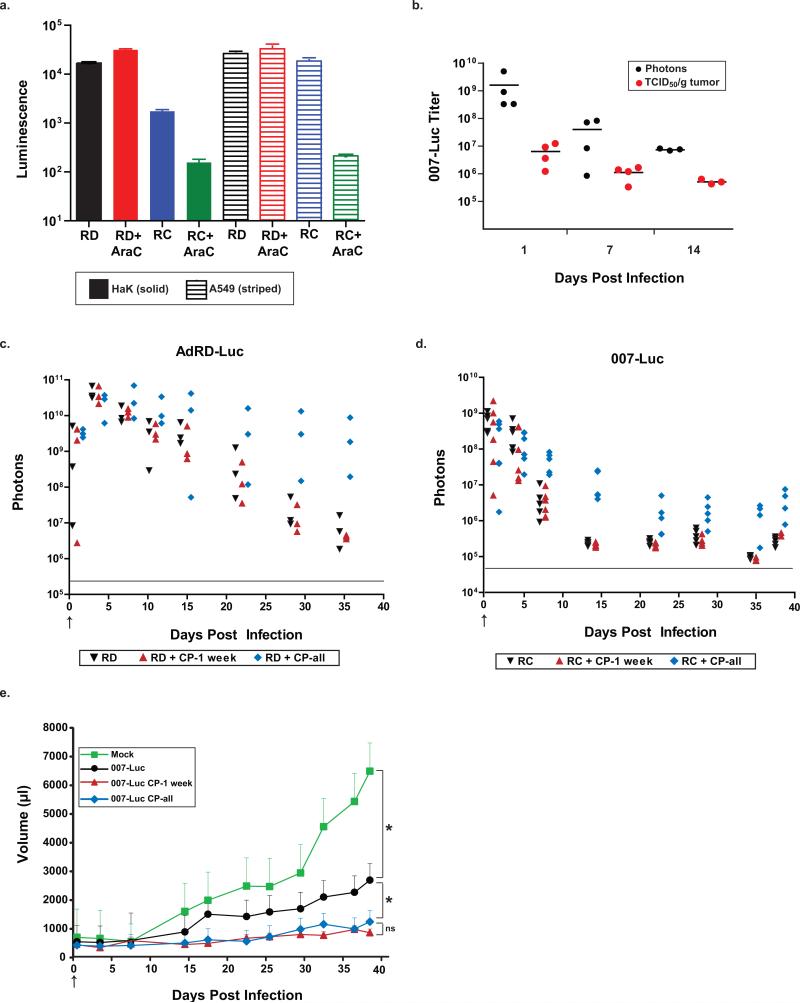
Figure 3. Cyclophosphamide does not increase the infectivity or replication of HaK cells in vivo
HaK tumors were injected once with 1×10¹⁰ PFU of virus or PBS (mock group). The arrows represent days on which the virus was injected. (a) 007-Luc expresses luciferase primarily in the late phase of infection. HaK (solid bars) and A549 (striped bars) cells were grown on 6-well plates and infected with either AdRD-Luc (RD) or 007-Luc (RC) at 25 PFU/cell. AraC was added every 12 h to prevent viral replication. After 54 h post infection, the cells were lysed and luminescence was measured. Error bars represent mean + SD. (b) Comparison between TCID50 and IVIS assays. HaK tumors were injected once with 1×10¹⁰ PFU of 007-Luc and imaged via IVIS at days 1, 7, and 14 post infection. Hamsters were sacrificed immediately after imaging and TCID50 assays were performed on the tumors. In panels c and d, luciferase expression in HaK tumors was measured by total flux of photons. The gray lines indicate background intensity. (c) AdRD-Luc replication-defective virus (RD). There were 3 animals per group. (d) 007-Luc replication-competent virus (RC). There were 5-6 animals per group. (e) Mean tumor volume. The number of animals for the 007-Luc group was 5, and the number of animals for all other groups was 4. Error bars represent mean + SE. (d) and (e) represent data from the same set of animals. The tumors from 007-Luc + CP-1 week vs 007-Luc + CP-all groups were never significantly different in size (P>0.35). At 38 days post infection, the tumors from the mock group were significantly larger than all other groups. Animals given virus alone had statistically significant larger tumors than did CP-treated animals starting on day 17. (* P<0.04)
Figure 4
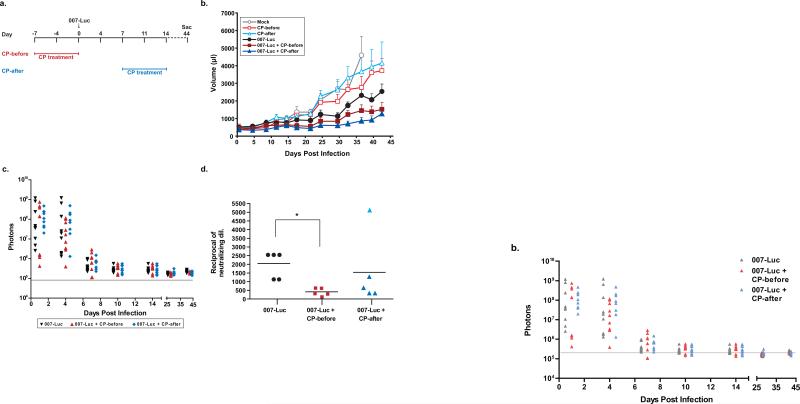
Figure 4. Cyclophosphamide and vector treatments work independently to inhibit tumor growth
HaK tumors were injected once with 1×10¹⁰ PFU of 007-Luc or PBS (mock group). The arrows represent days on which the virus was injected. CP-treated groups were given CP treatment for one week, consisting of 2 doses either one week before infection (CP-before) or one week after infection (CP-after). Animals in the mock group were sacrificed on day 36 due to tumor burden. (a) Timeline for the study. The schedule for the CP-before groups is shown in red, and the schedule for the CP-after groups is shown in blue. (b) Mean tumor volume. Error bars represent mean + SE, and the numbers of animals per group were as follows: 9 (CP-before, CP-after, 007-Luc); 8 (mock, 007-Luc + CP-before); 7 (007-Luc + CP-after). Mean tumor volume in the mock group was significantly greater than in the 007-Luc group starting at day 24 (P=0.04) and in both 007-Luc + CP groups starting at day 18 (P<0.05). The 007-Luc + CP-before and 007-Luc + CP-after groups did not have significantly different tumor sizes (P<0.05). Double therapy produced more tumor suppression than CP treatment alone: CP-before vs 007-Luc + CP-before (P=0.01) and CP-after vs 007-Luc + CP-after (P=0.05). (c) Luciferase expression in tumors, measured by total flux of photons. The gray line indicates the background intensity. (d) Neutralizing antibody titers in the serum at time of death (44 days). *P=0.0079.
Figure 5
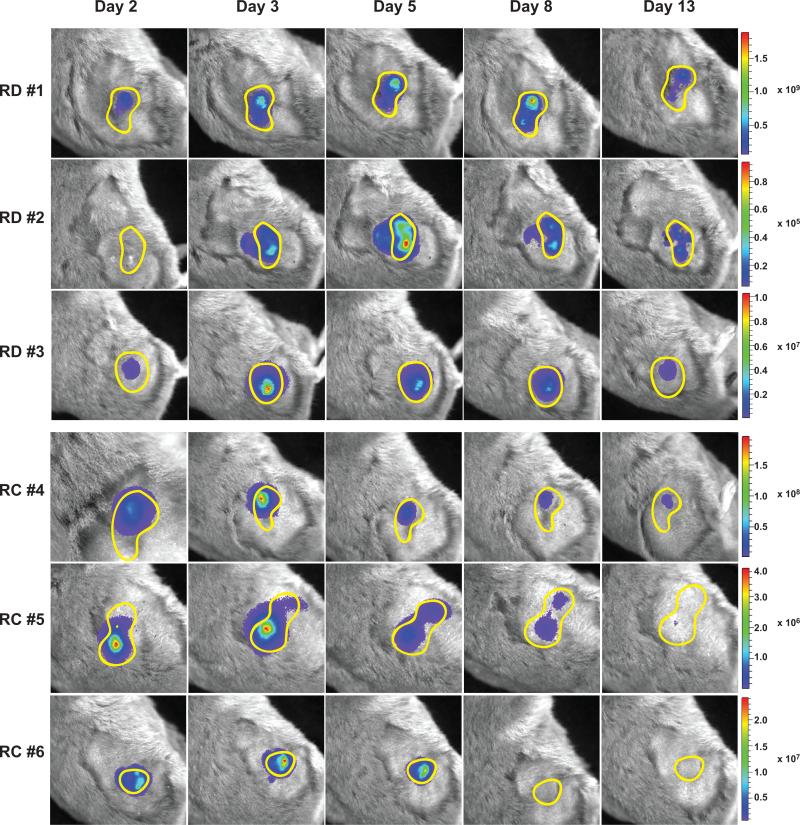
Figure 5. Vectors remain confined near the injection site in HaK tumors
HaK tumors were injected once with either 1.8×10⁹ PFU of AdRD-Luc (RD) or 1.5×10⁹ PFU of 007-Luc (RC) in 50 μl volume). Images were taken of 6 different animals (3 per group) on the days specified. Every animal was treated with CP biweekly starting one week before infection. A yellow line demarcates the approximate location of the subcutaneous tumor. Intensity scales are added for each animal; the range of expression was normalized for each animal individually, which is reflected in individual scale bars.
Figure 6
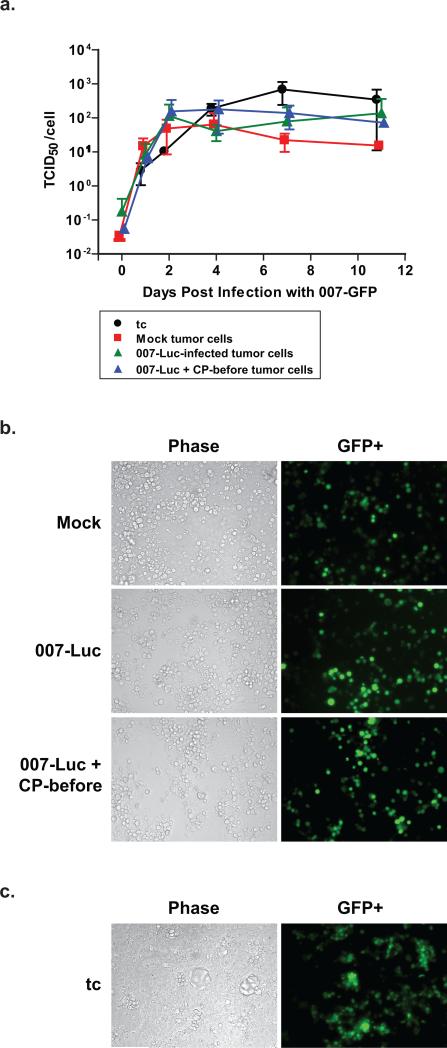
Figure 6. Cells from excised HaK tumors are not resistant to 007-GFP infection in culture
Three hamsters from the mock, 007-Luc, and 007-Luc + CP-before groups from the experiment in Fig. 4 were selected at random. The tumors from each group were excised and homogenized into single cell suspensions by digestion in trypsin/EDTA for 30 min. 5×10⁴ cells were plated per well in a 12-well plate. Three samples from HaK tissue culture cells were used as well (designated as tc). (a) Single step growth curve. Cells were infected 2 days after isolation with 007-GFP (50 PFU/cell) and then washed with DMEM 5%FBS. At each time point, one 12-well plate with all 12 samples was frozen away. A TCID50 assay was performed. Graphs represent virus yield produced per cell. (P>0.100 between each group on every day). GFP expression in (b) ex vivo tumor cells and (c) tissue culture cells. Images were taken of the tumor cells to determine the presence of GFP+ cells. Images above are representatives of each group, taken 4 days post infection. The number of cells per well at time of infection were as follows: Mock, 1.8×10⁵; 007-Luc, 1.8×10⁵; 007-Luc + CP-before, 1.1×10⁵; tc, 4.4×10⁵.

References

    1. Toth K, Wold WS. Increasing the efficacy of oncolytic adenovirus vectors. Viruses. 2010;2(9):1844–66. - PMC - PubMed
    1. Wold WSM, Ison MG. Chapter 56: Adenoviruses. In: Knipe DM, Howley PM, editors. Fields Virology. 6 edn Vol. 1. Lippincott Williams & Wilkins; Philadelphia: 2013. pp. 1732–1767.
    1. Liu TC, Galanis E, Kirn D. Clinical trial results with oncolytic virotherapy: a century of promise, a decade of progress. Nat. Clin. Pract. Oncol. 2007;4(2):101–117. - PubMed
    1. Pesonen S, Kangasniemi L, Hemminki A. Oncolytic adenoviruses for the treatment of human cancer: focus on translational and clinical data. Mol. Pharm. 2011;8(1):12–28. - PubMed
    1. Yamamoto M, Curiel DT. Current issues and future directions of oncolytic adenoviruses. Mol. Ther. 2010;18(2):243–250. - PMC - PubMed

Publication types

MeSH terms

Substances