


Maternal intrusiveness, family financial means, and anxiety across childhood in a large multiphase sample of community youth
- PMID: 23929005
- PMCID: PMC4164669
- DOI: 10.1007/s10802-013-9790-4
Maternal intrusiveness, family financial means, and anxiety across childhood in a large multiphase sample of community youth
Abstract
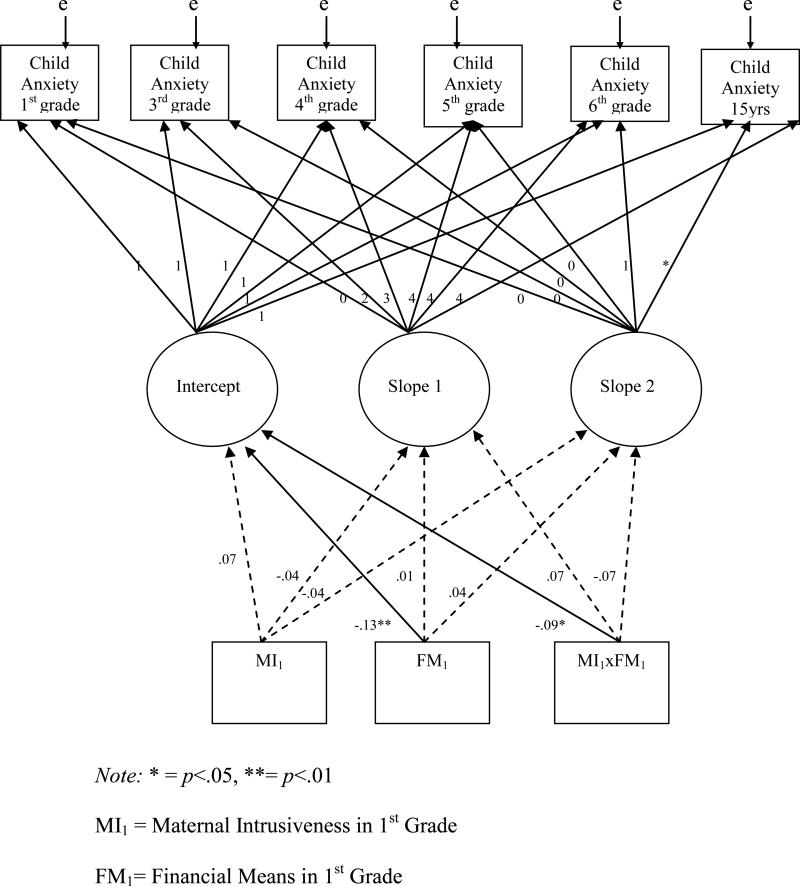
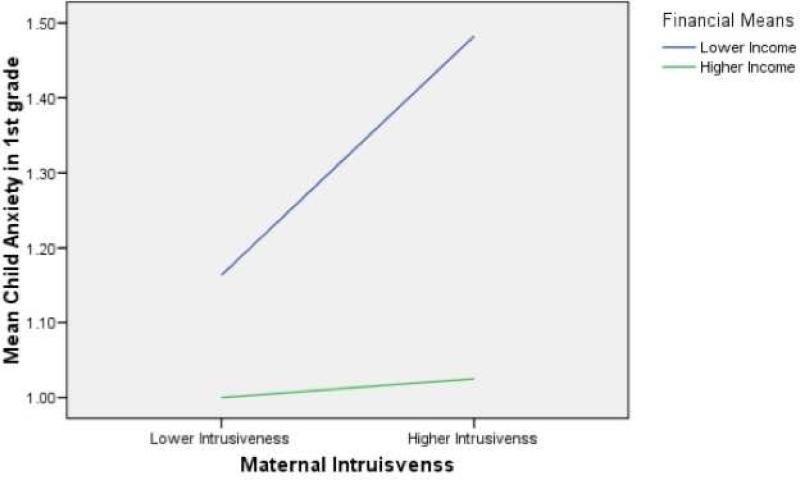
Intrusive parenting has been positively associated with child anxiety, although examinations of this relationship to date have been largely confined to middle to upper middle class families and have rarely used longitudinal designs. With several leading interventions for child anxiety emphasizing the reduction of parental intrusiveness, it is critical to determine whether the links between parental intrusiveness and child anxiety broadly apply to families of all financial means, and whether parental intrusiveness prospectively predicts the development of child anxiety. This study employed latent growth curve analysis to evaluate the interactive effects of maternal intrusiveness and financial means on the developmental trajectory of child anxiety from 1st grade to age 15 in 1,121 children (50.7 % male) and their parents from the NICHD SECCYD. The overall model was found to provide good fit, revealing that early maternal intrusiveness and financial means did not impact individual trajectories of change in child anxiety, which were stable from 1st to 5th grade, and then decrease from 5th grade to age 15. Cross-sectional analyses also examined whether family financial means moderated contemporaneous relationships between maternal intrusiveness and child anxiety in 3rd and 5th grades. The relationship between maternal intrusiveness and child anxiety was moderated by family financial means for 1st graders, with stronger links found among children of lower family financial means, but not for 3rd and 5th graders. Neither maternal intrusiveness nor financial means in 1st grade predicted subsequent changes in anxiety across childhood. Findings help elucidate for whom and when maternal intrusiveness has the greatest link with child anxiety and can inform targeted treatment efforts.
Figures
References
-
- Achenbach TM. Manual for the Child Behavior Checklist/4-18 and Profile. University of Vermont, Department of Psychiatry; Burlington, VT: 1991.
-
- Allhusen V, Appelbaum M, Belsky J, Booth CL, Bradley R, Brownell C, Weinraub M. Nonmaternal care and family factors in early development: An overview of the NICHD Study of Early Child Care. Journal of Applied Developmental Psychology. 2001;22:457–492. doi: 10.1016/s0193-3973(01)00092-2.
-
- Bacchini D, Miranda MC, Affuso G. Effects of parental monitoring and exposure to community violence on antisocial behavior and anxiety/depression among adolescents. Journal of Interpersonal Violence. 2011;26:269–292. doi: 10.1177/0886260510362879. - PubMed
-
- Barber B. Parental psychological control: Revisiting a neglected construct. Child Development. 1996;67:3296–3319. doi: 10.2307/1131780. - PubMed
Publication types
MeSH terms
Grants and funding
LinkOut - more resources
Full Text Sources
Other Literature Sources
Medical
