


Socioeconomic Inequality of Non-Communicable Risk Factors among People Living in Kurdistan Province, Islamic Republic of Iran
- PMID: 23930185
- PMCID: PMC3733035
Socioeconomic Inequality of Non-Communicable Risk Factors among People Living in Kurdistan Province, Islamic Republic of Iran
Abstract
Background: The most fundamental way to decrease the burden of noncommunicable diseases (NCDs) is to identify and control their related risk factors. The goal of this study is to determine socioeconomic inequalities in risk factors for NCDs using concentration index based on Non-Communicable Disease Surveillance Survey (NCDSS) data in Kurdistan province, Islamic Republic of Iran in 2005 and 2009.
Methods: The required data for this study are taken from two NCDSSs in Kurdistan province in 2005 and 2009. A total of 2,494 persons in 2005 and 997 persons in 2009 were assessed. Concentration index was used to determine socioeconomic inequality. To assess the relationship between the prevalence of each risk factor and socioeconomic status (SES), logistic regression was used and odds ratio (OR) was calculated for each group, compared with the poorest group.
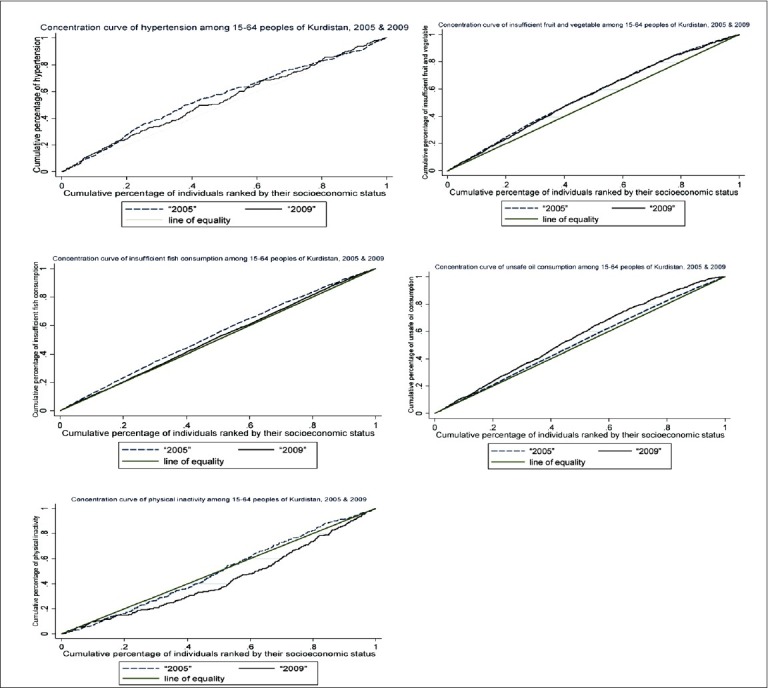
Results: The concentration index for hypertension was -0.095 (-0.158, -0.032) in 2005 and -0.080 (-0.156, -0.003) in 2009. The concentration index for insufficient consumption of fruits and vegetables was -0.117 (-0.153, -0.082) in 2005 and -0.100 (-0.153, -0.082) in 2009. The concentration index for the consumption of unhealthy fat and oil was -0.034 (-0.049, -0.019) in 2005 and -0.108 (-0.165, -0.051) in 2009. The concentration index for insufficient consumption of fish was -0.070 (-0.096, -0.044) in 2005. The concentration index for physical inactivity was 0.008 (-0.057, 0.075) in 2005 and 0.139 (0.063, 0.215) in 2009. In all the cases, the OR of the richest group to the poorest group was significant.
Conclusion: Hypertension, insufficient consumption of fruits and vegetables, consumption of unhealthy fat and oil, and insufficient consumption of fish are more prevalent among poor groups. There was no significant socioeconomic inequality in the distribution of smoking, excess weight, and hypercholesterolemia. Physical inactivity was more prevalent among the rich groups of society in 2009. The reduction of socioeconomic inequalities must become a main goal in health-care policies.
Keywords: Concentration index; Iran; inequality; non communicable diseases; socioeconomic status.
Conflict of interest statement
Figures
References
-
- WHO. Global status report on noncommunicable diseases 20102011 2011. Report No.: 978 92 4 156422 9
-
- Alwan A, Maclean DR, Riley LM, d’Espaignet ET, Mathers CD, Stevens GA, et al. Monitoring and surveillance of chronic non-communicable diseases: Progress and capacity in high-burden countries. Lancet Nov. 2010;376:1861–8. - PubMed
-
- Geneva: World Health Organization; 2005. WHO. Preventing chronic diseases: A vital investment.
-
- Samb B, Desai N, Nishtar S, Mendis S, Bekedam H, Wright A, et al. Prevention and management of chronic disease: A litmus test for health-systems strengthening in low-income and middle-income countries. Lancet. 2010;376:1785–97. - PubMed
LinkOut - more resources
Full Text Sources