Review
. 2013 Nov;104(11):1401-10.
doi: 10.1111/cas.12252. Epub 2013 Sep 23.

Newly developed strategies for improving sensitivity to radiation by targeting signal pathways in cancer therapy

Affiliations
Review

Newly developed strategies for improving sensitivity to radiation by targeting signal pathways in cancer therapy

Miao Ding et al. Cancer Sci. 2013 Nov.

Abstract

Inherent and acquired resistance of cancer cells is increasingly recognized as a significant impediment to effective radiation cancer treatment. As important intracellular factors, aberrant tumor transmembrane signal transduction pathways, which include the prosurvival cascades (PI3K/Akt, MAPK/ERK and JAK/STAT) and the proapoptosis pathways (Wnt, p53 and TNF-α/NF-κB), have been proved to be crucial determinants of the probability of cell sensitivity to radiation in malignant lesions. There is increasing evidence that targeting the abnormal pathways that can regulate the activity of the DNA damage response and further influence the response of tumor cells to radiation may be suitable for improving radiation sensitization. Preclinical and clinical evidence suggest that agents targeting aberrant tumor signals can effectively improve the therapeutic effect of ionizing radiation. Therefore, in this review, we discuss the intricate interplay between tumor responses to radiation with the aberrant signal pathways, and the potential druggable targets within the pathways to sensitize tumors without significant collateral damage to normal tissues. The application of novel targeting compounds to manipulate the aberrant signal of tumor cells in clinical treatments is also addressed.


Figures

Figure 1
Figure 1
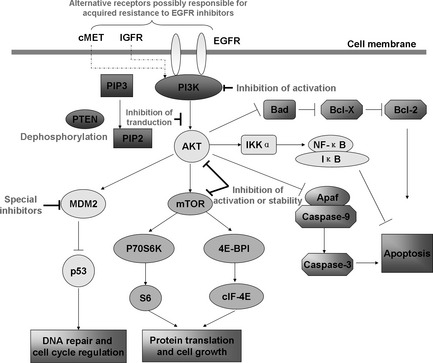
Mechanism of PI3K/Akt pathway to induce radioresistance and possible strategies to prevent acquired resistance to radiation through inhibiting the activity of relative elements. In the PI3K/Akt pathway, after GFR protein tyrosine kinases are activated, PI3K protein is recruited to the membrane by directly binding to phosphotyrosine consensus residues of growth factor receptor, leading to allosteric activation of the catalytic subunit. This activation results in production of the second messenger phosphatidylinositol‐3,4,5‐trisphosphate (PIP3). The lipid product of PI3K recruits Akt signaling protein domains to the membrane. Once activated, Akt mediates the activation of several targets, including IKKα, mTOR, MDM2 protein and Bad, Apaf/Caspase 9 proteins downregulation, and then results in cellular survival, growth and proliferation through various mechanisms. Possible strategies to prevent acquired resistance include combination therapy against alternate receptors, including cMET, IGFR and EGFR in the membrane and intracellular signal elements containing PI3K, AKT and mTOR.
Figure 2
Figure 2
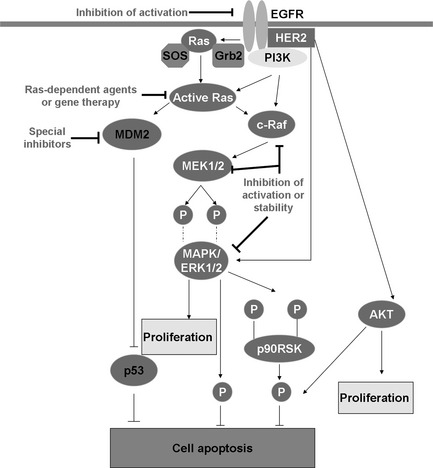
Ras‐induced MAPK prosurvival pathway: therapeutic targets and new therapies. The Ras‐Raf‐MEKERK (MAPK) signaling pathway represents significant and promising molecular targets for effective treatment using radiotherapy. The dimerisation and autophosphorylation of EGFR provide docking sites for signaling molecules, including the Grb2‐SOS complex, to activate the small G‐protein Ras. This exchange elicits a conformational change in Ras, enabling it to induce Raf activation and MDM2 upregulation. Activated Raf phosphorylates and activates MEK (MAPK/ERK kinase), which, in turn, phosphorylates and activates extracellular‐signal‐regulated kinase (ERK). Activated ERK induces many substrates' activity in the cytosol to inhibit the apoptosis. ERK can also enter the nucleus to control gene expression by phosphorylating transcription factors to induce proliferation. Activated MDM2 further inhibits p53 activity and inhibits cell apoptosis. Possible strategies to prevent acquired resistance include molecular agents or gene therapy against EGFR in the membrane and intracellular signal elements containing Ras, Raf, MEK, ERK, MDM2 activation.
Figure 3
Figure 3
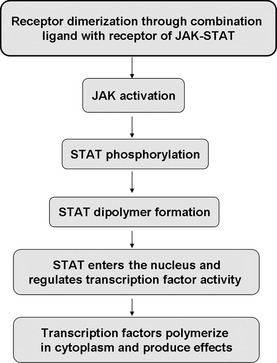
As a recently discovered nuclear signal transduction pathway, the mechanism of the JAK/STAT pathway in regulating proliferation, differentiation, apoptosis and radio‐resistance processes in numerous cancer types.
Figure 4
Figure 4
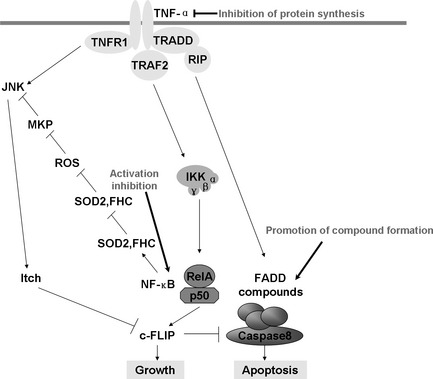
Activation of TNF‐α pathway and possible strategies to prevent resistance to radiation through inhibiting the activity of relative elements. Although TNF can bind two receptors, TNFR1 (TNF receptor type 1) and TNFR2 (TNF receptor type 2); most information regarding TNF signaling is derived from TNFR1. Upon contact with their ligands, TNF receptors form trimers and cause a conformational change, leading to the dissociation of the inhibitory protein SODD from the intracellular death domain and leading the adaptor protein TRADD to be binded. Following TRADD binding, three pathways can be initiated. First, TRADD recruits TRAF2 and RIP, then TRAF2, in turn, recruits the multicomponent protein kinase IKK. IKK phosphorylates an inhibitory protein, IκBα, and releases NF‐κB, which can translocate to the nucleus and mediate the transcription of a vast array of proteins involved in cell survival and proliferation, inflammatory response and anti‐apoptotic factors. Second, TNFR induces a strong activation of the stress‐related JNK group, evokes moderate response of the p38‐MAPK, and is responsible for minimal activation of the classical ERK. Of the three major TNF‐α cascades, TNFR is also involved in death signaling. TRADD binds FADD, which then recruits the cysteine protease caspase‐8. A high concentration of caspase‐8 induces its autoproteolytic activation and subsequent cleaves of effector caspases, leading to cell apoptosis. Possible strategies to prevent acquired resistance include combination therapy against TNF‐α protein synthesis in the membrance and NF‐κB activation or promoting FADD/Caspase 8 compound formation.
Figure 5
Figure 5
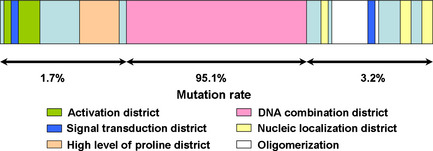
Mutation location and mutation ratio of p53.

Similar articles

Cited by

References

    1. Yorke E, Gelblum D, Ford E. Patient safety in external beam radiation therapy. Am J Roentgenol 2011; 196: 768–72. - PubMed
    1. Milosevic MF. Hypoxia, anerobic metabolism, and interstitial hypertension. In: Siemann DW, ed. Tumor Microenvironment, 1st edn. Chichester: John Wiley & Sons Ltd, 2010; 183–205.
    1. Wachsberger P, Burd R, Dicker AP. Tumor response to ionizing radiation combined with antiangiogenesis or vascular targeting agents: exploring mechanisms of interaction. Clin Cancer Res 2003; 9: 1957–71. - PubMed
    1. Kasten‐Pisula U, Menegakis A, Brammer I et al The extreme radiosensitivity of the squamous cell carcinoma SKX is due to a defect in double‐strand break repair. Radiother Oncol 2009; 90: 257–64. - PubMed
    1. Zhivotovsky B, Joseph B, Orrenius S. Tumor radiosensitivity and apoptosis. Exp Cell Res 1999; 248: 10–7. - PubMed

Publication types

MeSH terms

Substances