. 2013 Oct;24(5):310-20.
doi: 10.1089/hgtb.2013.022. Epub 2013 Aug 24.

Potential limitations of the NSG humanized mouse as a model system to optimize engineered human T cell therapy for cancer

Affiliations

Potential limitations of the NSG humanized mouse as a model system to optimize engineered human T cell therapy for cancer

Erik M Alcantar-Orozco et al. Hum Gene Ther Methods. 2013 Oct.

Abstract

The genetic modification of peripheral blood lymphocytes using retroviral vectors to redirect T cells against tumor cells has been recently used as a means to generate large numbers of antigen-specific T cells for adoptive cell therapy protocols. However, commonly used retroviral vector-based genetic modification requires T cells to be driven into cell division; this potent mitogenic stimulus is associated with the development of an effector phenotype that may adversely impact upon the long-term engraftment potential and subsequent antitumor effects of T cells. To investigate whether the cytokines used during culture impact upon the engraftment potential of gene-modified T cells, a humanized model employing T cells engrafted with a MART-1-specific T cell receptor adoptively transferred into NOD/Shi-scid IL-2rγ(-/-) (NSG) immune-deficient mice bearing established melanoma tumors was used to compare the effects of the common γ chain cytokines IL-2, IL-7, and IL-15 upon gene-modified T cell activity. MART-1-specific T cells cultured in IL-7 and IL-15 demonstrated greater relative in vitro proliferation and viability of T cells compared with the extensively used IL-2. Moreover, the IL-15 culture prolonged the survival of animals bearing melanoma tumors after adoptive transfer. However, the combination of IL-7 and IL-15 produced T cells with improved engraftment potential compared with IL-15 alone; however, a high rate of xenogeneic graft-versus-host disease prevented the identification of a clear improvement in antitumor effect of these T cells. These results clearly demonstrate modulation of gene-modified T cell engraftment in the NSG mouse, which supports the future testing of the combination of IL-7 and IL-15 in adoptive cell therapy protocols; however, this improved engraftment is also associated with the long-term maintenance of xenoreactive T cells, which limits the ultimate usefulness of the NSG mouse model in this situation.


Figures
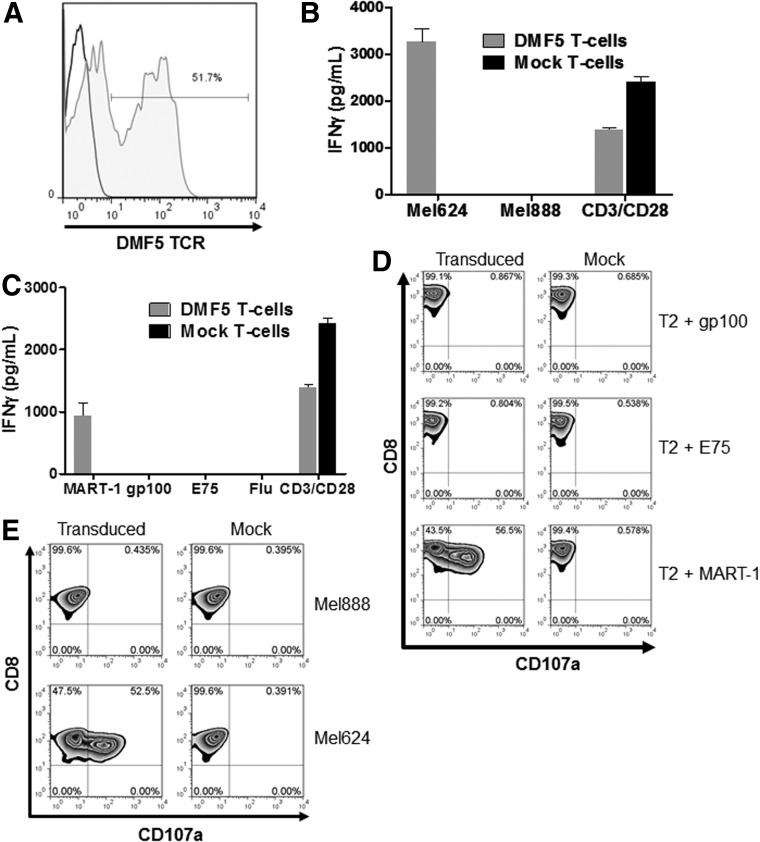
FIG. 1.
FIG. 1.
Efficient transfer of the DMF5 TCR to peripheral blood lymphocyes and in vitro efficacy of DMF5 T cells. (A) MART-1 pentamer staining of T cells transduced with the retroviral vector encoding the DMF5 recombinant TCR. (B) IFN-γ release by DMF5 T cells and mock T cells after coculturing with HLA-A*02+ melanoma cell line Mel624 and HLA-A*02 Mel888, and plate-bound anti-CD3/anti-CD28 as a control. (C) IFN-γ release by DMF5 T cells and mock T cells after coculturing with peptide-pulsed T2 cells and plate-bound anti-CD3/anti-CD28 as a control. (D) Cytotoxicity by CD107a expression of DMF5 T cells when cocultured with peptide-pulsed T2 cells. (E) Cytotoxicity by CD107a expression of DMF5 T cells when cocultured with HLA-A*02+ melanoma cell line Mel624, and HLA-A*02 melanoma cell line Mel888. TCR, T cell receptors.
FIG. 2.
FIG. 2.
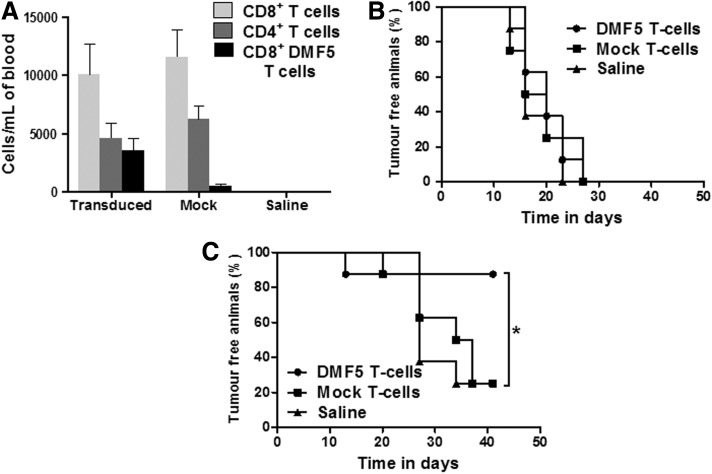
In vivo efficacy of DMF5 TCR T cells. (A) T cells recovered in the blood of tumor-bearing mice 1 week after systemic infusion of 2×10⁷ DMF5 T cells, mock T cells, or saline vehicle (mean±SEM). (B) Percentage in time of tumor-free animals on the right flank (injected with Mel888) treated with DMF5 T cells, mock T cells, or saline vehicle. (C) Comparison of the percentage of tumor-free animals inoculated with Mel624 tumor cells after injection of DMF5 T cells, mock T cells, or saline.
FIG. 3.
FIG. 3.
In vivo efficacy of adoptively transferred DMF5 T cells in a dose escalation model of ACT. (A) Number of CD4+ and CD8+ cells per ml of blood recovered in the blood of mice receiving escalating doses of T cells. Groups where no bars are shown had no detectable levels of human T cells. (B) Mice from Group A received saline only and were used as a control group. (C) Group B received 0.1×10⁷ transduced T cells. (D) Group C received 0.5×10⁷ transduced T cells. (E) Group D received 1×10⁷ T cells. (F) Group E received 2×10⁷ T cells. (G) Kaplan–Meier survival analysis of melanoma-bearing mice receiving escalating doses of DMF5 TCR-transduced T cells. Arrows indicate the day on which adoptive transfer of T cells was performed. Censored events are indicated by symbols identifying at which time point animals were culled because of x-GvHD symptoms. ACT, adoptive cell transfer; x-GvHD, xeno-graft-versus-host disease.
FIG. 4.
FIG. 4.
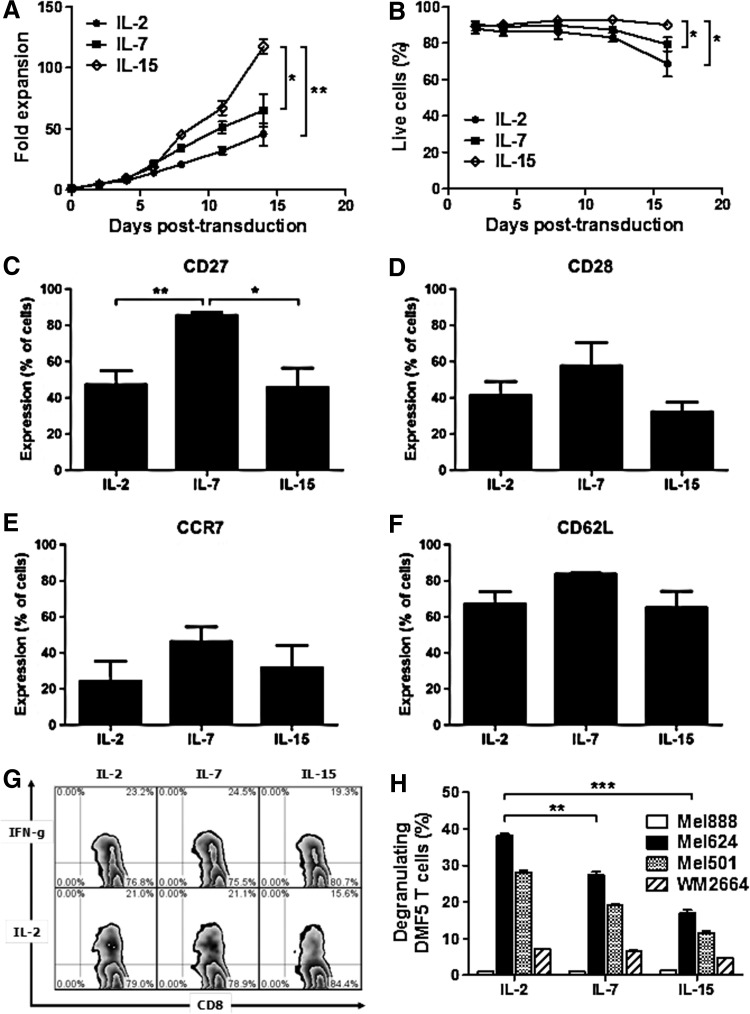
Effects of IL-7 and IL-15 on the proliferation, function, and phenotype of DMF5 T cells. (A) Proliferation of T cells cultured in IL-2, IL-7, and IL-15 after being activated with anti-CD3 and anti-CD28 antibodies, and transduced with the retroviral vector encoding the DMF5 TCR. (B) Viability of DMF5 T cells cultured in IL-2, IL-7, and IL-15 measured by flow cytometry according to the percentage of cells within the live lymphocyte gate. (C–F) Expression of costimulatory molecules CD27 and CD28 (C and D), and markers of homing to central lymphoid organs CCR7 and CD62L (E and F) on CD8+ DMF5 T cells after being cultured in IL-2, IL-7, and IL-15. (G) Representative flow cytometry plots showing production of IFN-γ and IL-2 by CD8+DMF5 T cells cultured in IL-2, IL-7, or IL-15 and stimulated with T2 cells loaded with MART-1 peptide. (H) Cytotoxicity of DMF5 T cells cultured in IL-2, IL-7, or IL-15 by CD107a expression after coculture with HLA-A*02+ cell lines Mel624, Mel501, and WM2664, and HLA-A*02 cell line Mel888. p-Values<0.05 by Student's t-test.
FIG. 5.
FIG. 5.
In vivo efficacy of DMF5 T cells cultured in IL-2, IL-7, and IL-15. (A) Comparison of the tumor volume on the day of adoptive transfer of T cells on NSG mice. Figures denote the number of animals that were culled because of x-GvHD as a proportion of the number of animals in the group. (B) Kaplan–Meier survival curve of tumor-bearing mice after systemic administration of DMF5 TCR T cells cultured in IL-2, IL-7, or IL-15, or saline vehicle as a control. Censored events are indicated by symbols identifying at which time point animals were culled due to x-GvHD symptoms. (C–F) Detection of systemically injected DMF5 T cells on tumor-bearing mice 7 days (C and D), and 3 weeks (E and F) after adoptive transfer. p-Values <0.05 by Student's t-test. NSG, NOD/Shi-scid IL-2rγ−/−.
FIG. 6.
FIG. 6.
In vivo efficacy of DMF5 T cells cultured in IL-7/IL-15 compared with IL-2 or IL-15 alone. (A) Kaplan–Meier survival curve of tumor-bearing mice after systemic administration of DMF5 T cells cultured in IL-2, IL-15, IL-7/IL-15, or saline as a control. (B) Kaplan–Meier survival curve of tumor-bearing mice after systemic administration of mock T cells cultured in IL-15, IL-7/IL-15, or saline as a control. Censored events are indicated by symbols identifying at which time point animals were culled because of x-GvHD symptoms. (C and D) Engraftment of systemically injected DMF5 T cells to tumor-bearing mice. T cells recovered in the blood of tumor-bearing mice 7 days after T cell injection. p-Values <0.05 by Student's t-test.

References

    1. Ali N. Flutter B. Sanchez Rodriguez R., et al. Xenogeneic graft-versus-host-disease in NOD-scid IL-2Rgammanull mice display a T-effector memory phenotype. PLoS One. 2012;7:e44219. - PMC - PubMed
    1. Bendle G.M. Linnemann C. Hooijkaas A.I., et al. Lethal graft-versus-host disease in mouse models of T cell receptor gene therapy. Nat. Med. 2010;16:565–570. , 561p following 570. - PubMed
    1. Berard M. Brandt K. Bulfone-Paus S. Tough D.F. IL-15 promotes the survival of naive and memory phenotype CD8+ T cells. J. Immunol. 2003;170:5018–5026. - PubMed
    1. Berger C. Jensen M.C. Lansdorp P.M., et al. Adoptive transfer of effector CD8+ T cells derived from central memory cells establishes persistent T cell memory in primates. J. Clin. Invest. 2008;118:294–305. - PMC - PubMed
    1. Besser M.J. Shapira-Frommer R. Treves A.J., et al. Clinical responses in a phase II study using adoptive transfer of short-term cultured tumor infiltration lymphocytes in metastatic melanoma patients. Clin. Cancer Res. 2010;16:2646–2655. - PubMed

Publication types

MeSH terms