


The impact of trisomy 21 on foetal haematopoiesis
- PMID: 23932236
- PMCID: PMC4727253
- DOI: 10.1016/j.bcmd.2013.07.008
The impact of trisomy 21 on foetal haematopoiesis
Abstract
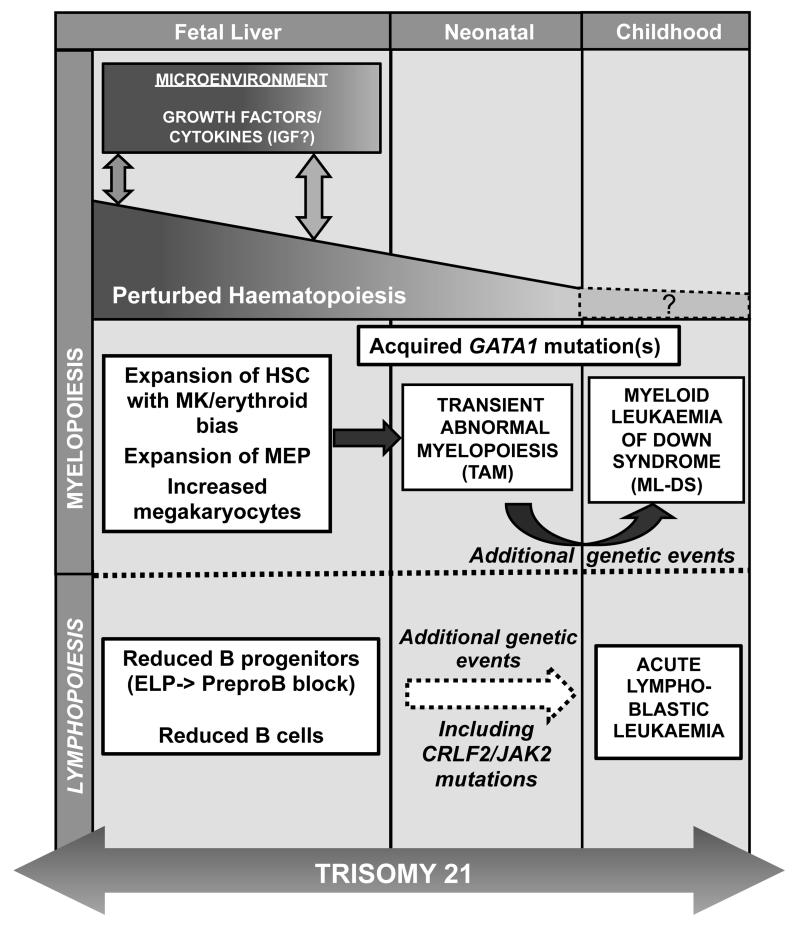
The high frequency of a unique neonatal preleukaemic syndrome, transient abnormal myelopoiesis (TAM), and subsequent acute myeloid leukaemia in early childhood in patients with trisomy 21 (Down syndrome) points to a specific role for trisomy 21 in transforming foetal haematopoietic cells. N-terminal truncating mutations in the key haematopoietic transcription factor GATA1 are acquired during foetal life in virtually every case. These mutations are not leukaemogenic in the absence of trisomy 21. In mouse models, deregulated expression of chromosome 21-encoded genes is implicated in leukaemic transformation, but does not recapitulate the effects of trisomy 21 in a human context. Recent work using primary human foetal liver and bone marrow cells, human embryonic stem cells and iPS cells shows that prior to acquisition of GATA1 mutations, trisomy 21 itself alters human foetal haematopoietic stem cell and progenitor cell biology causing multiple abnormalities in myelopoiesis and B-lymphopoiesis. The molecular basis by which trisomy 21 exerts these effects is likely to be extremely complex, to be tissue-specific and lineage-specific and to be dependent on ontogeny-related characteristics of the foetal microenvironment.
Keywords: Acute megakaryoblastic leukaemia; DS; Down syndrome; ES; Foetal liver; HSC; IGF; MEP; MK; ML-DS; MPP; Neonatal leukaemia; TAM; Transient abnormal myelopoiesis; Trisomy 21; acute myeloid leukaemia in Down syndrome; embryonic stem; haematopoietic stem cell; iPS; induced pluripotent stem; insulin-like growth factor; megakaryocyte; megakaryocyte–erythroid progenitor; multipotential progenitor; transient abnormal myelopoiesis.
© 2013.
Figures
References
-
- Hasle H, Clemmensen IH, Mikkelsen M. Risks of leukaemia and solid tumours in individuals with Down's syndrome. Lancet. 2000;355:165–169. - PubMed
-
- Zipursky A. Susceptibility to leukemia and resistance to solid tumors in Down syndrome. Pediatr Res. 2000;47:704. - PubMed
-
- Roy A, Roberts I, Norton A, Vyas P. Acute megakaryoblastic leukaemia (AMKL) and transient myeloproliferative disorder (TMD) in Down syndrome: a multistep model of leukaemogenesis. Br J Haematol. 2009;147:3–12. - PubMed
-
- Lange BJ, Kobrinsky N, Barnard DR, et al. Distinctive demography, biology, and outcome of acute myeloid leukemia and myelodysplastic syndrome in children with Down syndrome: Children's Cancer Group Studies 2861 and 2891. Blood. 1998;91:608–615. - PubMed
-
- Whitlock JA, Sather HN, Gaynon P, et al. Clinical characteristics and outcome of children with Down syndrome and acute lymphoblastic leukemia: a Children's Cancer Group study. Blood. 2005;106:4043–4049. - PubMed
Publication types
MeSH terms
Grants and funding
LinkOut - more resources
Full Text Sources
Other Literature Sources
Medical
