Review
. 2013 Nov-Dec;5(6):826-37.
doi: 10.4161/mabs.26008. Epub 2013 Aug 8.

Lessons for the clinic from rituximab pharmacokinetics and pharmacodynamics

Affiliations
Review

Lessons for the clinic from rituximab pharmacokinetics and pharmacodynamics

Josée Golay et al. MAbs. 2013 Nov-Dec.

Abstract

The anti-CD20 antibody rituximab (RTX; Rituxan®, MabThera®) was the first anti-cancer antibody approved by the US Food and Drug Administration in 1997 and it is now the most-studied unconjugated therapeutic antibody. The knowledge gained over the past 15 y on the pharmacodynamics (PD) of this antibody has led to the development of a new generation of anti-CD20 antibodies with enhanced efficacy in vitro. Studies on the pharmacokinetics (PK) properties and the effect of factors such as tumor load and localization, antibody concentration in the circulation and gender on both PK and clinical response has allowed the design of optimized schedules and novel routes of RTX administration. Although clinical results using newer anti-CD20 antibodies, such as ofatumumab and obinutuzumab, and novel administration schedules for RTX are still being evaluated, the knowledge gained so far on RTX PK and PD should also be relevant for other unconjugated monoclonal antibody therapeutics, and will be critically reviewed here.

Keywords: B-NHL; CLL; FcRn; FcγRs; pharmacodynamics; pharmacokinetics; rituximab.


Figures
None
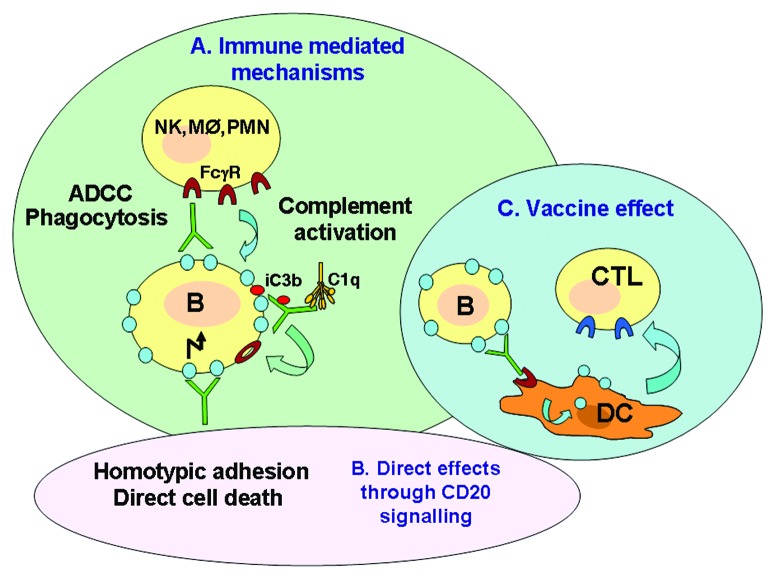
Figure 1. Possible mechanisms of action of RTX. (A) immune mediated. (B) direct mechanisms. (C) vaccine effect
None
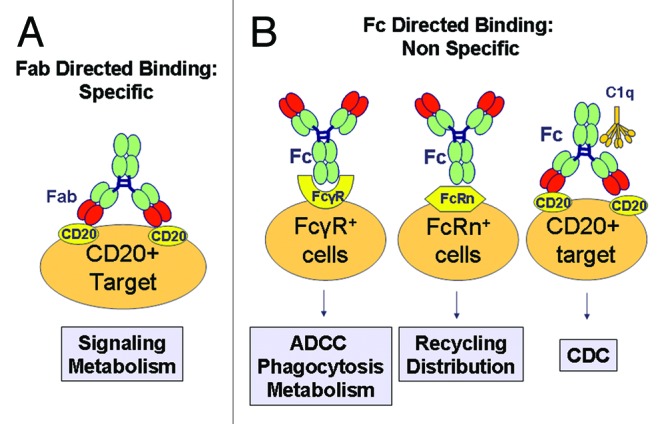
Figure 2. Major types of binding of RTX that affect PK and PD. (A) Specific binding to CD20 target takes place via Fab, leads to intracellular signaling and mAb metabolism. CD20 binding is saturable. (B) Non-specific binding of RTX includes binding to (1) FcγRs which leads to activation of immune cells (ADCC, phagocytosis) and mAb metabolism, (2) FcRn, which is non saturable and plays a major role antibody PK, and (3) C1q which activates CDC.
None
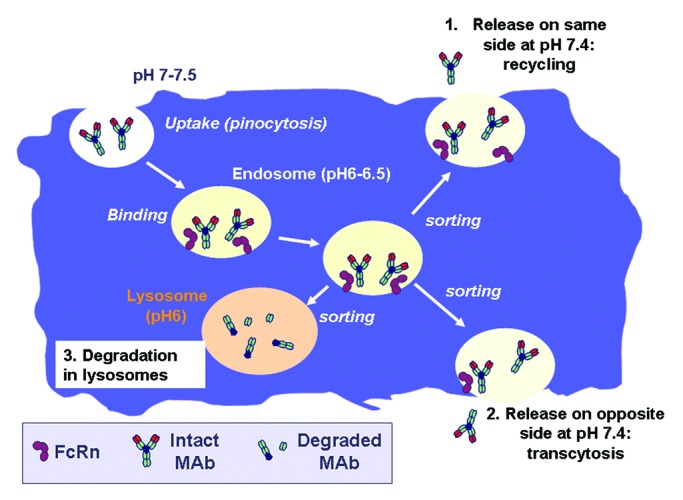
Figure 3. Interaction between IgG and FcRn. The mechanism by which IgG is taken up by cells (pinocytosis), binds inside the cell to FcRn in the acidic endosomes and is either recycled to the cell surface, transcytosed across the cell or degraded in lysosomes is shown.
None
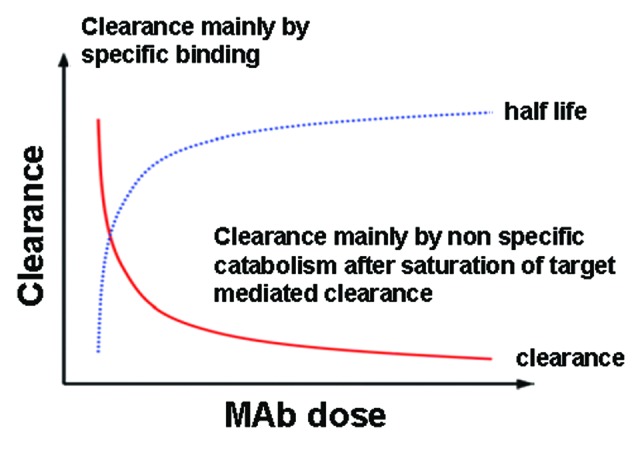
Figure 4. Biphasic PKs of RTX. The model shows high clearance by specific binding /to CD20) which, after saturation, leads to low clearance through non-specific binding via FcγR (RES)
None
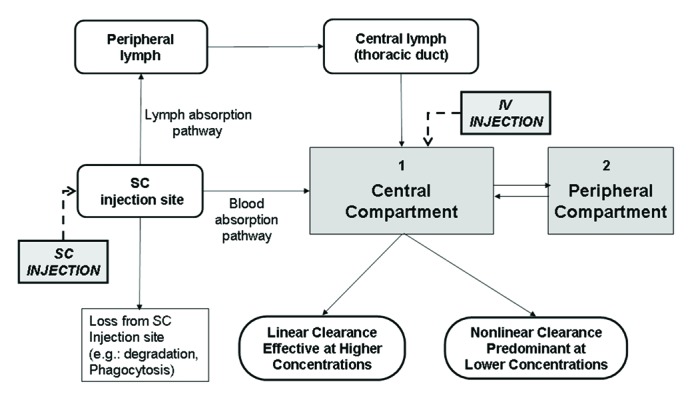
Figure 5. Model of mAb absorption and clearance after i.v. or s.c. administration. Absorption and clearance pathways are shown. Adapted from ref. .
None
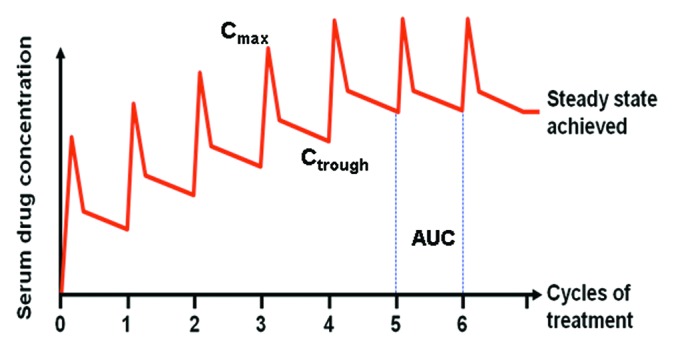
Figure 6. Model of RTX PK after multiple dosing. Cmax, Ctrough, AUC and steady-state, reached after about 5 cycles, are shown.
None
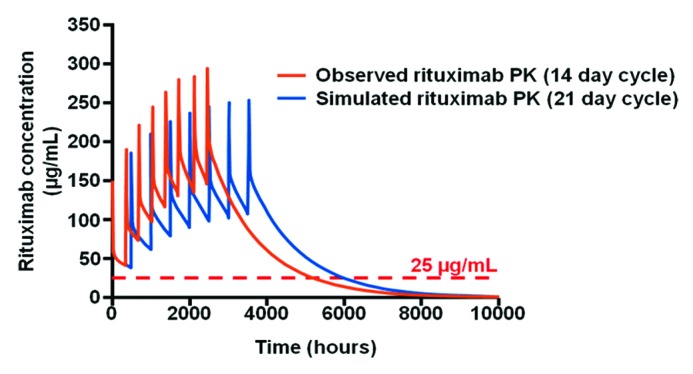
Figure 7. Model of RTX PK with 21 d vs. 14 d cycles. The model shows that RTX levels > 25 µg/ml are maintained for a longer period of time when RTX is administered every 21 d (red) rather than every 14 d (blue). Adapted from ref. .

References

    1. Riley JK, Sliwkowski MX. CD20: a gene in search of a function. Semin Oncol. 2000;27(Suppl 12):17–24. - PubMed
    1. Tedder TF, Engel P. CD20: a regulator of cell-cycle progression of B lymphocytes. Immunol Today. 1994;15:450–4. doi: 10.1016/0167-5699(94)90276-3. - DOI - PubMed
    1. Kehrl JH, Riva A, Wilson GL, Thévenin C. Molecular mechanisms regulating CD19, CD20 and CD22 gene expression. Immunol Today. 1994;15:432–6. doi: 10.1016/0167-5699(94)90273-9. - DOI - PubMed
    1. Martin P, Furman RR, Coleman M, Leonard JP. Phase I to III trials of anti-B cell therapy in non-Hodgkin’s lymphoma. Clin Cancer Res. 2007;13:5636s–42s. doi: 10.1158/1078-0432.CCR-07-1085. - DOI - PubMed
    1. St Clair EW. Novel targeted therapies for autoimmunity. Curr Opin Immunol. 2009;21:648–57. doi: 10.1016/j.coi.2009.09.008. - DOI - PMC - PubMed

Publication types

Substances