


doi: 10.1007/s12031-013-0085-6.
Epub 2013 Aug 10.
Loss of function of Slc20a2 associated with familial idiopathic Basal Ganglia calcification in humans causes brain calcifications in mice
Affiliations
- PMID: 23934451
- PMCID: PMC3824575
- DOI: 10.1007/s12031-013-0085-6
Item in Clipboard
Loss of function of Slc20a2 associated with familial idiopathic Basal Ganglia calcification in humans causes brain calcifications in mice
J Mol Neurosci.
2013 Nov.
Abstract
Familial idiopathic basal ganglia calcification (FIBGC) is a neurodegenerative disorder with neuropsychiatric and motor symptoms. Deleterious mutations in SLC20A2, encoding the type III sodium-dependent phosphate transporter 2 (PiT2), were recently linked to FIBGC in almost 50% of the families reported worldwide. Here, we show that knockout of Slc20a2 in mice causes calcifications in the thalamus, basal ganglia, and cortex, demonstrating that reduced PiT2 expression alone can cause brain calcifications.
Conflict of interest statement
The authors declare no competing financial interests.
Figures
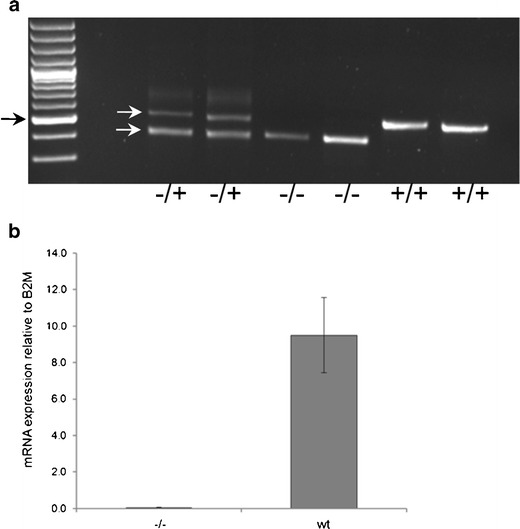
Genotyping and Slc20a2 mRNA levels. a Genotyping of breeders heterozygous for the knockout cassette (−/+) and of homozygous (−/−) and wt (+/+) offspring. Black arrow, 500-bp size marker. White arrows, 523-bp PCR product derived from wt allele (upper) and 443-bp PCR product derived from allele with inserted knockout cassette (lower). b Tail fibroblasts from a Slc20a2 knockout mouse (−/−) and three wt mice were lysed, and Slc20a2 mRNA levels were evaluated by qRT-PCR using primers positioned downstream of the knockout cassette. Slc20a2 mRNA levels relative to B2M are shown. Error bars represent standard deviations
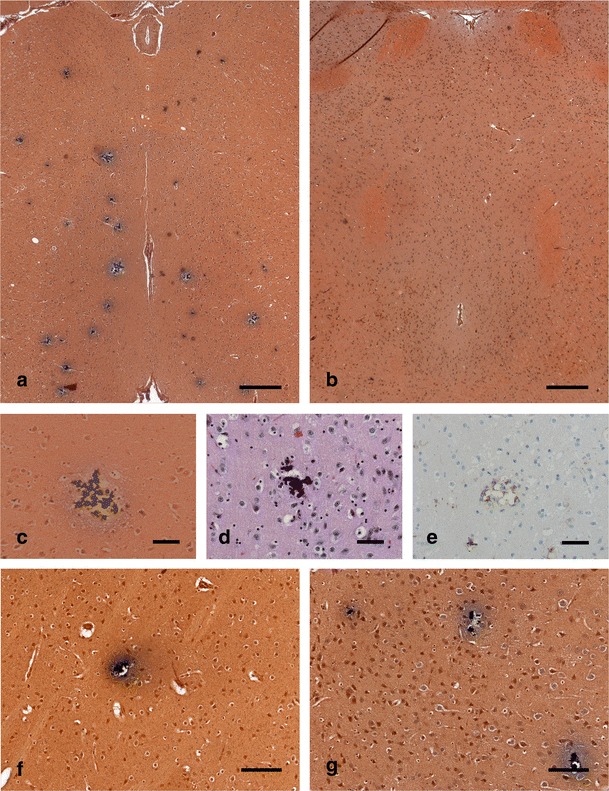
Histology of calcifications in brain sections from homozygous Slc20a2 knockout mouse. a, b Von Kossa staining of thalamus regions showing multiple calcifications as black conglomerates in a 19-week-old homozygous Slc20a2 knockout mouse (a), but not in a 21-week-old wt mouse (b) (scale bars, 300 μm). The calcifications are composed of smaller elements seen both in Von Kossa (c) and HE (d) stainings. In sections stained for macrophages/microglia (F4/80), a tissue reaction is demonstrated (e), but not in the wt control (not shown) (scale bars, 50 μm). Calcifications were also found in other brain regions, as seen by Von Kossa staining of the basal ganglia (f) and cortex (g) (scale bars, 100 μm)
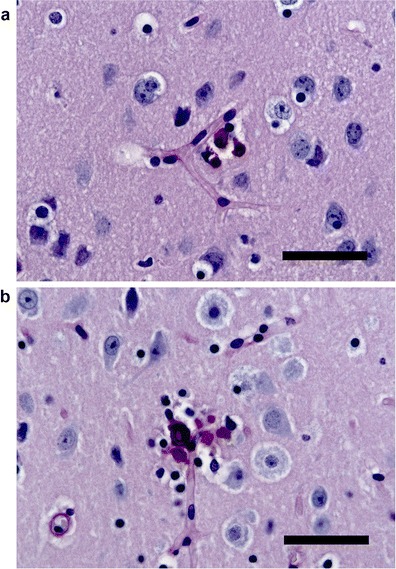
PAS staining of brain sections from homozygous Slc20a2 knockout mouse. Calcifications (purple stains) in close relation to blood vessels, delineated by the PAS-positive basal membrane, are found in the basal ganglia (a), thalamus (b), and cortex (not shown) (scale bars, 30 μm). No calcifications/lesions were observed in wt control (not shown)
References
-
- Bøttger P, Hede SE, Grunnet M, Høyer B, Klaerke DA, Pedersen L. Characterization of transport mechanisms and determinants critical for Na+-dependent Pi symport of the PiT-family paralogs, human PiT1 and PiT2. Am J Physiol Cell Physiol. 2006;291:C1377–87. doi: 10.1152/ajpcell.00015.2006. - DOI - PubMed
-
- Covic A, Kothawala P, Bernal M, Robbins S, Chalian A, Goldsmith D. Systematic review of the evidence underlying the association between mineral metabolism disturbances and risk of all-cause mortality, cardiovascular mortality and cardiovascular events in chronic kidney disease. Nephrol Dial Transplant. 2009;24:1506–23. doi: 10.1093/ndt/gfn613. - DOI - PubMed
Publication types
MeSH terms
Substances
Supplementary concepts
LinkOut - more resources
Full Text Sources
Other Literature Sources
Medical
Molecular Biology Databases
