. 2013 Oct;79(20):6325-30.
doi: 10.1128/AEM.01556-13. Epub 2013 Aug 9.

Mercury methylation by the methanogen Methanospirillum hungatei

Affiliations

Mercury methylation by the methanogen Methanospirillum hungatei

Ri-Qing Yu et al. Appl Environ Microbiol. 2013 Oct.

Abstract

Methylmercury (MeHg), a neurotoxic substance that accumulates in aquatic food chains and poses a risk to human health, is synthesized by anaerobic microorganisms in the environment. To date, mercury (Hg) methylation has been attributed to sulfate- and iron-reducing bacteria (SRB and IRB, respectively). Here we report that a methanogen, Methanospirillum hungatei JF-1, methylated Hg in a sulfide-free medium at comparable rates, but with higher yields, than those observed for some SRB and IRB. Phylogenetic analyses showed that the concatenated orthologs of the Hg methylation proteins HgcA and HgcB from M. hungatei are closely related to those from known SRB and IRB methylators and that they cluster together with proteins from eight other methanogens, suggesting that these methanogens may also methylate Hg. Because all nine methanogens with HgcA and HgcB orthologs belong to the class Methanomicrobia, constituting the late-evolving methanogenic lineage, methanogenic Hg methylation could not be considered an ancient metabolic trait. Our results identify methanogens as a new guild of Hg-methylating microbes with a potentially important role in mineral-poor (sulfate- and iron-limited) anoxic freshwater environments.


Figures
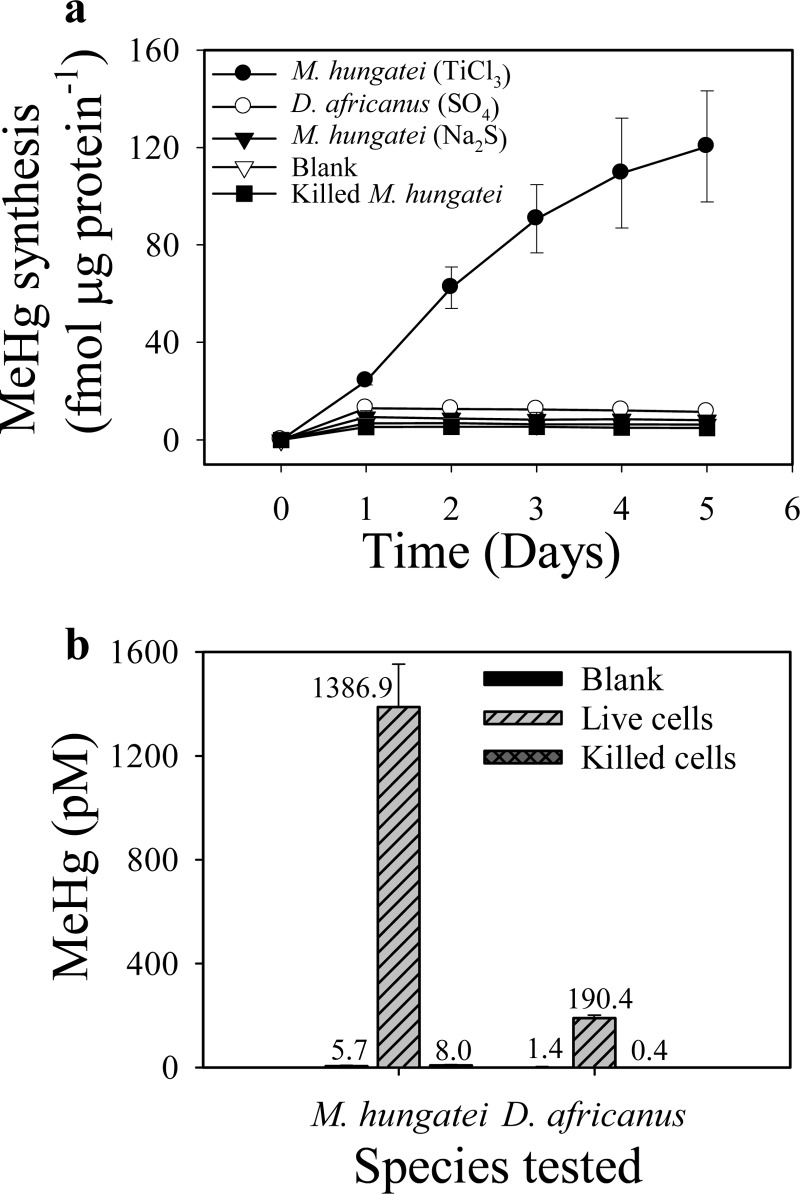
Fig 1
Fig 1
Hg methylation by M. hungatei. (a) Hg methylation by M. hungatei (with TiCl3 or Na2S as the reducing agent) and D. africanus (with TiCl3 as the reducing agent and SO4 as an electron acceptor) at 32°C, measured by the conversion of 203Hg(II) to toluene-extractable Me203Hg. (b) Confirmation of MeHg synthesis by M. hungatei (with TiCl3) and D. africanus (with TiCl3 and SO4) after 2-day incubations. MeHg was analyzed by GC separation of ethylated derivatives, followed by CVAFS detection.
Fig 2
Fig 2
Rates and yields of Hg methylation by M. hungatei and representative SRB and IRB strains. Shown are specific initial methylation rates (normalized to protein levels) obtained after 32 h of incubation (open bars) (left y axis) and maximum MeHg yields after 5 days of incubation (filled squares) (right y axis) of M. hungatei (M. h.), D. africanus (D. a.) (with TiCl3 as the reducing agent and fumarate as an electron acceptor), D. desulfuricans ND132 (D. d.) (with TiCl3 and fumarate), and G. sulfurreducens PCA (G. s.). Data were obtained by Me203Hg extraction from triplicate cultures.
Fig 3
Fig 3
Bayesian multilocus phylogeny of concatenated HgcA and HgcB proteins from known Hg-methylating species (shown in boldface) and orthologs identified by homology to the proteins in M. hungatei JF-1. The bar on the right identifies taxa at the phylum/class level; Chl stands for Chloroflexi, and the Deltaproteobacteria bracket distinguishes iron reducers, sulfate reducers, and two syntrophs. Note that the Chloroflexi sequences are embedded within the Deltaproteobacteria sequences. The tree is outgrouped by paralogs of Hgc proteins belonging to the CdhD family. The bar at the bottom indicates a branch length corresponding to 3 substitutions per 1,000 amino acids. Numbers at branching points represent the posterior probabilities of the Bayesian analyses.

References

    1. Selin NE. 2011. Science and strategies to reduce mercury risks: a critical review. J. Environ. Monit. 13:2389–2399 - PubMed
    1. Lin C-C, Yee N, Barkay T. 2012. Microbial transformations in the mercury cycle, p 155–191 In Liu G, Cai YO', Driscoll N. (ed), Environmental chemistry and toxicology of mercury. John Wiley & Sons, Inc., Hoboken, NJ
    1. Compeau GC, Bartha R. 1985. Sulfate-reducing bacteria: principal methylators of mercury in anoxic estuarine sediment. Appl. Environ. Microbiol. 50:498–502 - PMC - PubMed
    1. Fleming EJ, Mack EE, Green PG, Nelson DC. 2006. Mercury methylation from unexpected sources: molybdate-inhibited freshwater sediments and an iron-reducing bacterium. Appl. Environ. Microbiol. 72:457–464 - PMC - PubMed
    1. Kerin EJ, Gilmour CC, Roden E, Suzuki MT, Coates JD, Mason RP. 2006. Mercury methylation by dissimilatory iron-reducing bacteria. Appl. Environ. Microbiol. 72:7919–7921 - PMC - PubMed

Publication types

LinkOut - more resources
