. 2013 Oct;195(2):331-48.
doi: 10.1534/genetics.113.155382. Epub 2013 Aug 9.

Precise and heritable genome editing in evolutionarily diverse nematodes using TALENs and CRISPR/Cas9 to engineer insertions and deletions

Affiliations

Precise and heritable genome editing in evolutionarily diverse nematodes using TALENs and CRISPR/Cas9 to engineer insertions and deletions

Te-Wen Lo et al. Genetics. 2013 Oct.

Abstract

Exploitation of custom-designed nucleases to induce DNA double-strand breaks (DSBs) at genomic locations of choice has transformed our ability to edit genomes, regardless of their complexity. DSBs can trigger either error-prone repair pathways that induce random mutations at the break sites or precise homology-directed repair pathways that generate specific insertions or deletions guided by exogenously supplied DNA. Prior editing strategies using site-specific nucleases to modify the Caenorhabditis elegans genome achieved only the heritable disruption of endogenous loci through random mutagenesis by error-prone repair. Here we report highly effective strategies using TALE nucleases and RNA-guided CRISPR/Cas9 nucleases to induce error-prone repair and homology-directed repair to create heritable, precise insertion, deletion, or substitution of specific DNA sequences at targeted endogenous loci. Our robust strategies are effective across nematode species diverged by 300 million years, including necromenic nematodes (Pristionchus pacificus), male/female species (Caenorhabditis species 9), and hermaphroditic species (C. elegans). Thus, genome-editing tools now exist to transform nonmodel nematode species into genetically tractable model organisms. We demonstrate the utility of our broadly applicable genome-editing strategies by creating reagents generally useful to the nematode community and reagents specifically designed to explore the mechanism and evolution of X chromosome dosage compensation. By developing an efficient pipeline involving germline injection of nuclease mRNAs and single-stranded DNA templates, we engineered precise, heritable nucleotide changes both close to and far from DSBs to gain or lose genetic function, to tag proteins made from endogenous genes, and to excise entire loci through targeted FLP-FRT recombination.

Keywords: CRISPR/Cas9 and TALENs; dosage compensation; genome editing; homology-directed repair; nematode species.


Figures

Figure 1
Figure 1
Precise, targeted DNA insertions mediated by homology-directed repair of TALEN-induced DSBs. In a single experiment, animals were injected simultaneously with RNA encoding a ben-1 TALEN pair and three different ssOligos encoding different restriction sites (NcoI, HindIII, and EcoRI) designed to replace the endogenous PsiI site (TTATAA) shown in red. Shown are examples of the HDR-mediated mutations resulting from the single set of injections. Mutations include all three precisely inserted restriction sites and two NHEJ-mediated mutations causing a deletion or an indel. The TALE recognition sequences within ben-1 are shown adjacent to the color-coded repeat variable diresidues (RVDs), which recognize specific nucleotides (nt) of the DNA target site according to the code shown in the key. The locations in ben-1 DNA of the 20-nt homology arms used in each ssOligo are designated by a green line. Each ssOligo is composed of only the 6-nt restriction site to be inserted and the flanking 20-nt homology arms.
Figure 2
Figure 2
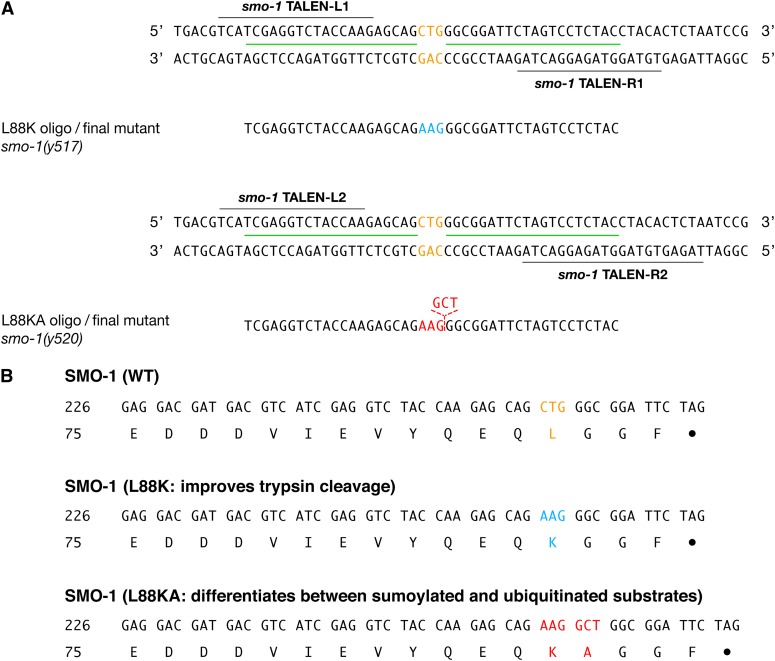
Reprogramming the smo-1 gene by precise DNA insertions to encode SUMO variants that facilitate mass spectrometric identification of SUMO attachment sites within modified proteins. (A) Segment of smo-1 and the two sets of TALE recognition sequences (black lines) within smo-1 for the two TALEN pairs used to induce DSBs for HDR. The ssOligos that serve as templates for HDR are shown below the gene. The smo-1 codon to be replaced is shown in orange, and the replacement sequences are shown in blue and red. The homology arms used in each ssOligo are designated by a green line. (B) Final amino acid sequences of the relevant segment of the SUMO variant.
Figure 3
Figure 3
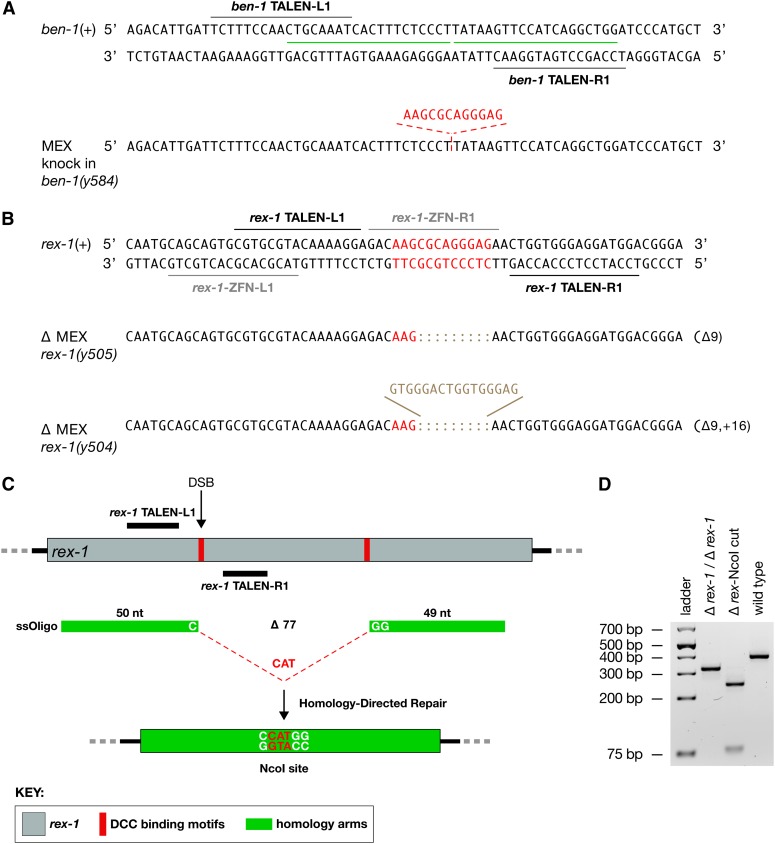
Targeted HDR and NHEJ to obtain insertions and deletions of DCC binding motifs close to and relatively far from the DSB site. (A) Insertion of a DCC binding motif on an autosome. Shown is a segment of the ben-1 gene on chromosome III and the TALE recognition sequences (black lines) used to target the DSB that induced the insertion of a 12-bp DCC binding motif (MEX) by HDR. The ssOligo contained the DC binding motif (red) flanked by 20-bp homology arms (green). (B) NHEJ-mediated deletion of a DCC binding motif (MEX, in red) within rex-1. Shown is a segment of the rex-1 DCC binding site on X and the TALE recognition sequences (black lines) used to target a DSB. Sequences of representative rex-1 deletion and indel mutations generated by NHEJ are shown. Gray lines show the location of recognition sequences for ZFNs that previously caused numerous rex-1 deletions, none of which knocked out the MEX motif. (C) HDR-mediated deletion of two MEX motifs in rex-1. Schematic diagram of rex-1 (gray) shows the relative location of DCC binding motifs (red). The same TALEN pair used in B was employed to induce a DSB within the first MEX motif. The DSB was repaired by an ssOligo, including homology arms and the sequence CAT, which guided the HDR event to delete both MEX motifs. The precise deletion event was designed to remove 77 bp and insert the nucleotides CAT to create an NcoI site. (D) Agarose gel of PCR products from a rex-1 deletion strain and a wild-type strain verify the deletion. The PCR product from a precise deletion event is 326 bp. NcoI digestion of the Δ rex-1 PCR product yields a 244-bp fragment and a 82-bp fragment. The PCR product from a wild-type strain is 400 bp. The precision of the deletions was confirmed by DNA sequence.
Figure 4
Figure 4
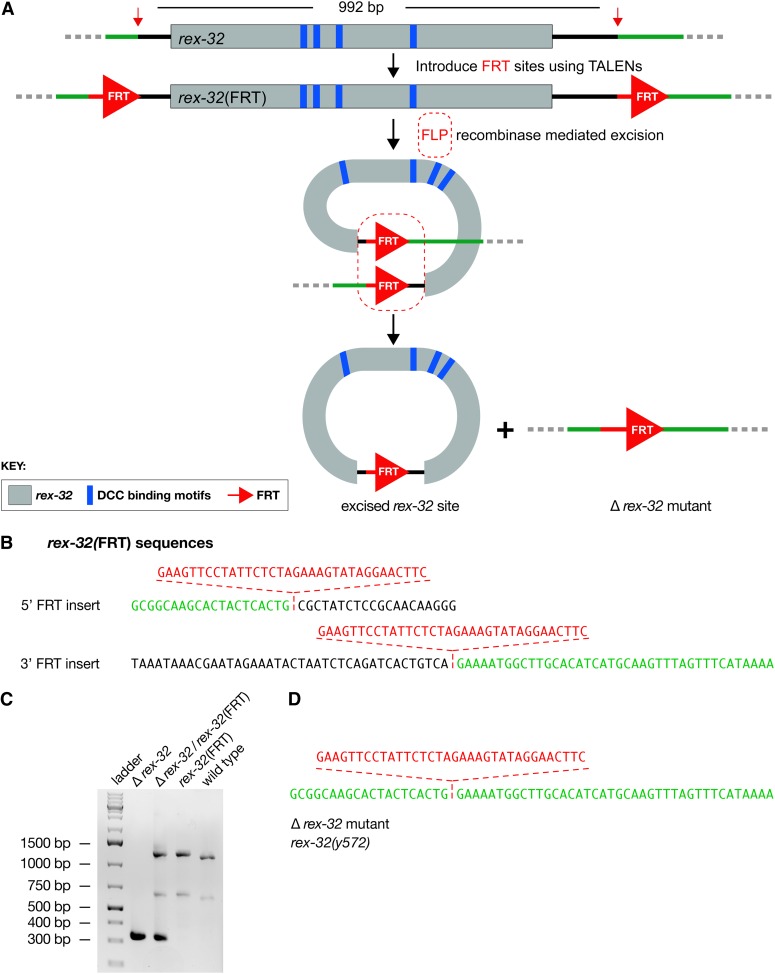
FLP-FRT-mediated deletion of the rex-32 DCC binding site. (A) Diagram of rex-32 (gray) with its four DCC binding motifs (blue) and the scheme to delete it. FRT sites (red) were inserted at opposite ends of rex-32 via HDR, using the TALENs and ssOligos shown in Figure S3. RNA encoding FLP recombinase was introduced into the germline of the FRT-containing animals, and F2 animals were screened by PCR for the deletion events. (B) DNA sequences of regions carrying the 5′- and 3′-FRT insertions. They are identical to those of the ssOligos used to make the FRT insertions. (C) Agarose gel of PCR products from a homozygous rex-32 deletion strain (360 bp), a heterozygous strain bearing the rex-32 deletion in trans to the FRT-containing rex-32, a homozygous rex-32 FRT strain (1251 bp), and a wild-type strain (1183 bp). The PCR product from the wild-type strain is smaller because it lacks the FRT inserts. The gel verified the deletion, and (D) DNA sequence analysis confirmed that the deletion was precise.
Figure 5
Figure 5
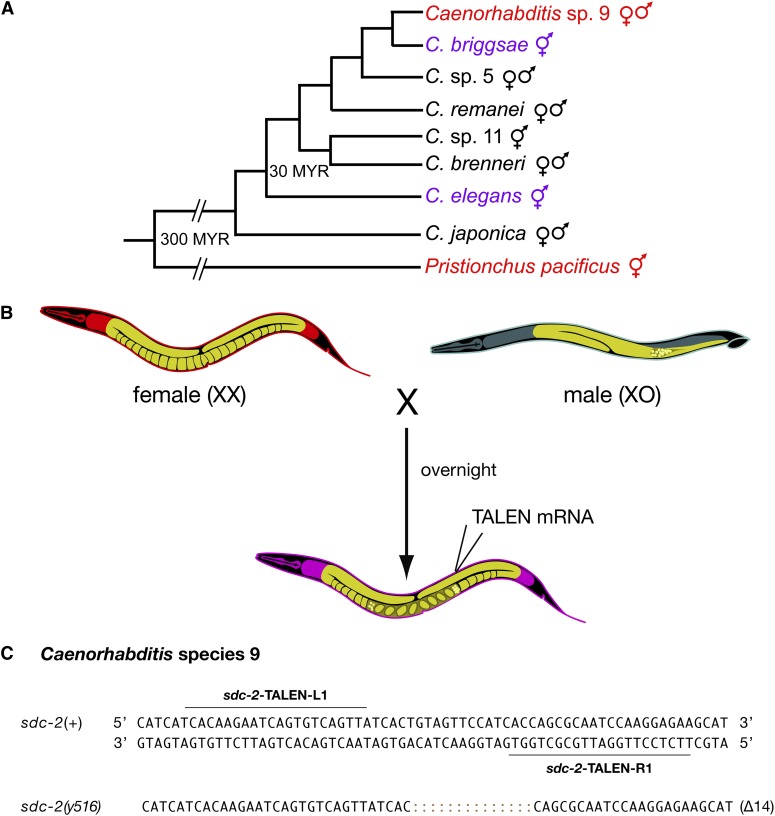
Genome editing in male/female species. (A) Evolutionary tree for nematode species spanning 300 MYR, from the male/female free-living strain C. sp. 9 to the necromenic nematode strain P. pacificus. Our prior studies described genome editing in C. elegans and C. briggsae (blue), and our current studies describe genome editing for C. sp. 9 and P. pacificus (red). (B) For male/female species, the TALEN mRNA is introduced into females that have been mated overnight. (C) NHEJ-mediated deletion of sdc-2 in C. sp. 9. Shown is a segment of the sdc-2 gene and the TALE recognition sequences (black lines) used to target a DSB. Sequence of the 14-bp deletion in sdc-2 meditated by NHEJ is shown.
Figure 6
Figure 6
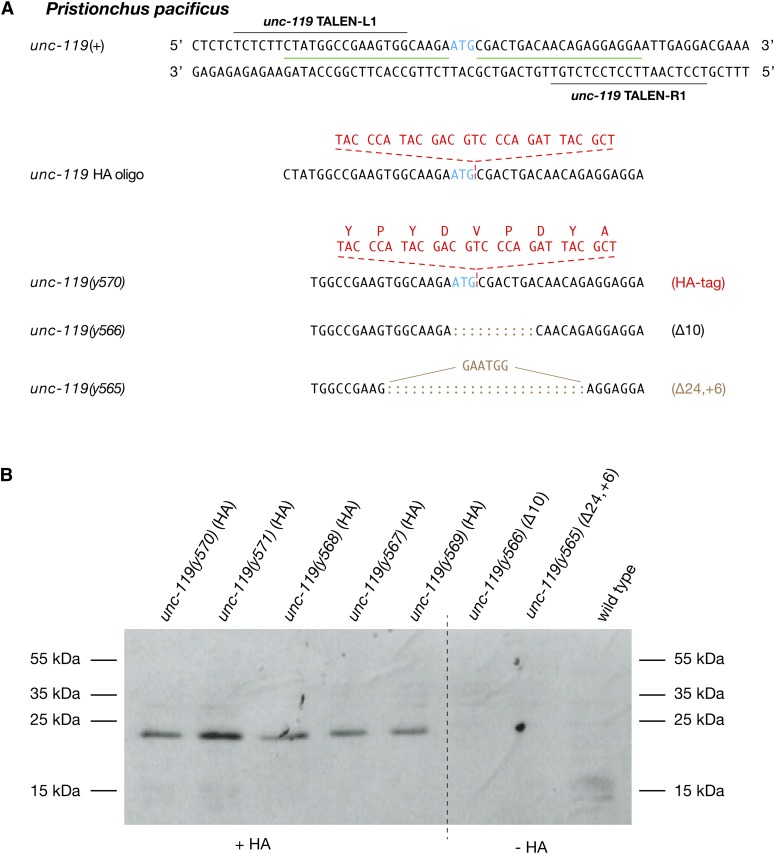
Genome editing in P. pacificus results in an HA-tagged protein made from the endogenous unc-119 locus. (A) Segment of unc-119 spanning the ATG translation start codon (blue) and the TALE recognition sequences within unc-119 (black lines) used to target TALEN-induced DSBs for HDR-mediated insertion of DNA encoding an HA tag. Shown is the DNA sequence of the ssOligo containing the two 20-nt homology arms (green lines) flanking the 27-nt sequence (red) that encodes the 9-aa HA tag. The tag was inserted just after the ATG translation start. Also shown are the sequences of the precise HDR-mediated insertion of the HA tag and the NHEJ-mediated deletions and indels obtained from the same experiment. (B) Western blot of protein extracts from the insertion strains carrying the HA-tagged unc-119 gene, control strains from the same experiment bearing NHEJ-mediated deletions or indels in unc-119, and a wild-type strain. The blot was probed with an antibody directed against the HA tag.
Figure 7
Figure 7
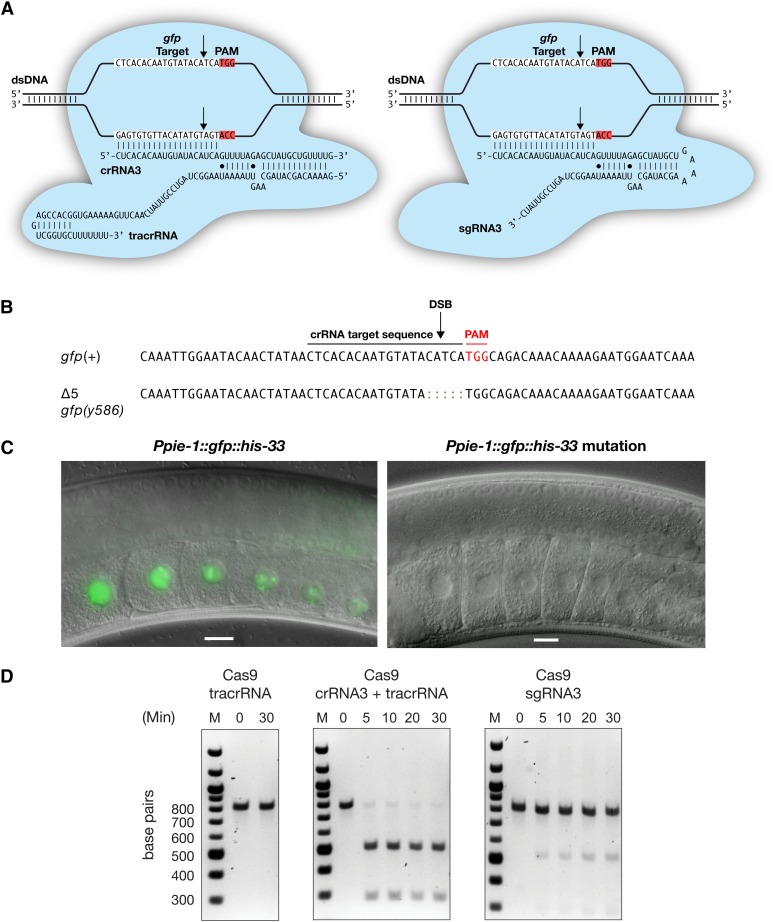
Heritable, RNA-targeted gene disruption in the C. elegans germline using CRISPR/Cas9. (A) Schematic of Cas9 interacting with its dsDNA target, gfp, and either the dual crRNA:tracrRNA guide RNA (left) or an sgRNA (right), both having the same target DNA. Red highlights the TGG nucleotide protospacer-adjacent motif (PAM), and the arrow designates the DSB site, which occurs in genomic DNA complementary to the crRNA sequence. (B) DNA sequence of the gfp deletion resulting from NHEJ-mediated repair of the Cas9-induced DSB made from the Cas9 complex containing the dual crRNA:tracrRNA guide RNA. (C) Hermaphrodite gonads expressing the wild-type (left) or Cas9-mediated Δ5 mutant (right) version of the Ppie-1::gfp::his-33 transgene, which expresses GFP::histone 2B exclusively in the germline. Bars, 10 µm. (D) In vitro DNA cleavage assays comparing the effectiveness of Cas9-crRNA:tracrRNA and Cas9-sgRNA complexes. Double-stranded DNA cleavage was tested in time-course reactions, using the molar ratio of Cas9:guide RNA:target DNA as 0.5:1:0.5 µM. Reactions were conducted at 37°. The in vitro assays show that the dual RNA guides are more effective at promoting DNA cleavage than the sgRNAs, a finding that recapitulates our results in vivo demonstrating that the dual RNA guides are more effective at promoting mutations than the single RNA guides. M, 100-bp markers.

References

    1. Bassett A. R., Tibbit C., Ponting C. P., Liu J. L., 2013. Highly efficient targeted mutagenesis of Drosophila with the CRISPR/Cas9 system. Cell Rep. 4: 220–228. - PMC - PubMed
    1. Bedell V. M., Wang Y., Campbell J. M., Poshusta T. L., Starker C. G., et al. , 2012. In vivo genome editing using a high-efficiency TALEN system. Nature 491: 114–118. - PMC - PubMed
    1. Bernard P., Gabant P., Bahassi E. M., Couturier M., 1994. Positive-selection vectors using the F plasmid ccdB killer gene. Gene 148: 71–74. - PubMed
    1. Beumer K., Bhattacharyya G., Bibikova M., Trautman J. K., Carroll D., 2006. Efficient gene targeting in Drosophila with zinc-finger nucleases. Genetics 172: 2391–2403. - PMC - PubMed
    1. Bhaya D., Davison M., Barrangou R., 2011. CRISPR-Cas systems in bacteria and archaea: versatile small RNAs for adaptive defense and regulation. Annu. Rev. Genet. 45: 273–297. - PubMed

Publication types

MeSH terms